



The previous article had focused on the finding by the World Bank that Pakistan accounted for half the poverty in the MENAAP Region. This is a region including 23 countries from Middle East, North Africa and the two countries, Afghanistan and Pakistan.
There are two reasons why the incidence of poverty is much higher in Pakistan. First, the level of per capita income of the country is only one-fourth of the average of the 23 countries in MENAAP. This is due particularly to the very high incomes in the oil-rich countries of the Middle East.
Second, Pakistan has been through a period of low economic growth and high inflation since COVID-19 in 2019-20, followed by one of the worst floods in 2022-23. The process of growth has had to be sacrificed so as to achieve a modicum of stabilization to sustain the balance of payments. This has also needed the resort to IMF Programmes, with a high focus on stabilization.
READ ALSO: High incidence of poverty
A look at the trend in the incidence of poverty over the last 15 years or so is very revealing. This is based on the World Bank data base, the World Development Indicators. The poverty line throughout the period of analysis is USD 4.20 (2021 PPP) per day.
The World Bank estimates are that in 2011 the incidence of poverty was as high as 55.9 percent. It declined sharply to 44.7 percent by 2018, implying that almost 28 million people were taken out of poverty during these seven years.
The GDP growth rate was from 2011 to 2018 relatively high at 4 percent and the overall rate of inflation was just over 5 percent, while food prices increased annually on average by 4 percent only. These somewhat favourable trends explain the significant drop in the incidence of poverty from 2011 to 2018 by as much as 11.2 percentage points.
Turning to the period, 2018-19 to 2024-25, the growth rate of the GDP plummeted to only 2.7 percent, barely above the population growth rate of 2.5 percent. The rate of inflation spiralled up to a double-digit rate of 13.5 percent and food prices rose at an even faster annual rate of over 15 percent.
Therefore, the World Bank estimates of the U-shaped trend in poverty over the last 13 years are consistent with the underlying economic trends.
We turn now to look at the placement of Pakistan in terms of the incidence of poverty in the South Asian region to which the country has traditionally belonged.
The same poverty line of USD 4.20 (2021 PPP) is used to determine the incidence of poverty in each South Asian country in 2024-25 from the World Development Indicators data base.
The South Asian region comprises of seven countries, namely, Bangladesh, Bhutan, the Maldives, Nepal, Pakistan and Sri Lanka. There is a large variation in population size among these countries. It is as high as 1483 million in India to a low of under 1 million in the Maldives and Bhutan.
There is also significant variation in per capita income among the countries, but much less than in the MENAAP region. Pakistan has a per capita income 32 percent below the regional average.
The incidence of poverty varies substantially in South Asia. It is unfortunate that Pakistan has the highest incidence of poverty in South Asia in 2024-25 of almost 48 percent. The lowest incidence of poverty at a very low level is in Bhutan and Maldives. The corresponding magnitudes in India, Bangladesh and Sri Lanka are 16.1 percent, 20.5 percent and 11.9 percent, respectively.
Overall, the bottom line is that in the South Asian region, Pakistan again performs poorly like in the MENAAP region. Pakistan has a population share in the South Asia region of 13 percent, but a share in the number of poor is as much as 30 percent.
There has been a release recently of the country ratings in another important index, the Global Hunger Index, prepared by Welthungerhilfe (WHH), the Institute for International Law of Peace and Armed Conflict (IFHV).
The Global Hunger Index reflects on the extent of under-nourishment in a population and impact on the population, especially children. It is, therefore, similar to the measure of poverty, which indicates the percentage of the population below the poverty line in terms of their income. The poverty line corresponds to the total cost of meeting a minimum level of nutrition on an adult equivalent basis.
There are four sub-indices in the Index relating to the following:
• Undernourishment
• Child stunting
• Child wasting
• Child mortality.
The Index has a severity scale, as follows:
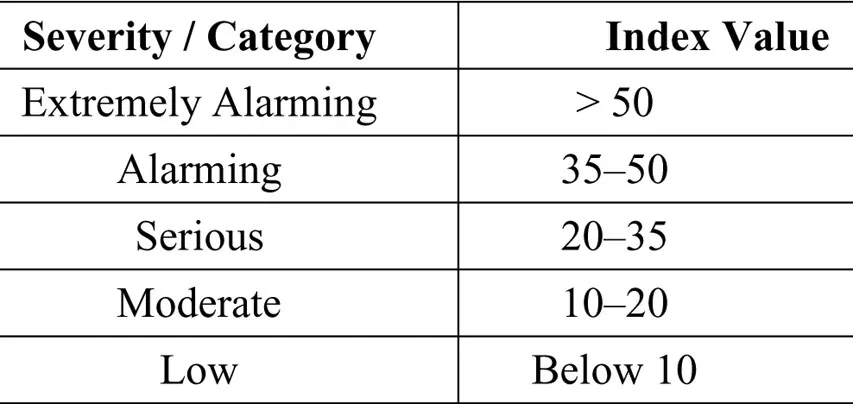
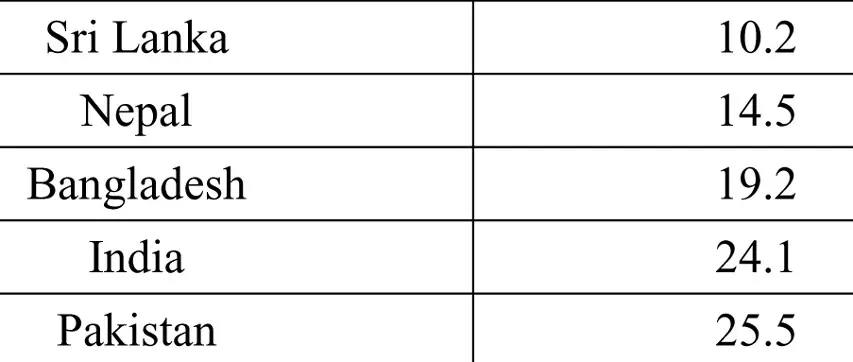
How does Pakistan do in the Global Hunger Index? It has an index value of 25.5, which implies that the people of Pakistan face a serious problem of hunger and malnutrition.
Among the relatively large South Asian countries, the variation in the Index value in 2026 is as follows:
It is, however, worth noting that in 2018 Pakistan was ranked better than India.
The same U-shaped trend over the years is observed in this index in Pakistan. It fell from 34.6 in 2012 to 24.0 in 2018. Since then it has worsened and risen to 25.5.
The levels of poverty and hunger have clearly reached a crisis state in Pakistan. It is truly a sad reflection of the fact that almost eight decades after Independence, half the population of Pakistan is in a state of poverty and under-nutrition.
There is need for declaring a national emergency for tackling poverty. This will include expansion of the coverage and increase in per family assistance in the Benazir Income Support Programme, an enhanced and better-enforced Minimum Wage Policy by the Provincial governments and spatial targeting of high-poverty districts by provision of basic services like water, gas and sanitation.
Relative price stability will be a key instrument in tackling poverty, especially of basic food items. A GDP growth rate of over 4 percent will need to be achieved.
Copyright Business Recorder, 2026
The writer is Professor Emeritus at BNU and former Federal Minister











Comments