


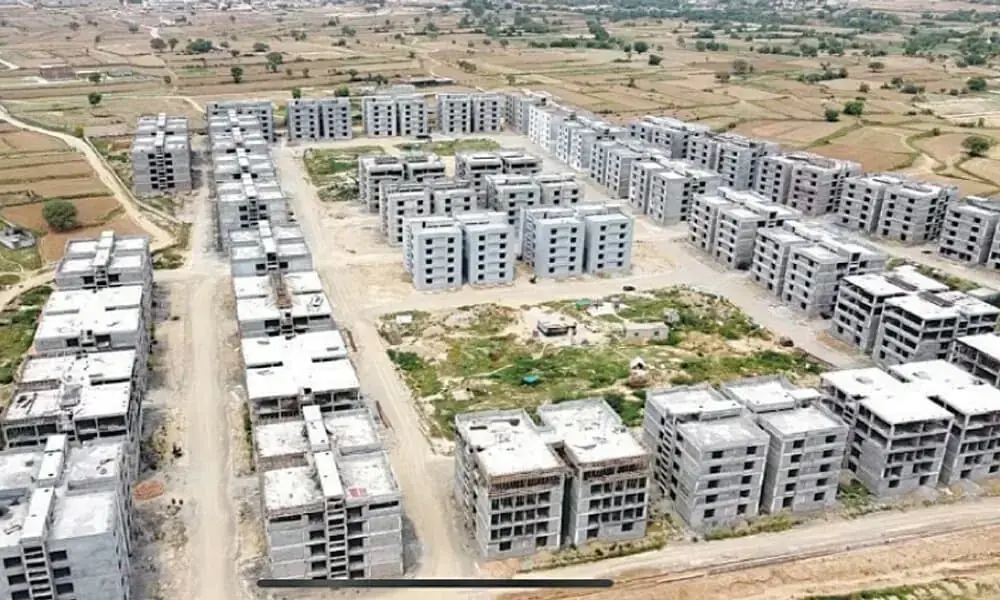
Pakistan’s new housing policy never asks what the state should do in housing, or why our cities cannot grow up.
The National Housing Policy 2026, issued by the Ministry of Housing and Works in August, runs to ninety pages contains fluent donor speak: climate resilience, inclusion, public-private partnership. What it lacks is the clarity of concept. It never asks whether the federal government needs such a document, what the state should and should not do in housing, or why our cities are low, sprawling and plotted sprawls.
Start with the federal role. Since the 18th Amendment, housing, land, urban planning, building control and property tax belong to the provinces. The policy cites Canada, Australia and India, where the center leads anyway. But those centers lead with money. Islamabad, short of funds and under an IMF programme, has none. A federal policy that hands tasks to provinces without budgets, laws or enforcement is a letter, not a policy.
There is real federal work, and the list is short:
• Foreclosure and recovery laws, without which no mortgage market can develop.
• Property law and laws that make real estate transactions simple and safe.
• The census and national surveys, and systems that reveal true property prices and transactions.
• how to make wealth out of vast urban land held by ministries, railways, cantonments and estate offices in Islamabad and other cities, which is the wealth of those cities and the nation.
Ten pages on these four levers, with costs attached, would have done more than ninety pages of advice to the provinces.
Perhaps encouraged by UN-Habitat, Pakistan periodically writes a housing policy and puts it on the shelf. UN-Habitat’s review of 159 countries finds nearly two-thirds have a national housing policy. The policy claims that simply having a policy shows a government is serious. Basically, UN claims posturing is policy.
The first question: should public policy on housing go beyond zoning and city management? Yes, but narrowly. The state should keep clear titles and land records, enforce contracts for lenders, landlords and tenants, build trunk infrastructure, enforce building safety, and help the genuinely poor. Beyond that, from London to Karachi, affordability crises are mostly supply crises created by land-use rules.
Second, Pakistan does not suffer from too little government in housing. It suffers from too much. As I have argued for more than thirty years, bureaucratic controls on building, zoning and real estate development have held back our cities, housing included. The state is in fact the country’s largest real estate developer, through development authorities, defence and employee housing bodies and state-licensed societies. It hands out plots as compensation to its own officials. The policy treats these bodies as a coordination problem. It never asks why the regulator is also the biggest player in the market.
Third: is Pakistan a socialist state, and has the state’s role in housing ever been debated? It is not socialist, but the Constitution carries a socialist inheritance that has never been confronted. Article 3 promises to end exploitation. Article 38 asks the state to prevent the concentration of wealth and to house those unable to earn a living. Article 253 lets Parliament cap private property. Against these stand Articles 23 and 24, which protect property, and Article 30, which keeps the welfare principles out of court. The nationalizations of the 1970s were reversed in the 1990s without any constitutional debate. Meanwhile, every government has campaigned on houses: Ashiana, five million homes, now Apna Ghar.
The new policy does not debate this either. It legislates it, in one bullet: Section 3.7.2 would make “adequate and affordable housing” a legal right for every citizen. Yet the policy cannot say what affordable means. It offers the 30-percent-of-income rule, dismisses it, recommends two other methods, and applies none. Affordability is not a property of a house. It is the gap between prices and incomes, shaped by land, building rules and jobs. A right to it is a right to a ratio. When Lahore’s prices outrun its wages, what will a court order: a subsidy, a price control, or a house? Article 38 limits the state’s duty to those who cannot earn a living. A change this large needs Parliament, a definition and a price tag.
The fourth question is the one I have asked for three decades: why not let cities grow up, dense and mixed-use, through markets? The words are all there. Compact, mixed-use, medium- to high-rise development is an official objective. Zoning is to give way to form-based codes. But density is justified only as a way to save farmland and stop sprawl, which is a planner’s argument. It is never seen as a way to unlock land value and let owners and small builders add floor space where people want to live.
The policy says nothing about relaxing floor-area ratios or height limits; height appears mainly as a fire risk. Conversion fees, which are a tax on density, remain. Developers get a rebate only if 80 percent of floor space goes to low-income flats, a deal nobody building on prime land will accept. Parking rules and setbacks go unmentioned. Instead we get growth boundaries, green belts, master plans every five years, apartment quotas funded by overcharging bungalow buyers, a new NOC before land can change hands, and licences for masons. Worse, the policy wants a substantial budget for more government employee housing, when the officers’ estates in our city centers are exactly the land that should be sold and released.
Blocking cities from growing up while letting them sprawl out is the worst combination. Land gets dearer, the cost cannot be spread over more floors, and the poor are pushed into the informal city. Notice where the policy does want towers: in katchi abadis, rebuilt with shops on the lower floors. Density is imposed on the poor, on land they already hold, while the low-density bungalow sectors stay untouched.
Like its predecessor, this policy rests on an inflated shortage: 10 to 13 million units, with no method or source. In 2022 PIDE’s Durr-e-Nayab traced the 10 million figure, usually credited to the World Bank, through a chain of citations and found no calculation at its root. Her estimate of households living in congested conditions was 4.37 million, two-thirds of them rural. She and other researchers have found that homelessness is very limited. The census figures in the policy itself show home ownership near 82 percent. The problem is congestion, quality, services, tenure, and rental law, not missing roofs.
(To be continued)
Copyright Business Recorder, 2026
The writer served as the Deputy Chairman of the Planning Commission. X: @nadeemhaque; YouTube: @SiaLytics and Substack: Aid, Policy and Growth
























Comments