


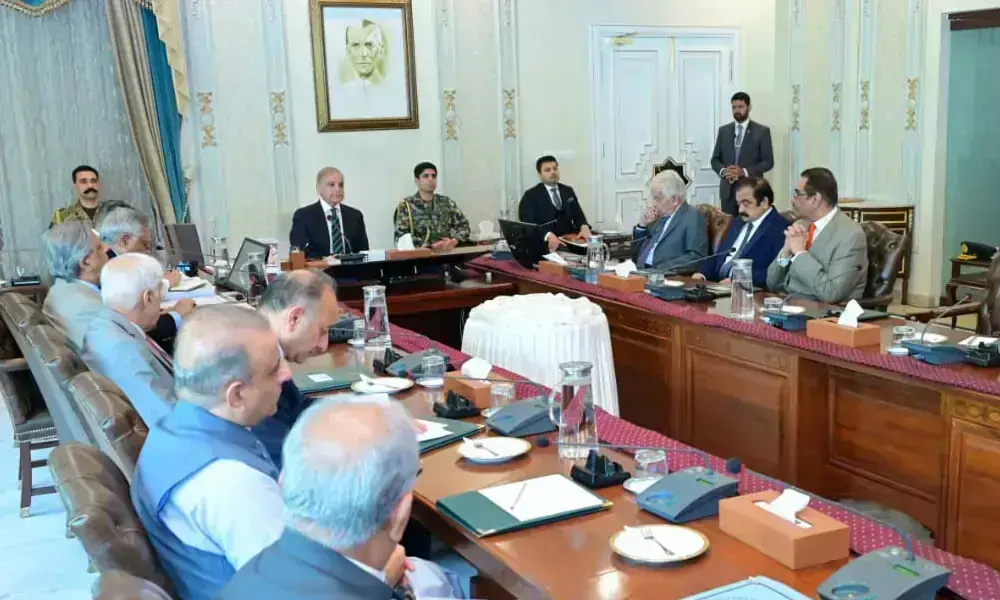
ISLAMABAD: Khyber Pakhtunkhwa has once again become a testing ground for the country’s selective commitment to democracy.
The PML-N-led federal coalition has imposed governor’s rule, displacing an elected Pakistan Tehreek-e-Insaf (PTI) government backed by a substantial assembly majority.
The intervention raises a fundamental question: does an electoral mandate retain any value when a province is governed by political opponents of those ruling Islamabad?
The federal government cites security concerns and provincial failures in counterterrorism. These concerns deserve scrutiny, but they cannot provide a blank cheque for dismantling an elected administration.
Constitutional powers are not political weapons to be deployed whenever relations between the Centre and a province become inconvenient.
Under the new arrangement, Governor Faisal Karim Kundi of the Pakistan People’s Party (PPP) assumes authority, assisted by an 11-member council of technocrats.
Chief Minister Sohail Afridi’s government has been displaced, while PTI founder and former prime minister Imran Khan remains imprisoned.
Against this backdrop of political confrontation, the government must establish that security, rather than political expediency, necessitated its decision.
If the provincial administration failed to cooperate against militancy, Islamabad should disclose the evidence, explain what corrective measures were attempted and demonstrate why ordinary constitutional mechanisms proved inadequate.
Without such justification, the intervention risks appearing less like a security measure and more like an attempt to override an inconvenient electoral verdict.
An emergency under Article 232 covers 12 districts, including the eight former tribal districts merged into KP, alongside Dera Ismail Khan, Tank, Bannu and Lakki Marwat.
These areas face serious security challenges, but their residents need accountable government, effective policing and sustained political engagement – not another experiment in administrative control from Islamabad.
Security cannot become a universal excuse for political centralisation. The coalition must explain the emergency’s objectives, define the limits of its powers and establish safeguards against abuse.
It must also demonstrate how the arrangement will improve security. Removing an elected government is an administrative act, while defeating militancy requires intelligence, policing, public cooperation and a credible political strategy.
The PPP faces an especially uncomfortable test of consistency. The party has long championed provincial autonomy and played a central role in the 18th Constitutional Amendment, which strengthened the provinces’ constitutional position.
Its participation in a coalition that has displaced an elected provincial administration raises an obvious question: does its commitment to provincial rights extend equally to provinces governed by political opponents?
The party’s own record makes this question harder to evade. On February 25, 2009, the PPP-led federal government imposed governor’s rule in Punjab after the Supreme Court disqualified Nawaz Sharif and then-chief minister Shehbaz Sharif from holding public office.
Governor Salman Taseer assumed control, sidelining the PML-N government. The arrangement was withdrawn on March 30 amid mounting political pressure and the opposition’s long march.
The irony is unmistakable. The PPP once used governor’s rule against the PML-N, its present coalition partner. Today, both parties preside over an intervention against PTI.
Their past disagreements cannot excuse their present responsibilities. If they once considered such measures threats to democratic representation, they must explain what has changed beyond the identity of the political target.
KP’s history offers further warnings. In 1975, following the killing of Hayat Muhammad Khan Sherpao in a Peshawar bomb blast, Zulfikar Ali Bhutto’s federal government imposed emergency measures.
The National Awami Party was subsequently banned, arrests followed and the province came under governor’s rule.
In 1994, during Benazir Bhutto’s government, the administration of PML-N’s Pir Sabir Shah faced a no-confidence motion amid allegations that provincial assembly members had disappeared.
Aftab Ahmad Khan Sherpao subsequently assumed power. Following General Pervez Musharraf’s October 1999 coup, military-backed administrators governed the province until the Muttahida Majlis-e-Amal government took office in late 2002.
These episodes arose from different circumstances and cannot simply be equated. Nevertheless, their recurrence exposes a persistent weakness in the country’s political system: successive governments have resorted to extraordinary arrangements instead of resolving disputes through representative institutions.
Article 234 provides for intervention when a provincial government cannot be carried on in accordance with the Constitution. But citing a constitutional provision does not, by itself, establish that its use is justified.
Legality, necessity, proportionality and democratic legitimacy remain distinct questions. The federal government must answer each rather than hide behind constitutional terminology.
The PML-N must justify displacing an elected administration. The PPP must reconcile its participation with its longstanding advocacy of provincial autonomy. Neither party can demand democratic principles in opposition and treat them as dispensable in government.
Governor’s rule will not automatically restore public confidence or eliminate militancy. Without transparent evidence, meaningful safeguards and a credible timetable for restoring elected governance, the intervention risks deepening political alienation.
The ultimate question is whether the country’s ruling parties defend democracy as a principle or merely as a route to power.
Khyber Pakhtunkhwa deserves an answer, not another demonstration of how readily an electoral mandate can be subordinated to the calculations of those governing from Islamabad.
Copyright Business Recorder, 2026
















Comments