


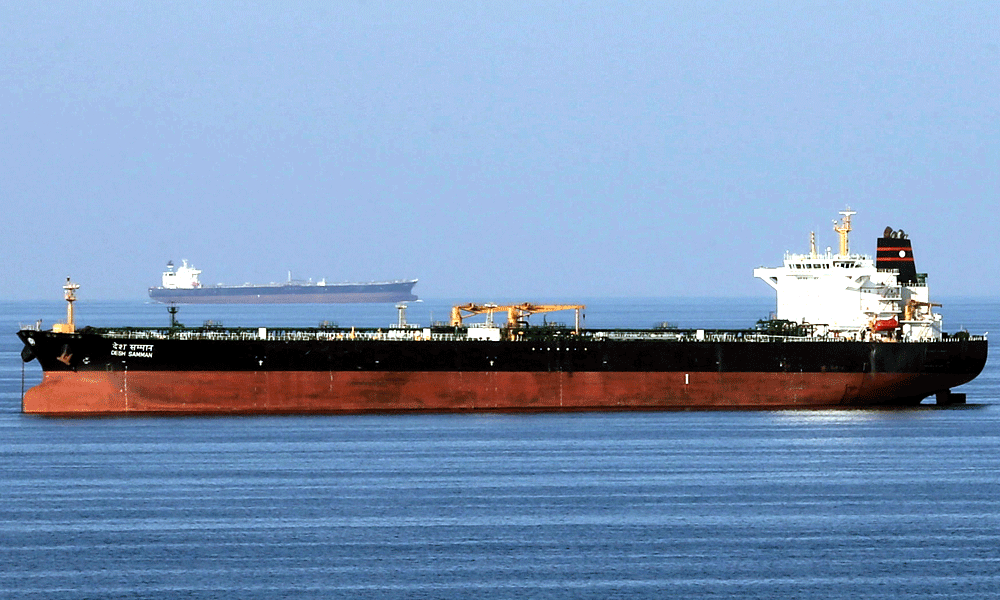

Pakistan’s energy problem is not simply that energy is expensive. It is that a large part of the country’s energy requirement remains exposed to international prices, supply disruptions, and geopolitical events over which it has little control.
For an economy already under persistent foreign-exchange pressure, that exposure carries a significant cost. Every increase in global oil and fuel prices raises the import bill, while disruptions in international energy markets can quickly feed into domestic energy costs and external account pressures.
This is why the debate over Thar coal deserves attention. Pakistan cannot eliminate its dependence on imported energy. Crude oil, petrol, diesel, and RLNG will remain necessary across transport, industry, and other parts of the economy. But where domestic alternatives are available, reducing reliance on imported fuel can still improve energy security.
Pakistan’s petroleum import bill for FY26 was around 16.9 billion. At the same time, the country has a fleet of coal-fired power plants with a combined capacity of around 5,280MW that rely wholly or partly on imported coal.This leaves Pakistan exposed not only to international fuel prices but also to freight costs, exchange-rate movements, and disruptions in global supply. In such an environment, the case for making greater use of domestic energy resources becomes stronger.
Thar is one of the few large indigenous fuel resources already operating at scale. Sindh Engro Coal Mining Company operates the open-pit lignite mine in Thar Block II, which began commercial operations in 2019 with an annual capacity of 3.8 million tonnes. Phase II doubled capacity to 7.6 million tonnes per annum in 2022.
Today, Phase III begins, increasing annual production capacity further to 11.2 million tonnes.
The significance of the expansion lies less in the mining milestone itself and more in what it potentially means for Pakistan’s energy mix. Over the past seven years, Thar Block II has supplied approximately 38.7 million tonnes of coal, supporting nearly 38,500GWh of electricity generation from power plants with a combined installed capacity of 1,320MW.
According to SECMS, that generation is estimated to be enough to power nearly three million households every day. The company estimates that the use of indigenous coal has also helped Pakistan save an estimated USD1.7 billion in foreign exchange through lower fuel imports.
The economics have also improved as production has expanded. The levelised mine tariff declined from USD47.92 per tonne at Phase I CODto about USD36.7 per tonne at Phase II COD, Thar Coal and Energy Board (TCEB) subsequently determined an initial multi-year levelised reference tariff of USD34.77 per tonne, while the Phase III contract-stage levelised tariff for the 11.2 million-tonne capacity was determined at USD32.01 per tonne.
For Pakistan, this matters because energy security is ultimately also about affordability. A larger domestic fuel base can reduce exposure to imported fuel prices and foreign-exchange pressures, while giving the country greater control over part of its energy supply.
But Thar should not be treated as a complete answer to Pakistan’s energy problem. Coal is only one part of the energy mix, and imported oil, petroleum products and RLNG cannot simply be replaced by lignite. The argument is therefore not that Pakistan should shift its entire energy system towards coal, but that it should make better use of domestic resources where substitution is possible and economical.
There are also broader considerations. Coal remains a carbon-intensive fuel, while Pakistan will increasingly need to expand renewable energy, hydropower, and other cleaner sources as part of a more diversified energy system. Energy security should therefore not mean dependence on any single fuel, whether imported or domestic.
The more practical objective is to reduce avoidable import dependence.
Thar’s expansion also carries a socioeconomic dimension. Mining and power projects have created employment and local economic activity, while associated initiatives have supported education, healthcare, vocational training, and basic infrastructure in surrounding communities.
The larger lesson is relatively simple. Pakistan cannot insulate itself from global energy markets, but neither should it remain more exposed to them than necessary.
Phase III therefore comes at a crucial time. Its success should ultimately be judged not only by higher coal output, but by whether that additional domestic supply can reduce fuel imports, save foreign exchange and contribute to more affordable and predictable power generation.
Pakistan may not be able to import less energy everywhere. But where a domestic alternative already exists, the case for using it more effectively is becoming harder to ignore.












Comments