


Aurangzeb's press briefing: No questions asked
The finance minister claims protests cause 120 billion rupees daily loss, but the article argues government actions, widening deficits, high poverty, and IMF policies also severely impact Pakistan's economy.
- Government's own measures contributing to economic losses.
- Widening trade deficit and increasing reliance on borrowing.
- High inflation and poverty rates impacting the public.
- Challenges to economic growth data from major industries.
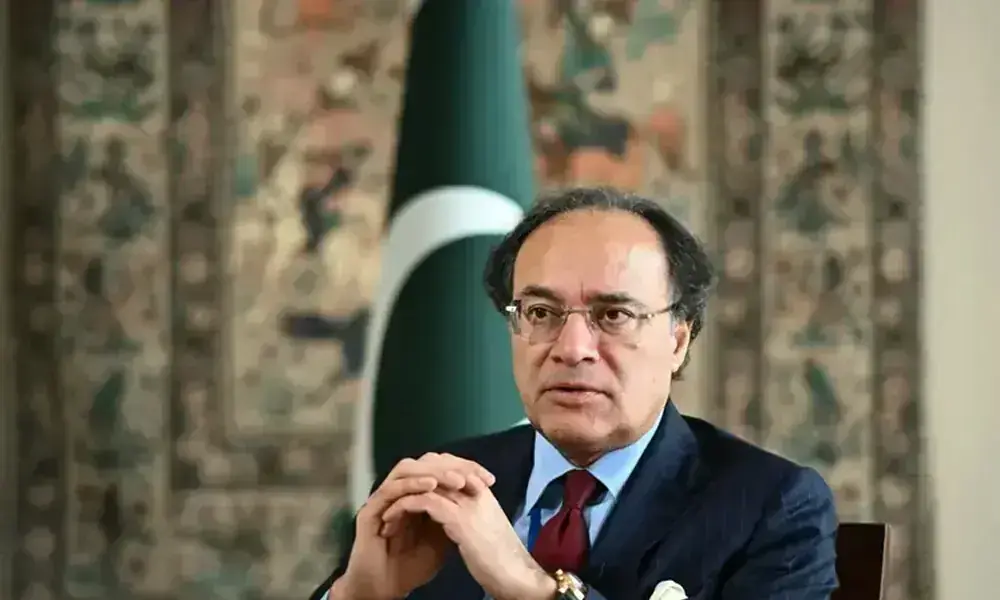
EDITORIAL: Federal finance minister Muhammad Aurangzeb called a press briefing—during which he entertained no questions from reporters—and maintained that the country suffers a daily loss of 120 billion rupees due to strikes, sit-ins, long marches, and road blockades.
He termed such disruptions “self-inflicted pain” and deemed them ill-advised given that the economy has achieved stabilization and is moving toward growth.
However, the minister did not quantify the losses the economy suffers as a consequence of the mitigating measures employed by administrations, including the incumbent, to defuse protests. These measures include appropriating private-sector containers and trucks to transport security personnel or block streets, which negatively impacts both domestic and international trade.
Furthermore, administrations frequently shut down roads and allow only a single entry into sensitive areas. This creates massive traffic jams that drastically increase fuel consumption and disrupt government operations, given that roads leading to official offices are often the most affected.
Because these pre-emptive measures pre-date actual strikes by four to seven days, one would hope that the minister will task his staff with also quantifying the losses associated with government actions.
Macro-economic indicators show that stabilisation has been achieved as a consequence of following the International Monetary Fund prescriptions under the ongoing programme.
The foreign exchange reserves’ position has strengthened to 21,389 million dollars as of 11 September; however, given the rise in the international prices of oil and products as well as the prices of other import items, including fertilizers (imports from the Gulf countries) the reserves are no more than two-and-a-half to three month of imports with the minimum requirement of donor agencies for reserves to be three months’ of imports.
The trade deficit is widening as a consequence – from 5964 million dollars July-August 2025 to 6752 million dollars in the same period of 2026 or a rise of 13 percent – while remittances have risen from the Gulf countries with reports suggesting that this is attributable to Pakistani expatriates, unlike from other countries, opting not to leave the Middle East due to the ongoing conflict.
The government is increasingly reliant on borrowing to meet its foreign exchange requirements – evident from the recent two phase 3 billion-dollar issue of Eurobonds as well as the request from the United States to borrow 10 billion dollars, which is still pending. And additionally, there appears to be no significant reduction in the government’s current expenditure due to external factors impacting on the economy – an outlay that was budgeted at a high of 93 percent this year.
The finance minister would be well advised to consider the performance of indicators that directly impact the quality of life of the general public. Sensitive Price Index for the week ending 17 September year-on-year was a high of 10.64 percent with major increases evident in perishables, including garlic, eggs, mutton, and of course diesel, petrol, LPG and firewood (whose consumption would rise upcountry as winter approaches).
Diesel (not eligible for the 75 billion subsidy extended by the government last week) is not only used in public transport (which is availed by those who do not possess their own transport) but also to transport perishables from farm to market.
The second disturbing indicator is the 44.7 percent of the population lives below the poverty line (at 4.20 dollars per day), with extreme rate at 16.5 percent (3 dollars per day), and the national poverty line sitting between 22.5 percent and 25.3 percent—roughly a quarter of the country’s population.
The widespread hardship should have been a source of very serious concern for the finance minister while formulating the budget for the current year. Instead, he extended fiscal incentives to the rich and influential while raising indirect taxes—such as sales tax, excise duty, and customs—which impact the poor more heavily than the wealthy.
Furthermore, the revenue generated from enforcement measures also came from indirect taxes, such as the sales tax levied at the factory gate on sugar, cement, and fertilizer. These costs were passed entirely onto consumers, thereby driving up inflation.
While it is true that the minister was probably referring to the year-on-year growth of 3.03 percent in large-scale manufacturing for June, as well as a 9.51 percent month-on-month increase, this data is being challenged by major industries.
The textile sector, for instance, claims that 150 units closed recently. Their claim is backed by the government’s continued implementation of harsh fiscal and monetary policies dictated by the IMF, which are raising input costs and making local products uncompetitive both externally and domestically, especially as smuggling across borders becomes increasingly lucrative.
It is critical for the Finance Ministry to formulate innovative, out-of-the-box policies, convince the International Monetary Fund (IMF) of their efficacy, and—as a measure of good faith—slash current expenditure by at least 2 to 3 trillion rupees. Doing so will create the fiscal space necessary to convince the Fund to support their implementation.
Copyright Business Recorder, 2026



















Comments