


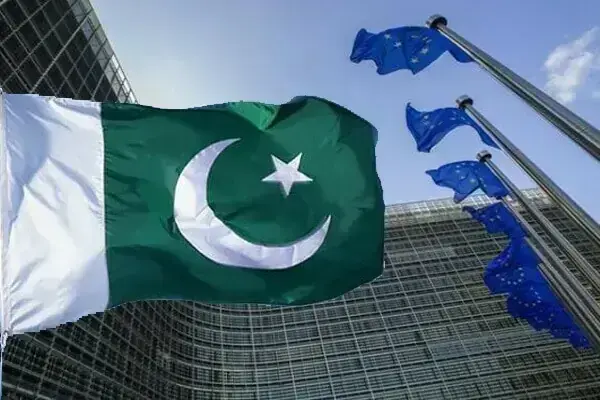

Back in 2014, when Pakistan was granted GSP+ status, a World Bank report projected that the EU’s GSP+ regime could increase Pakistan’s value-added textile exports under Chapters 61, 62, and 63 by US$280 million annually and create 25,000 jobs per year (Sánchez-Triana et al., 2014). Based on this projection, Pakistan’s exports of apparel and made-up textile articles to the EU should have reached US$5.86 billion by 2026.
Today, as the current scheme approaches its conclusion, these exports stand at US$6.304 billion—more than 7 percent above the projected level.
This export performance has also supported a substantial employment footprint. A 2017 ILO study estimated that approximately 4.2 million workers were employed across Pakistan’s broader textile and apparel sectors, with women accounting for around 35 percent of employment in the garment, textile and footwear sectors (Huynh, 2017).
The Labour Force Survey 2024–25 reports that industry accounts for 25.7 percent of total employment in Pakistan. Applying the textile and apparel sector’s 40 percent share of industrial employment yields an estimated 7.94 million workers in 2025, nearly twice the ILO’s 2017 estimates.
The industry’s broader employment footprint reaches approximately 15 million when supporting industries are included, such as chemicals and dyes, accessories and trims, packaging, transport and logistics, warehousing, wholesale and retail trade, and other associated sectors.
While this partnership has delivered many dividends, two tangible outcomes of Pakistan–EU trade relations under GSP+ stand out: exports and employment.
Doing business in Pakistan is far from easy, not because the country lacks the capacity for industrialisation, but because it faces serious structural constraints. These include some of the region’s highest energy costs, a heavy regulatory burden, an excessive tax burden and a large undocumented sector, all of which constrain industrial growth and formal employment creation for Pakistan’s expanding working age population.
Over a span of just four years, 19.8 million people have entered the working-age bracket of 15 to 64 years. However, between the two most recent Labour Force Surveys, LFS 2020–21 and LFS 2024–25, the number of unemployed people increased by approximately 31 percent, adding 1.4 million jobless individuals to the economy.
Most concerningly, the unemployment rate is highest among young people aged 15 to 24, at 12.8 percent, nearly twice the national unemployment rate of 7.1 percent. The second-highest rate, at 7.3 percent, is recorded among those aged 25 to 34.
When labour supply grows faster than job creation, unemployment, informality and outward migration tend to rise. This is increasingly evident in Pakistan.
In 2025 alone, 763,526 Pakistanis left the country for employment abroad. Of these workers, 4.23 percent were classified as highly skilled or highly qualified, while approximately 30 percent were classified as skilled. Moreover, according to a 2025 study on brain drain, the largest proportion of migrants, 35 percent, belonged to the 23 to 27 age group (Sami & Dar, 2025).
These figures indicate that overseas employment remains an important outlet for Pakistan’s growing working-age population. While moving overseas in pursuit of better career opportunities is not inherently problematic, brain drain driven by limited domestic opportunities is a serious concern.
This outward movement extended across both talented young professionals and workers in essential occupations. The 2025 figures included 465,724 labourers, 1,131 agriculturists, 6,090 operators and 2,992 welders, alongside workers from numerous other occupations.
If not directly, then indirectly, this is precisely why GSP+ increasingly matters beyond conventional trade debates, as it has also supported employment. Growth in the working-age population increases the potential labour supply, but it does not automatically create employment. Economic theory points to two connected mechanisms.
Employment depends on labour demand generated through investment, exports and economic growth, while tariff reductions improve market access and can stimulate export expansion.
Since 2014, Pakistan’s textile industry has made significant investments and created specialised employment opportunities. As companies aligned their operations with buyers’ product specifications, composition and quality requirements, mandatory EU regulations and voluntary international sustainability standards, they began creating roles such as Chief Sustainability Officer (CSO), Head of ESG, Traceability and Blockchain Specialist, Carbon Accounting Analyst, Effluent Treatment Plant (ETP) Bioengineer, Recycled Materials Manager, among others. These specialised functions have, in turn, generated additional supporting positions within their respective departments and increased labour-market demand for qualified specialists in technical textile and apparel fields, as well as in compliance and sustainability.
In fact, the Government of Pakistan, the European Union and other international public and private development partners began investing in skills development for both qualified professionals and workers on the manufacturing floor across the textile industry and other sectors, helping them acquire new skills, adapt to evolving market requirements and improve productivity at the firm level.
Economies naturally adapt over time. However, a decade ago, sustainability standards were far less embedded in Pakistan’s industrial landscape, as was the case across much of South Asia. GSP+ helped accelerate this transition by raising awareness of international conventions and strengthening the business case for compliance.
The scheme has now evolved, and so have the obligations attached to it.
A successful reapplication, which is supported by a comprehensive national action plan addressing implementation gaps in the existing 27 international conventions and covering five additional conventions, will be required for Pakistan to preserve its gains in exports and employment as a GSP+ beneficiary.
And this is particularly critical for a country that does not have a trade agreement with any Western market.
Copyright Business Recorder, 2026
The writer is Chairman APTMA— North Zone. The views expressed in this article are not necessarily those of the newspaper
Sarah Javaid is an Economist by education and practice, with experience in the Ministry of Commerce, the textile sector, and think tanks. She has participated in the monitoring mission of the Pakistan Regional Economic Integration Activity for USAID. Her writings focus on international trade and export competitiveness. Currently, she serves as a Trade Economist at the All Pakistan Textile Mills Association








Comments