


Too broke to obey the Constitution
The federal government is accused of wasting Rs5-6 trillion annually by failing to complete constitutional devolution, retaining ministries that should be provincial. This structural failure undermines reform and necessitates immediate action.
- Federal government's failure to complete constitutional devolution.
- Rs5-6 trillion annual waste from retained federal ministries.
- Bureaucratic interests and political patronage hindering reform.
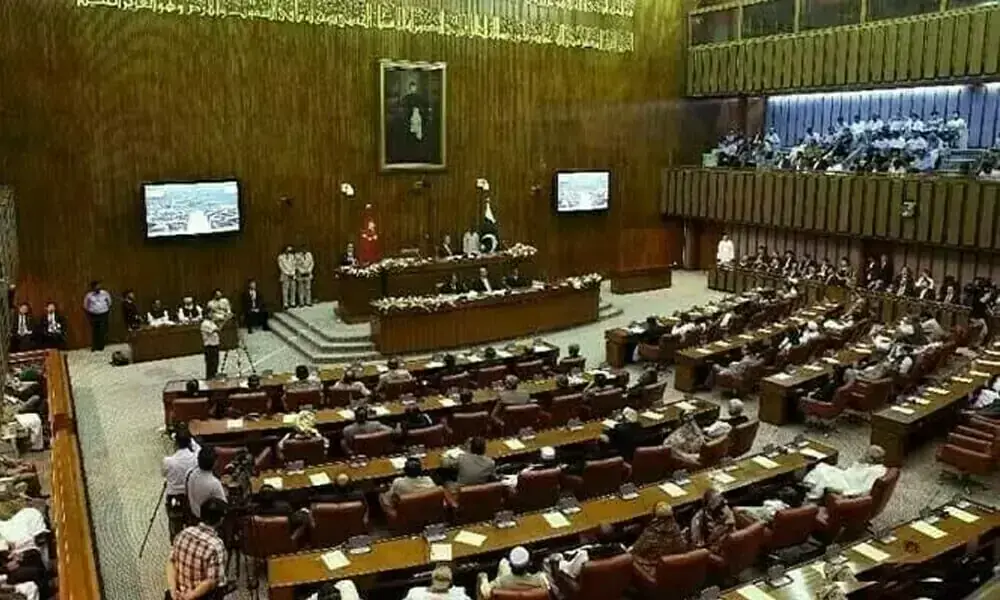
EDITORIAL: A federal government struggling to contain expenditure and repeatedly turning to foreign lenders is now being accused by a Senate subcommittee of wasting between Rs5-6 trillion every year simply because it has failed to complete a constitutional devolution process that should have been settled long ago.
The Senate Subcommittee on Devolution says ministries, institutions and functions that should have passed to the provinces or come under the Council of Common Interests (CCI) continue to be retained at the Centre despite the 18th Constitutional Amendment. If its assessment of the financial cost is correct, the scale of this failure is staggering.
The committee has identified 25 ministries and bodies that it says have been unlawfully retained by the federal government, including health, education, national food security, climate change, housing, petroleum, planning and development, railways and Wapda. It argues that faithful implementation of the 18th Amendment could reduce federal expenditure by Rs5-6trn annually.
Against a federal budget of approximately Rs19trn for FY2026-27, this is hardly an accounting footnote. It points to a potentially enormous structural failure at the heart of government.
The obvious question is how such a situation was allowed to persist. The 18th Amendment was passed in 2010 and the devolution process was formally completed by June 2011. If federal institutions have continued performing functions that the Constitution assigned elsewhere, why were the necessary red flags not raised much earlier? And if they were raised, who ignored them? Most importantly, who bears responsibility for the financial consequences?
These questions demand answers because the government cannot simultaneously plead poverty, impose austerity, pursue right-sizing and seek external financing while tolerating duplication on anything approaching the scale alleged by the Senate panel.
Successive governments have repeatedly promised to reduce the size and cost of the state. Yet the committee’s findings suggest that the machinery of government has continued consuming resources through structures whose constitutional justification it now openly questions.
This also exposes the deeper dysfunction that repeatedly undermines reform in Pakistan. Laws are passed, constitutional amendments celebrated, implementation commissions formed and deadlines declared, only for the old administrative machinery to find ways of surviving. Bureaucratic interests, political patronage and institutional inertia have proved remarkably resistant to reform.
Where such enormous sums of public money are potentially involved, questions of incompetence and possible misuse of authority cannot simply be brushed aside.
The committee’s findings must, of course, now withstand proper scrutiny. Its Rs5-Rs6trn estimate should be broken down ministry by ministry and function by function, while the constitutional status and actual expenditure of every institution it has identified should be established transparently. Such an extraordinary claim requires equally rigorous evidence. But that requirement cannot become another excuse for delaying corrective action where duplication or unconstitutional retention is established.
There is bitter irony in Pakistan borrowing repeatedly to keep the state functioning while potentially carrying trillions of rupees in avoidable expenditure within the state itself.
Debt has become embedded in the country’s fiscal architecture because expenditure consistently outruns available resources. If even a substantial part of the savings identified by the committee is achievable, failure to pursue it would be indefensible.
The government should therefore order an immediate, time-bound review of the committee’s findings and publish the results.
Every ministry and body found to be performing functions that no longer constitutionally belong to the Centre must be devolved, restructured or abolished according to law, with responsibility fixed for unjustified expenditure.
Before asking taxpayers for more money or creditors for another loan, Islamabad might finally try obeying its own Constitution.
Copyright Business Recorder, 2026



















Comments