


CDF Munir, Minister Naqvi reach Iran as Pakistan pushes for regional peace
- Hold meeting with Iranian security czar
Pakistan's Chief of Army Staff and Interior Minister traveled to Iran to promote regional peace and stability, focusing on a lasting resolution to the Middle East conflict.
- Pakistan's diplomatic efforts for regional peace.
- Advancing a peaceful resolution to the Middle East conflict.
- The role of military and interior leadership in regional stability.
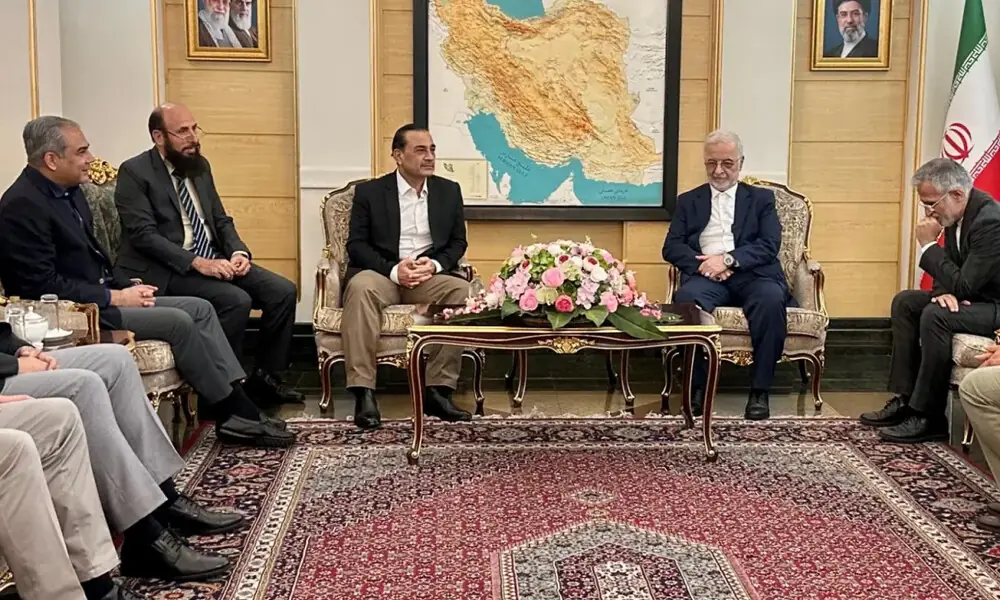
Chief of Army Staff and Field Marshal Asim Munir has arrived in Tehran along with Interior Minister Mohsin Naqvi as part of Pakistan’s diplomatic initiative to promote regional peace and security and help ease tensions between Iran and the United States.
Iranian Interior Minister Eskandar Momeni received Field Marshal Asim Munir upon his arrival in Tehran and held a meeting with the visiting delegation.
During his visit, Field Marshal Munir is scheduled to hold detailed meetings with the Iranian leadership in a bid to ease regional tensions.
The Inter-Services Public Relations (ISPR) said on Monday Field Marshal Munir will focus on advancing efforts aimed at achieving a peaceful, lasting and comprehensive resolution to the conflict in the Middle East.
Reuters on Monday cited three Pakistani sources as saying that Army Chief Munir spoke with US President Donald Trump last week, days before Munir was expected to hold talks in the Iranian capital of Tehran.
The call, which has not been previously reported, came as the US threatened to roll out major economic sanctions targeting Iran and its trade partners.
The White House Office of the Press Secretary did not immediately respond to a request for comment. It was unclear what Munir and Trump discussed.
Another Pakistani government source said while US-Iran tensions were a focus of the visit, Munir was also expected to discuss recent attacks by Iran-aligned Houthi fighters on Pakistan’s ally Saudi Arabia as well as the recently signed mutual defence agreement between Pakistan, Turkey and Saudi Arabia.
Pakistan’s earlier mediation efforts between the US and Iran resulted in an interim peace agreement signed in June. But the Islamabad Memorandum quickly faltered, amid new fighting between Iran and the US that has threatened to spiral into a wider regional conflict in recent weeks.
“There is a trust deficit on both sides,” a third Pakistani source said about the US and Iran, adding that Munir’s aim was to mitigate the lack of mutual trust on Monday.
Iran’s foreign ministry spokesperson Esmaeil Baghaei in a statement on Sunday said the visit was in continuation of Pakistan’s efforts to strengthen peace and security in the region.
Pakistan has taken on the mediator role in negotiations between Iran and the US aimed at ending their war. This role is driven by Pakistan’s desire to prevent regional conflict escalation, protect its economy reliant on Strait of Hormuz oil and gas imports, and enhance its international standing.
Pakistan’s advantages as a mediator include maintaining direct diplomatic channels with both Washington and Tehran. Its reputation as a relatively neutral player with long-standing ties to Iran and the US as well as close strategic relations with Saudi Arabia, the Gulf states, and Turkiye.
This mediation role could bring significant benefits to Pakistan, including enhancing its regional influence.

























Comments