


Reflection of political conflicts in trade barriers
- South Asian mutual trade remains below 4% of global trade, largely due to persistent non-tariff barriers and geopolitical tensions.
Despite trade agreements, mutual trade in South Asia, particularly between India and Pakistan, remains low due to political conflicts, pervasive non-tariff barriers, and non-complementary economic structures.
- Non-tariff barriers (NTBs) impeding regional trade.
- Political conflicts affecting India-Pakistan economic relations.
- SAFTA's limited success despite trade agreements.
- Challenges in India-Pakistan cross-border trade.
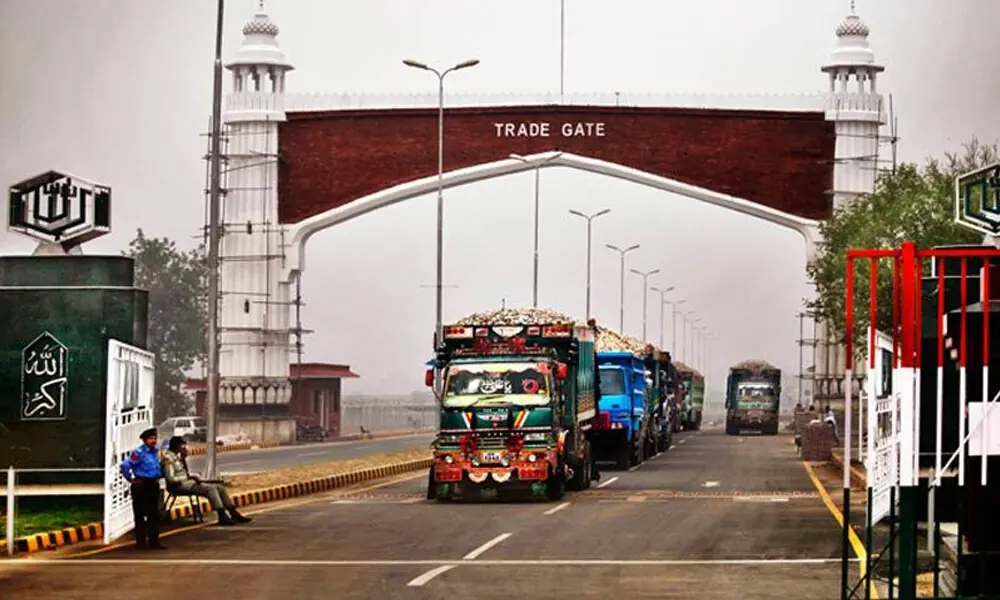

The substantial growth in the mutual trade of neighboring countries is a natural outcome of the trade facilitations and removal of trade barriers, while its overall economic impacts are much greater in terms of lowering inflation, efficient utilization of domestic resources in the comparative advantage sectors, and improvement in business competitiveness.
In some cases, political conflicts and enmity are carried over into economic relations and trade-enhancement activities. The non-tariff barriers (NTBs) are one of the most drastic impediments to the mutual trade of neighbouring countries. It is included in such tactics, which can fail the targets and objectives of the regional connectivity.
The South Asia Free Trade Area (SAFTA) is one of the examples of such unsuccessful stories, which reflect the consequences of non-tariff barriers (NTBs). Despite several efforts and policies to enhance the mutual trade of South Asian nations, their mutual trade is less than 4 percent of their global trade.
Similarly, there are no visible signs of cross-border mobilization of capital, labour, or entrepreneurship. The formation of the South Asian Association for Regional Cooperation (SAARC) and its subsidiaries, including the SAARC Chamber of Commerce & Industry (SCCI), ratification of the South Asia Preferential Trade Agreement (SAPTA), establishing the South Asia Free Trade Agreement (SAFTA), and granting the status of most favoured nation (MFN) are steps that have been taken in the past. None of these steps provided a revolutionary development in the trade relations of the South Asian countries in general and Indo-Pakistan relations in particular.
There are two obvious reasons behind the ineffectiveness of the mutual trade enhancement strategies. The first reason for this undesired outcome is the transmittal of political conflicts between India and Pakistan into trade barriers. Despite relaxation in tariffs and free trade agreements, several types of NTBs are still active, and even enhanced. The second reason is that the countries in South Asia do not depend on each other; their industries are not vertically integrated, and their products and services do not complement each other.
The history of their mutual trade reveals the transmission of the first reason. The SAARC Preferential Trading Agreement (SAPTA) was signed in 1993. During the SAPTA regime, there were positive lists for the duty-free imports between India and Pakistan. After six years of its implementation, only a marginal improvement in their mutual trade was observed. Much of their trade is considered symbolic and generally does not involve the trade of vital commodities. The formation of the South Asian Free Trade Area (SAFTA) in 2006, and the conversion of the positive list into the negative list, removed the tariff barriers in the imports of all commodities except the items in the negative list. However, no significant enhancement in the mutual trade has been observed because of the rapid growth in NTBs in the trade between India and Pakistan.
To know the use of NTBs to restrict or block the imports of goods from a country, it is important to understand first the mechanism of non-tariff measures (NTMs). In principle, NTMs include all measures, besides tariffs, that are used to protect a domestic economic activity. They may be imposed or sponsored by the government. In the presence of a free trade agreement, NTMs are used to reinforce the restrictions on imports. To identify NTMs is not a simple task, and there is no agreed-upon definition of NTMs. The measures to influence prices, quantity, para-tariff, financial transactions, competitiveness, export-related investment, distribution restrictions, restrictions on post-sales services, subsidies, government procurement restrictions, intellectual property, and rules of origin are included in the NTMs. Some of the NTMs may be imposed based on the legitimate goals: measures to protect national security, the environment, sanitary and phytosanitary measures, and technical trade barriers are included in those legitimate measures that are compatible with WTO principles.
If the main objective of a requirement is not based on moral grounds but primarily it is for the protection of domestic economic activity, it will be considered an NTM. If this NTM is not for all trading partners but for a specific country, it will be considered as an NTB. The existence of non-tariff barriers (NTBs) may complicate the issue of NTMs in the case of bilateral trade between neighboring countries that have severe geopolitical conflicts. The arbitrary, inconsistent, and discriminatory behavior of the dealing officials of importing country, favoring specific producers or suppliers, inefficiency or cases of outright obstruction, non-transparent practices, legal obstacles, and unusually high fees or charges are included in NTBs.
The tools and types of NTBs cannot be identified unless they are observed. In most of the cases, such barriers may be invisible, and identifying those invisible barriers is not a simple task. These are changed from time to time and vary from product to product. Regular investigation and monitoring are always required to perform this task.
The majority of Pakistani exporters noted the different types of NTBs used by the Indian trade regulatory agencies. Sanitary and phytosanitary measures through some laws, a strong focus on food security and self-sufficiency, a complex licensing system varying according to product or user, frequent use of anti-dumping measures, the duties and over charges, use of reference prices for some products to align with international market prices, import of some goods only through specified ports, import only by state trading agencies, quarantine requirements in case of agriculture and textile related products, stringent visa requirements, import prohibitions and licensing in the name of health,safety, security,religious and environmental reasons, and approval requirements by relevant ministries/ agencies are included in those measures.
According to a study jointly conducted by the national chambers of commerce and industry of South Asian countries under the guidance of the NTM desk established by the SAARC, 61 percent respondents identified the problems in land transportation, more than 50 percent indicated the problems in getting visas and harassment during visits, and 60 percent mentioned the problems in handling at ports and dealings of customs. Several types of problems in certification requirements, the port of entry, and banking transactions are also identified by the desk.
Based on the surveys conducted by different think tanks and policy institutes, some issues have been identified by the exporters of India and Pakistan. Regarding the issuance of visas, both sides of exporters identified that too much documentation, limited duration of visit, limited number of cities, police reporting, and no multiple visas are the main problems. Pakistani exporters also identified that arranging a sponsorship and delay in obtaining a visa are also important issues.
Concerning the transportation infrastructure and logistics, both sides’ exporters highlighted the shortage of railway wagons and the modal change at the border as problematic areas. Furthermore, Indian exporters mentioned that the restricted list of goods by land route and the absence of alternative land routes are problematic areas.
Regarding the testing and quarantine facilities, both sides indicated the absence of border facilities, while Indian exporters added the delays in certification due to the multiplicity of agencies. Both sides highlighted the problem in the movement of consignment from one state/ province to another. So far as customs-related issues are concerned, both sides agree that delays in clearing consignments and security checks are the main issues. The Indian exporters highlighted that the lack of harmonization of product classification is also an issue. Regarding banking transactions, both sides mentioned that problems in opening L/Cs, delays in receipts of payments, and high cost of transactions are major issues.
A “Most Favored Nation (MFN)” status provides a simple and immediate solution to the NTBs after their identification. So, Pakistan decided to grant the most favored nation status to India in January 2013, while India had already granted this status to Pakistan. Later on, this term was replaced by the “Normal trade relations (NTR)”, because of ambiguity in the use of MFN. Interestingly, the United States had also renamed the “Most Favored Nation status” as “Permanent normal trade relations(NTR)” in1998. The drive for this amendment in terminology came from irritation voiced by some Americans that some dictatorial governments around the world enjoyed beinga”most favored nation“ of the United States.
However, the reciprocal granting of MFN status by India and Pakistan did not succeed in enhancing their mutual trade. Certainly, the political conflicts and their consequent effects on the attitude of people on both sides are one of the reasons. The second important reason is the nature of the structure of their output, exports, and imports.
India has advantages in the supply of medium and high-tech exports. The share of its agriculture in its GDP is significantly lower than that of Pakistan. Their policymakers expect and want to establish “Business-to-business (B2B) relations with Pakistan.
In most of the cases, on different platforms, they strongly emphasize establishing B2B relations with Pakistan. In this type of trade relations, they expect that Pakistan will supply primary goods and raw materials to their industrial units, and will import plants, machinery, and high-tech products. In this way, Indian exporters do not need to take marketing risk.
As a result, prices of basic goods will increase in Pakistan. In the past, the trade policies of Pakistan were softer than Indian trade policies. The import of capital goods from India will lead to Pakistan’s dependency on the Indian industrial sector. An important point is the role of several types of frequent subsidies to the Indian private sector in building its capacity and competitiveness. The development and modernization of logistic infrastructure by the Indian government plays an important role in building its industrial competitiveness.
The indicators of logistic infrastructure in India depict that its position is better than the world average. Due to several fiscal constraints and agreements with the IMF, Pakistan cannot afford subsidies. The past experience can predict that foreign exchange will not come into Pakistan through exports to India. Because importing from India will be more profitable than exporting Pakistani products to India.
However, the best model for Pakistan is “Business-to-consumer (B2C)”. The data on trade patterns shows the competitiveness of the manufacturing sectors of both countries. There is a high demand for Pakistani consumers’ products in India. The garments, leather products, sports goods, plastic, cutlery, furniture, packaged halal food, and several other consumer goods are included in these goods. Pakistani companies can establish their showrooms, customer support centers, and marketing offices in India, while India does not favor this model.
The author is a professor at Iqra University Karachi.










Comments