


China's yuan pulls back from one-month high as tensions flare in Middle East
- The onshore yuan slipped to 6.7703 per dollar
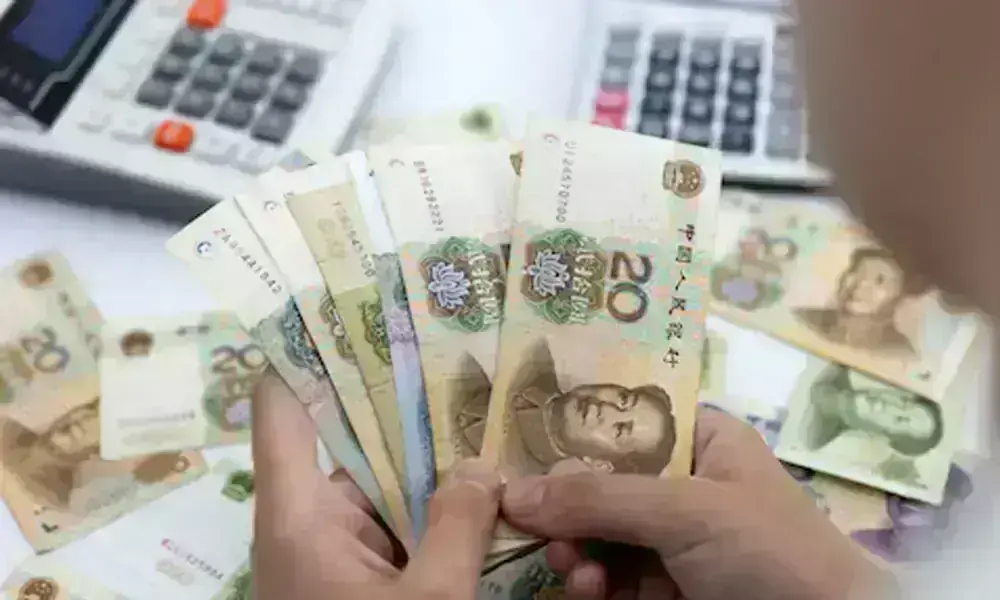

SHANGHAI: China’s yuan pulled back from a one-month high against the dollar on Thursday, weighed down by renewed US-Iran tensions, although broad greenback weakness and reduced expectations for domestic easing lent support.
Escalating hostilities between the Washington and Tehran kept oil prices near one-month highs, while the dollar hovered near a one-month low after cooling US producer price data.
The onshore yuan slipped to 6.7703 per dollar as of 0250 GMT, compared with a one-month high of 6.7635 hit a day earlier.
Its offshore counterpart last fetched 6.7714 per dollar.
Prior to the market opening, the People’s Bank of China (PBOC) set the midpoint rate at 6.7909 per dollar, a more than three-year high, and 1 pip firmer than the previous setting.
The spot yuan is allowed to trade a maximum of 2% either side of the fixed midpoint each day.
The central bank has been setting a weaker-than-expected midpoint guidance rate since November 2025, a move investors interpreted as an attempt to keep the market stable and prevent excess yuan gains.
However, the gap between the official setting and market projections widened on Thursday, with the midpoint coming in 332 pips softer than Reuters’ estimate of 6.7577, marking the largest weaker-side deviation since June 23.
“The PBOC continues to guide the daily USD/CNY fixing lower, but the pace of appreciation has slowed since early June,” said Eugenia Victorino, head of Asia strategy at SEB.
“At this point, the slow decline in the daily fixing reflects more of a return to a comfortable position rather than a push for a stronger currency. So long as the RMB index does not gain too much ground from here, the PBOC is likely to tolerate a resilient yuan.”
The yuan has strengthened 3.2% against the dollar so far this year, while its trade-weighted CEFTS RMB Index has gained 4.5% during the same period, according to Reuters calculations based on official data.
Looking into the second half of this year, “the near-term swing will hinge on the interaction between export performance, the energy import bill, and trade-policy headlines,” analysts at J.P. Morgan said in a note.
“A firmer USD and a more hawkish Fed tilt could slow the pace of CNY appreciation, particularly given policy divergence with the PBOC, even if US–China rate differentials now play a less reliable role in explaining CNY moves than they do for other currencies,” they said.
Separately, investors are turning their focus to the upcoming Politburo meeting, where policymakers are expected to set the economic policy agenda for the second half of the year.
Markets, however, largely view the recent softer-than-expected second-quarter economic data as insufficient to prompt broad-based policy easing.
“Beijing appears to be managing a controlled correction in excess sectors while continuing to support tech,” said Wei Yao, global chief economist at Societe Generale.
“At times, policymakers may top up support for consumption and infrastructure, but that is likely the extent of easing, consistent with recent policy signals. As such, we expect little from the July Politburo meeting.”




















Comments