




There is something rather unusual happening in financial markets. The more uncertain the future of artificial intelligence becomes, the more convinced investors appear to be that they already know how it ends. That is an odd place for markets to find themselves.
After all, uncertainty usually breeds caution. This time, it seems to be producing certainty.
Could that be the biggest warning of all?
The debate surrounding artificial intelligence has become increasingly polarised. On one side stand the optimists, convinced that AI represents a technological revolution comparable to electricity, the internet or the smartphone. Trillions of dollars in investment, they argue, will ultimately generate productivity gains and profits large enough to justify today’s extraordinary valuations. On the other are those who believe investors have become so captivated by the promise of AI that they are no longer asking whether the returns can possibly justify the spending.
The remarkable thing is that both camps have become more confident at precisely the moment the evidence has become less conclusive.
Nobody possesses an AI playbook, after all. No historical model can tell us how quickly businesses will adopt the technology, whether expensive proprietary models will retain pricing power, how much cheaper open-source alternatives might become or what the eventual winners will look like. Yet instead of becoming more cautious as the unknowns multiply, markets appear to be digging in.
How often does uncertainty strengthen conviction rather than weaken it? Perhaps the answer lies in the sheer scale of the numbers involved.
Corporate America is now spending amounts on artificial intelligence that would have seemed unimaginable only a few years ago. Data centres are expanding at breath-taking speed. Semiconductor manufacturers continue racing to meet demand. Every earnings season brings fresh announcements of larger capital expenditure budgets.
Yet another set of numbers deserves equal attention.
Much of that investment is now being financed by companies whose own free cash flows are coming under increasing pressure. The largest technology firms continue pouring hundreds of billions of dollars into AI infrastructure while relying more heavily on debt and equity markets to finance the buildout. Meanwhile, much of the immediate financial benefit appears to be flowing elsewhere, particularly toward semiconductor manufacturers supplying the chips powering this revolution.
Could both sides of that equation continue working indefinitely?
Perhaps they can. Transformational technologies have always required enormous upfront investment before delivering widespread economic returns. Railways did. Electricity did. The internet certainly did.
History, however, also offers another lesson.
Technological revolutions and speculative episodes have often arrived together. One does not necessarily invalidate the other. The internet transformed the global economy even as the dotcom bubble destroyed billions of dollars of wealth. Genuine innovation and financial excess have never been mutually exclusive.
That is where today’s market becomes particularly interesting.
AI-related investment now accounts for an unprecedented share of new corporate capital expenditure in the United States, while investment elsewhere in the economy has slowed noticeably. In other words, corporate America appears to be making an increasingly concentrated bet on one technology, one narrative and, ultimately, one set of future assumptions.
Is that confidence or concentration risk? Markets are beginning to ask the question in their own language.
Volatility has returned.
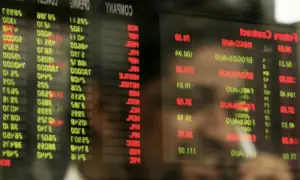
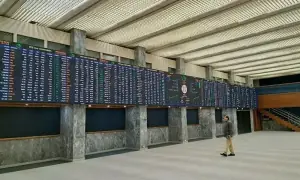
Some of the largest companies sitting at the centre of the AI story have experienced unusually sharp price swings in recent weeks. Semiconductor stocks that only months ago appeared almost incapable of falling have suddenly reminded investors that momentum works in both directions. South Korea’s chip-heavy KOSPI has endured some of its largest declines since the global financial crisis, driven largely by sharp moves in semiconductor shares. Individual technology stocks are experiencing levels of volatility that would have seemed extraordinary during the earlier stages of this rally.
Perhaps volatility is trying to tell us something that conviction refuses to hear.
Markets generally become volatile when investors disagree about value. That disagreement appears to be widening rather than narrowing. Every earnings report, every capital expenditure announcement and every shift in demand for AI infrastructure is now interpreted as decisive evidence by whichever side already holds the stronger opinion.
Could markets have become less interested in discovering the truth than in defending existing beliefs?
That may be the real paradox.
The deeper uncertainty becomes, the stronger both narratives appear to grow.
If that trend continues, volatility may become less of an exception and more of a permanent feature of the AI trade. Large swings cease to be signs of panic and instead become the mechanism through which markets gradually discover what these businesses are actually worth.
For countries such as Pakistan, this debate might appear comfortably distant.
It is not.
Pakistan may not manufacture advanced semiconductors or build hyper-scale data centres, but it remains deeply exposed to shifts in global financial conditions. A sharp correction in the world’s most crowded trade would not remain confined to Silicon Valley. It could tighten global liquidity, strengthen the dollar, widen risk premiums and reduce capital flows into emerging markets. History suggests that when global investors become nervous, they rarely distinguish carefully between different emerging economies before reducing exposure.
That is precisely why developments on the Wall Street deserve attention in Islamabad.
The question is no longer whether artificial intelligence will change the global economy. It almost certainly will.
The more difficult question is whether financial markets have already priced decades of future success into today’s valuations while the underlying economics remain stubbornly uncertain.
Perhaps the optimists will be proved entirely right. Perhaps today’s investment boom will produce productivity gains that dwarf every previous technological revolution. Perhaps current valuations will eventually look remarkably cheap.
Or perhaps future historians will conclude that markets correctly identified the next great technological transformation while simultaneously mispricing almost everything associated with it.
Would that really be the first time investors managed to be right about the future and wrong about the price?
Copyright Business Recorder, 2026
The writer can be reached at [email protected]
















Comments