


Aurangzeb calls for review of NFC Award's population criterion
- Finance Minister calls for reviewing the "unsustainable" 82% population-based NFC Award resource distribution.
Pakistan's Finance Minister proposes reviewing the National Finance Commission (NFC) Award's population-based resource distribution formula, deeming it unsustainable. He also highlighted population growth and climate change as critical existential issues.
- Review of the National Finance Commission (NFC) Award formula.
- Population growth and climate change as existential issues.
- Funding for population-related initiatives through the World Bank.
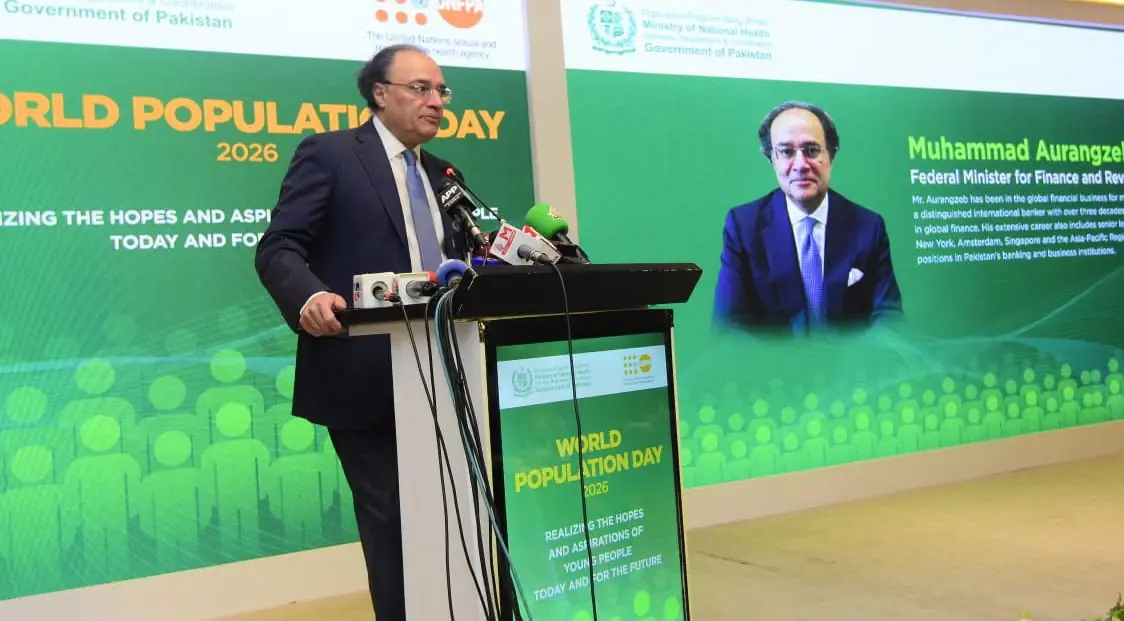

Finance Minister Muhammad Aurangzeb said on Wednesday the government would have to review the National Finance Commission (NFC) Award’s population-based resource distribution formula, arguing that the current 82% weight assigned to population is ‘not sustainable’.
“So whenever we move this NFC discussion forward in terms of horizontal matrices, this formula will have to be looked at and reviewed,” he said, while addressing an event.
The National Finance Commission (NFC) Award is a constitutional body in Pakistan responsible for distributing tax revenue between the federal and provincial governments, and then among the provinces themselves. Under the Constitution, an NFC is mandated to be formed every five years to devise an appropriate mechanism for financial allocation.
The 7th NFC Award was the first to adopt a multi-factor formula, reducing the population’s weight from 100% to 82% and incorporating factors like poverty levels (10.3%), revenue generation (5%), and inverse population density (2.7%).
Since the 7th NFC Award, there has been considerable debate and calls for a new award to address evolving fiscal needs and imbalance.
Meanwhile, while addressing the event, Aurangzeb termed population growth and climate change ‘existential issues’ for Pakistan.
“If we don’t address these two existential issues, then in terms of the potential of Pakistan by the time we get to be 100 years old, we are not going to get there,” he said.
Aurangzeb said while the government had taken immediate steps through the federal budget—such as removing the sales tax on contraceptives—those measures alone would not be enough to address the country’s demographic challenges.
“As I mentioned, these are tactical measures,” he said, adding that deeper structural reforms would be required to produce lasting results.
The minister stressed that measurable targets and regular monitoring should back the implementation of the National Population Council’s agenda.
On financing population-related initiatives, the finance minister said resources would be available beyond the annual federal budget through the World Bank’s 10-year Country Partnership Framework.
“Roughly $600 million to $700 million per year is available to finance all interventions that are going to be there around population,” he said.























Comments