


Sindh Assembly concludes budget debate as CM outlines Rs720bn development plan
- CM Murad announces Rs206bn package for Karachi development schemes
Sindh CM Murad Ali Shah defended the Rs3.652 trillion budget, emphasizing prudent fiscal management, record legislative participation, and an ambitious roadmap to transform Sindh into a regional economic hub.
- Fiscal discipline and resource redirection for development.
- Plans for Keti Bandar, a financial hub, and green energy.
- Record housing initiatives and international investment in Sindh.
- Addressing opposition claims and unfulfilled federal packages.
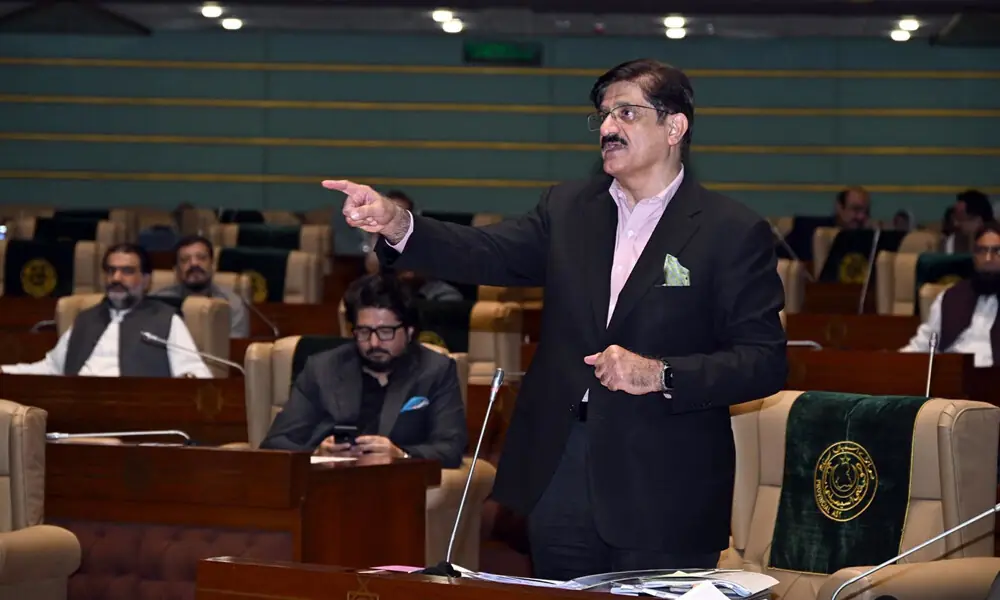

Sindh Chief Minister Syed Murad Ali Shah on Sunday defended his government’s Rs3.652 trillion budget for the fiscal year 2026-27, highlighting prudent fiscal management, record legislative participation, and an ambitious roadmap aimed at transforming Sindh into a regional economic hub.
Winding up the budget debate in the Sindh Assembly, the chief minister stated that the province managed to maintain strict fiscal discipline despite facing a budget deficit of Rs344 billion, reduced federal fiscal space, and unexpected expenditures exceeding Rs95 billion during the outgoing year.
“Administrative expenditures were slashed by more than Rs62 billion, allowing resources to be redirected toward development, social welfare, and economic growth initiatives,” he noted.
Presenting a comprehensive vision for the province’s future, CM Murad announced plans to develop Keti Bandar as a major logistics hub through public-private partnerships, establish the Sindh International Financial Centre, create a province-wide Green Energy Network, and introduce a new agricultural financing framework to empower small farmers.
He unveiled an Annual Development Programme (ADP) of Rs720 billion for the next financial year, which includes Rs206 billion earmarked for Karachi to complete more than 1,800 development schemes.
Showcasing the achievements of the outgoing fiscal year 2025-26 through a detailed pictorial presentation, the chief minister highlighted completed projects in healthcare, education, irrigation, and infrastructure. He specifically pointed to the success of the Sindh People’s Housing for Flood Affectees (SPHF) programme, describing it as the world’s largest owner-driven housing initiative, with one million houses completed and another 600,000 currently under construction.
“Growing international confidence in Sindh’s strategy was evident as the World Bank approved projects worth around $1.7 billion for the province during the past two and a half months,” he added.
Responding to opposition’s criticism and what he termed factual inaccuracies, CM Murad rejected claims that quality healthcare was concentrated only in Karachi, citing specialised services and treatment statistics from facilities in Gambat, Sukkur, and Hyderabad.
He also dispelled assertions regarding historical spending on Karachi, clarifying that records showed past local administrations spent Rs33 billion rather than the Rs300 billion claimed.
The chief minister criticised successive federal governments for announcing massive development packages for Karachi—including past promises of Rs62 billion and Rs1.1 trillion—that never fully materialised, noting that current federal support remains limited to a few road projects.
Addressing remarks made during the session regarding national unity and historical legacies, CM Murad recalled the deep roots of Quaid-i-Azam Muhammad Ali Jinnah in Sindh and Karachi, urging political leaders to avoid divisive rhetoric. He maintained that Sindh continues to embody the values of inclusion and coexistence, and called for mutual respect for the historical contributions of all communities toward national cohesion.






















Comments