


Aurangzeb stoutly defends FY27 budget
- The minister said the government had received positive feedback from lawmakers and stakeholders regarding the budget
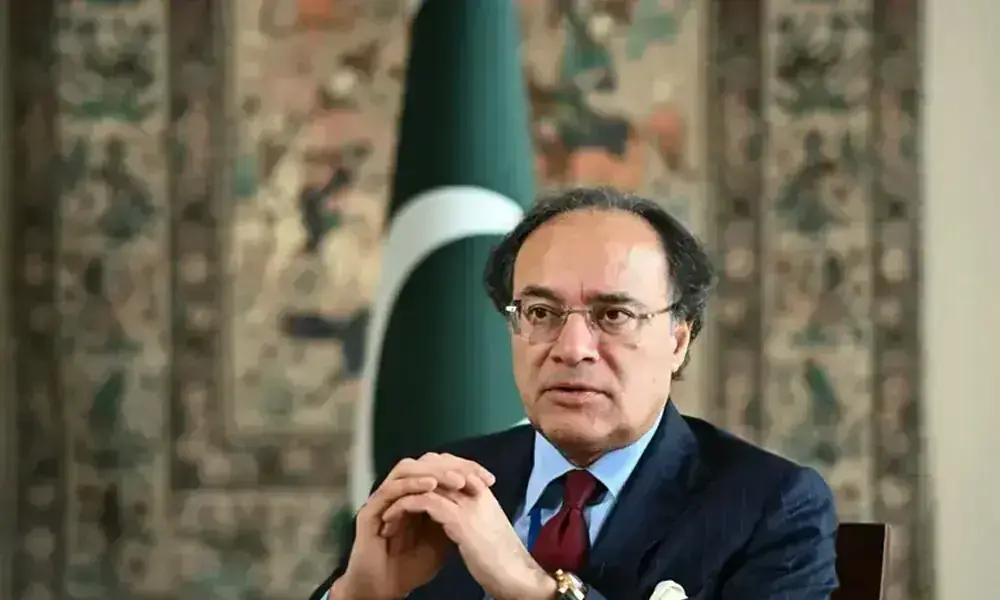

ISLAMABAD: Rejecting opposition allegations of discrepancies in official economic data, Finance Minister Muhammad Aurangzeb on Saturday said the country’s GDP figures were calculated according to international standards and maintained that the federal budget for 2026-27 was a pro-growth package designed to broaden the tax base, boost exports and accelerate sustainable economic growth.
Winding up the debate on the federal budget for 2026-27 in National Assembly, the minister said the government had received positive feedback from lawmakers and stakeholders regarding the budget’s overall direction.
“We have gotten very clear feedback from within and outside the House that this is overall a positive and pro-growth budget, which sets the foundation to accelerate the sustainable growth witnessed over the last two years,” he told the House.
At the outset of his speech, he addressed concerns raised through a privilege motion moved by lawmakers Khawaja Sheraz Mehmood and Azimuddin Zahid regarding alleged discrepancies in the budget document, particularly relating to GDP growth figures, per capita income and the methodology used to calculate economic indicators.
READ ALSO: Senior economist says a ‘maxi budget’ will be unavoidable
“I want to clarify that no changes at all have been made to the methodology used for reporting the economic indicators,” he said, stressing that economic measurements had remained consistent across successive administrations.
He explained that the country’s reported real GDP growth of 3.7 per cent for FY26 had been calculated at constant prices based on the FY15-16 base year, in line with international statistical standards.
He further clarified that nominal GDP and real GDP represented different concepts and measurements, while per capita income was calculated on the basis of gross national income (GNI), current prices and population estimates derived from the 2023 census and subsequent projections.
According to the minister, the country’s nominal GDP increased from USD 408.2 billion in FY25 to USD 452.1 billion in FY26.
He noted that GNI also included net factor income received from abroad, particularly workers’ remittances.
The minister said the government remained committed to achieving “sustainable and inclusive export-led growth that increases productivity”, describing it as the central objective of both the government’s economic strategy and the FY27 budget.
Addressing concerns frequently raised about the tax burden on the documented corporate sector and salaried individuals, Aurangzeb said the government had shifted its focus towards expanding the tax base rather than imposing additional burdens on existing taxpayers.
“We have changed this trend and thinking in the budget, and focused on deepening and broadening rather than burdening,” he said, adding that reforms initiated in the previous budget had been further strengthened through new measures in the current finance bill.
He maintained that the proposed budget would reduce the burden on salaried employees, small businesses, exporters and industrialists while adhering to the principles of equity and fairness. He highlighted the introduction of the Fixed Asaan Tax Scheme as a key initiative aimed at bringing more businesses into the tax net.
The minister also outlined a series of reforms undertaken over the past two years to modernise tax administration.
He said tax policy had been separated from tax administration and a new operating model was being introduced under which direct interaction between taxpayers and tax officials would be significantly reduced.
“The process of audit, identification and implementation will be conducted through an automatic system,’ he said, adding that digitisation would eliminate discretionary powers, reduce opportunities for harassment and improve transparency.
Responding to criticism of the Federal Board of Revenue’s (FBR) performance, he argued that recent revenue gains compared favourably with previous periods.
He added that the government has collected USD 14 billion in additional revenue over the past two years, calling it a record since 1988.
Turning to agriculture, which he described as the backbone of the economy, he said the government had announced substantial relief and development measures for farmers.
He highlighted the Zarkhez Scheme under which 750,000 small farmers were being provided interest-free and collateral-free loans.
He said Rs9.5 billion had been allocated for subsidies under the Prime Minister’s Youth Business and Agriculture Loan Scheme, facilitating loans exceeding Rs109 billion.
To help stabilise fertiliser prices, he added, the budget included a Rs15.8 billion package, including a Rs10 billion subsidy on urea fertiliser.
In addition, he said Rs4.2 billion had been earmarked for development programmes in the agriculture and livestock sectors.
Aurangzeb said import duty relief worth Rs2 billion would be provided through the abolition of duties on tractors, combine harvesters and other agricultural machinery to encourage mechanisation and modernisation of farming practices.
He also announced plans to deepen agricultural cooperation with China, including training opportunities for Pakistani students and experts.
He said the government would establish agricultural cold storage facilities through public-private partnerships at an estimated cost of Rs7.1 billion to strengthen the agricultural value chain and promote value-added agricultural production.
Highlighting measures aimed at providing relief to masses, Aurangzeb said the budget offered tax relief to salaried individuals, increased salaries and pensions for government employees, simplified pension procedures and abolished taxes on sanitary pads and contraceptives. Taxes on life-saving medicines had also been reduced, he added.
Reviewing the broader economy, he claimed that the government’s policy direction outlined in the previous budget had begun producing tangible results.
He said large-scale manufacturing recorded growth of 6.6 percent, the highest level in four years, while the external account had stabilised and the current account posted a surplus during the first 11 months of FY26.
He noted that workers’ remittances reached a record USD 4.25 billion in May and expressed confidence that inflows would meet the annual target of USD 41 billion by the end of the fiscal year.
He also pointed to improvements in exports, particularly in value-added sectors such as garments, home textiles and information technology. IT exports increased by 20pc during the outgoing year, he said, while Pakistani freelancers earned a record USD 1.6 billion in export income.
In an unusual departure from budgetary matters, the minister also referred to Pakistan’s diplomatic role in facilitating dialogue between the US and Iran, which culminated in a peace memorandum signed earlier this week.
Describing the development as a “golden chapter” in Pakistan’s diplomatic history, he praised the country’s leadership and congratulated parliament.
“The first dividend of this peace agreement has already been announced by the prime minister,” he said, referring to a recent reduction in petroleum products.
He thanked lawmakers from both sides of the aisle for participating in the budget debate, specifically acknowledging Opposition Leader Mehmood Khan Achakzai, Senate Standing Committee on Finance Chairman Saleem Mandviwala and National Assembly Standing Committee on Finance Chairman Naveed Qamar.
He said the parliamentary committees had reviewed budget proposals sincerely and offered recommendations, some of which were expected to be incorporated into the Finance Bill 2026-27. He also thanked leaders of coalition parties for their role in finalising the budget.
In his concluding remarks, Aurangzeb stressed that national consensus would be essential to maintaining economic recovery and reform momentum, and sought continued cooperation from all stakeholders for the country’s economic development.
Copyright Business Recorder, 2026





















Comments