


Pakistan’s savings crisis
Pakistan's domestic savings rate has plummeted to a three-decade low, exacerbating economic instability and external dependence. Urgent policy reforms are needed to boost formal savings and foster resilience.
- Pakistan's plummeting domestic savings rate.
- Reasons for low formal savings and informal asset preference.
- Proposed policies to boost national savings and economic resilience.

EDITORIAL: One of the more underappreciated aspects of Pakistan’s economic malaise has been the alarming collapse in domestic savings. As underscored in a recent Pakistan Institute of Development Economics (PIDE) policy note, the country’s gross domestic savings rate has fallen to a three-decade low, plummeting from 17.4 percent of GDP in 1992 to a meagre 6.4 percent in 2024.
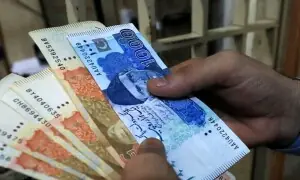
Put simply, Pakistanis now save just Rs6 out of every Rs100 they earn. Given that the country has spent much of the past three decades trapped in a cycle of economic crises, balance-of-payments emergencies and IMF bailouts, all against the backdrop of widening fiscal deficits, rising public expenditure and an ever-expanding external debt burden, the steady erosion of domestic savings should have set alarm bells ringing long ago.
Yet successive governments, through both action and inaction, have repeatedly demonstrated a limited understanding of the extent to which this critical pillar of economic resilience underpins investment, shields economies from external shocks and reduces dependence on debt-fuelled growth.
Domestic savings, in fact, are the foundation of sustainable capital formation in any economy as they can be channelled into productive investment, financing infrastructure, industry and innovation without excessive reliance on external borrowing. When this channel weakens, economies are inevitably forced into a position where growth hinges on the availability of external financing rather than being driven by domestic resources, and in effect remain vulnerable to global liquidity cycles. For Pakistan, the continued decline in savings has therefore meant not only reduced buffers against external shocks; it has also effectively narrowed the domestic space available for investment-led growth and weakened the economy’s capacity to build resilience from within.
It is pertinent to note that this low savings rate is both a reflection of constrained incomes as well as of distorted incentives that discourage formal saving.
As outlined by PIDE, around 94 percent of household earnings in Pakistan are absorbed by essentials such as food, housing, energy, transport and education, and what little is left is further eroded by inflation that has consistently outpaced returns on bank deposits. It is little surprise, then, that households increasingly shift towards cash holdings, gold, real estate and foreign currency as informal stores of value that are perceived to better preserve purchasing power in an unstable environment.
Crucially, this preference is reinforced by the tax regime applied to financial savings, including high withholding tax rates on interest income from bank deposits for tax filers and even steeper rates for non-filers.
As a result, net returns within the formal financial system are steadily compressed, shaping savings behaviour in ways that discourage participation in formal instruments and make them comparatively less attractive than informal alternatives.
PIDE’s call, then, for a decisive policy shift in the upcoming budget to arrest the erosion of domestic savings through a comprehensive National Savings Mobilisation Package must be given due consideration.
The proposals centre on widening access to formal saving and investment channels, including Sukuk, Shariah-compliant instruments, voluntary pension schemes, Takaful, regulated gold funds and digitised National Savings products, alongside simplified know-your-customer requirements to bring small-balance savers into the formal system.
Crucially, it has also urged the implementation of targeted tax incentives for long-term savings, stronger protections for small depositors, and dedicated measures for women, pensioners and informal sector workers to broaden participation.
Moreover, the think tank has called for establishing an annual savings mobilisation dashboard to track progress and ensure accountability in rebuilding the country’s savings base.
Such measures, however, are unlikely to move beyond the drawing board unless policymakers fully recognise the pivotal role domestic savings can play in building economic resilience and reducing Pakistan’s dependence on external financing. Time for action on this front is running out.
Copyright Business Recorder, 2026



















Comments