


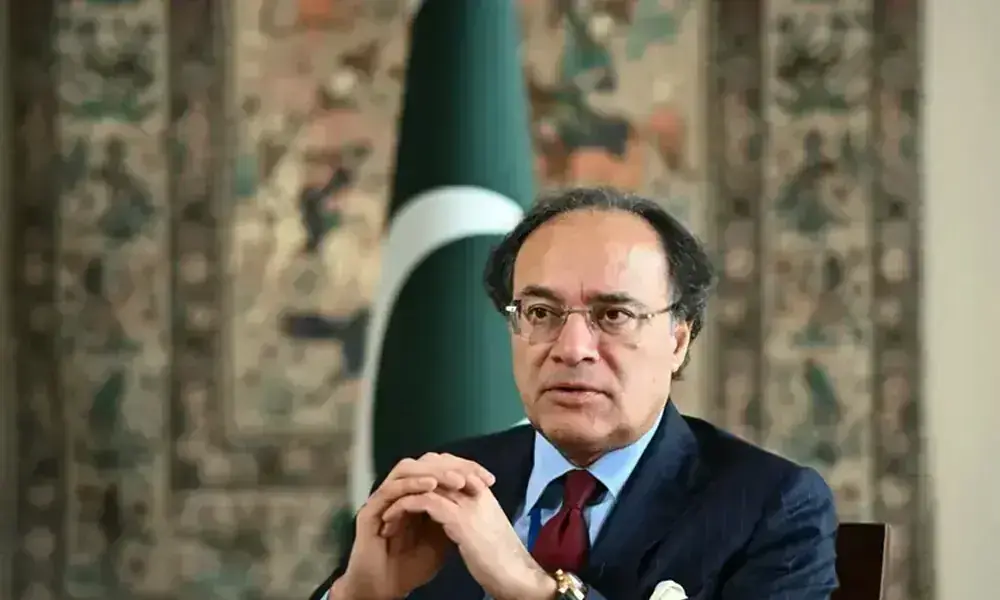

ISLAMABAD: Finance Minister Muhammad Aurangzeb on Monday acknowledged that Pakistan’s exports have remained largely stagnant over the past five years and indicated that the super tax would eventually be phased out. He warned that the existing business operating model has run its course and urged the industrial sector to adopt innovation, as the government works to create an enabling environment for export-led growth.
This he stated while briefing the Senate Standing Committee on Finance and Revenue, which continued its detailed examination of the Finance Bill 2026. The Senate body held its third consecutive session with Senator Saleem Mandviwallato conduct a clause-by-clause review of the Income Tax Ordinance, 2001, and deliberate on a wide range of fiscal, taxation, industrial, and revenue-related proposals.
Aurangzeb hinted that the government is working towards the gradual abolition of the super tax, reaffirming that efforts to remove it will continue each year. Committee members also voiced concern about the decline in Pakistan’s exports. Talha Mahmood argued that Pakistan’s tax burden and electricity tariffs are higher than those in neighbouring countries such as India and Bangladesh. According to him, these factors are making Pakistani exports less competitive in international markets. The minister also said that exports to Afghanistan were also affected. He urged changing the existing business model to boost production and exports by bringing innovation.
The committee also reviewed proposals relating to the super tax and broader taxation reforms. Aurangzeb briefed members on the government’s ongoing efforts to rationalize the tax structure and support economic activity. During the discussion, members examined proposals regarding exemption thresholds and their potential fiscal implications. The FBR informed the committee that increasing the exemption threshold from Rs500 million to Rs1 billion would require approximately Rs250-300 billion in additional tax measures to balance revenue losses. The committee approved a proposal to abolish the one percent withholding tax imposed on exporters.
The committee undertook an extensive clause-by-clause review of the Income Tax Ordinance, 2001, while examining key taxation measures, financial reform proposals, and amendments proposed under the Finance Bill 2026. The FBR officials briefed members on various provisions and responded to detailed queries regarding tax administration, revenue collection, and implementation mechanisms.
The committee held detailed deliberations on matters relating to the steel and manufacturing sectors, including proposals concerning taxation mechanisms, refund systems, and industrial facilitation measures. Representatives of the large-scale manufacturing sector apprised the committee of operational challenges being faced by the industry and shared data regarding electricity costs and sectoral composition. Members reviewed proposals aimed at ensuring a balanced and efficient framework that supports industrial growth while maintaining revenue objectives.
Mandviwalla emphasized the importance of evidence-based policymaking, institutional continuity, and effective implementation of tax reforms. The committee stressed the need for a comprehensive evaluation of taxation measures to ensure consistency, transparency, and long-term sustainability within the fiscal framework.
The committee received a detailed briefing on FBR’s digital monitoring initiatives designed to enhance documentation and improve compliance through technology-driven systems. Members were informed that digital monitoring mechanisms are being introduced for industrial units to facilitate transparent oversight and reduce administrative burdens. The committee reviewed proposals associated with the initiative and discussed implementation modalities.
Members also considered proposals relating to tax collection mechanisms in the steel sector, including options linked to electricity consumption data. The committee reviewed measures aimed at broadening the tax base, improving documentation, and facilitating the efficient processing of refunds. FBR officials informed the committee that approximately Rs55 billion in refunds are processed on a monthly basis and briefed members on efforts to further streamline the refund system.
The committee approved a proposal to tax the profit component of life insurance policies from Tax Year 2026. The principal amount will remain exempt from taxation. Insurance proceeds payable upon death, disability-related insurance benefits, and policies maturing after seven years will continue to enjoy tax exemption under the proposed framework.
The committee also endorsed the continuation of sales tax exemptions on property settlements following the death of parents. Members were informed that no sales tax would apply on property division or valuation adjustments carried out as part of inheritance settlements.
The committee further reviewed taxation proposals relating to mutual funds and Modarabas as part of broader efforts to ensure uniformity within the taxation framework. During discussions on the digital economy, members reviewed proposals concerning the taxation of income generated through social media and online platforms. The committee emphasized the importance of encouraging digital entrepreneurship, facilitating foreign exchange inflows, and ensuring an equitable taxation framework for emerging sectors of the economy.
The committee subsequently approved a proposal for a five percent withholding tax on specified categories of social media income. Under the approved proposal, annual income up to Rs600,000 will remain exempt, while a five percent withholding tax will apply to income between Rs600,000 and Rs1.2 million. The FBR officials told lawmakers that many individuals are earning substantial incomes through social media activities and digital content creation. “We want taxation on those earnings as well,” the FBR chairman informed the committee.
The committee heard representations from stakeholders of the auto import and automobile sectors regarding policy implementation, regulatory procedures, and trade facilitation measures. Members were briefed on matters relating to vehicle imports, inspection procedures, and sectoral challenges. Relevant officials informed the committee about ongoing consultations and policy developments aimed at supporting the sector and ensuring regulatory clarity.
The committee alleged that a case involving Rs1.5 billion had emerged and accused the Engineering Development Board of misusing its powers. He demanded the resignation of the industry secretary and warned that the matter could lead to serious legal consequences. “This is a straightforward case that could result in handcuffs,” he said.
The meeting was attended by Federal Finance Minister Muhammad Aurangzeb, Minister of State for Finance Bilal Azhar Kayani, Chairman Federal Board of Revenue (FBR) Rashid Mahmood Langrial, Senator Abdul Qadir, Senator Talha Mehmood, Senator Shazaib Durrani, Senator Anusha Rehman Ahmad Khan, Senator Faisal Vawda, Senator Syed Faisal Ali Subzwari, Senator Dilawar Khan, representatives of Pakistan Steel Mills, telecom sector stakeholders, large-scale manufacturing representatives, auto industry stakeholders and senior officials from the FBR and relevant ministries.
Copyright Business Recorder, 2026




















Comments