


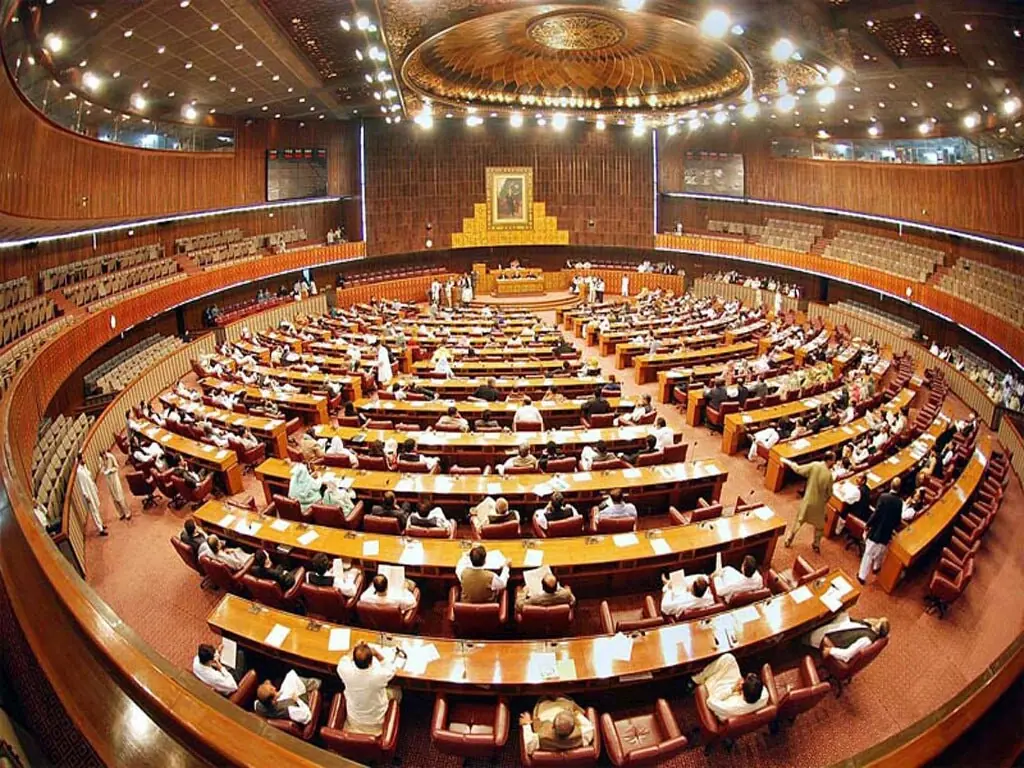

ISLAMABAD: In a heated National Assembly session on Sunday, the government’s claims of economic recovery were aggressively challenged by opposition lawmakers who dismissed the government claim of stabilisation of economy.
The discussion ostensibly focused on the federal budget for 2026-27, frequently veered into familiar political battlegrounds, with treasury and opposition members sparring over governance records, accountability cases and democratic norms. At several points, tempers flared, prompting noisy exchanges across the House.
Leading the opposition charge, senior PTI leader and ex-National Assembly speaker Asad Qaiser challenged the government’s portrayal of an economy on the mend, arguing that official claims stood in stark contrast to the hardships being experienced by citizens.
Questioning the government’s narrative of recovery, the PTI leader demanded a comprehensive parliamentary debate on the country’s mounting debt burden and asked lawmakers to examine how much debt had been inherited by the current administration, and how much had been accumulated during its tenure.
Turning to the agriculture sector, Qaiser painted a grim picture of the plight of wheat farmers in Punjab, accusing the government of pursuing policies that had compounded the difficulties of growers already grappling with escalating production costs.
He claimed that investment had declined, many multinational firms had exited the country and unemployment had increased despite official claims of economic improvement. “What practical relief has reached the people,” Qaiser asked, contending that economic challenges could not be addressed without political stability, transparent governance and public trust in state institutions.
Reaffirming PTI’s support for judicial independence and parliamentary supremacy, Qaiser said his party remained open to dialogue on a charter of economy and called for an election commission acceptable to all political stakeholders.
Drawing attention to issues in his constituency, he said nearly 70 per cent of Pakistan’s tobacco production came from his province, yet growers continued to struggle.
He also highlighted prolonged power outages in areas surrounding Tarbela Dam, saying residents remained subjected to load-shedding despite living near one of the country’s most important power-generating facilities.
His remarks provoked an immediate response from treasury benches, particularly Planning Minister Ahsan Iqbal, triggering heated exchanges and brief disorder in the House.
Responding forcefully, Iqbal accused the opposition of relying on political rhetoric rather than facts and sought to turn the spotlight back on PTI’s own record in government.
The minister alleged that democratic norms had suffered during the PTI administration and claimed opposition members at the time had repeatedly struggled to obtain production orders for detained parliamentarians.
He also accused the former government of weaponising accountability institutions against political opponents, recalling that several senior PML-N leaders – including Nawaz Sharif, Prime Minister Shehbaz Sharif, Maryam Nawaz, Khawaja Asif, Saad Rafique, Hamza Shehbaz and Rana Sanaullah – had spent time behind bars.
In a pointed rebuttal to Qaiser’s criticism, Iqbal cited federal development initiatives in Swabi and noted that a university had been established there, adding that he had personally laid its foundation stone.
Another PTI lawmaker, Shahid Khattak, shifted attention to household finances, saying soaring electricity and gas bills had made daily life increasingly difficult for households. He argued that indirect taxation had sharply increased fuel prices and added to pressure on consumers.
Khattak also accused the government of politically targeting PTI workers and alleged that the party’s founding chairman was being denied access to his personal physician while in custody.
He maintained that sustainable economic activity and tourism could not flourish without peace and stability and highlighted the difficulties faced by low-income households amid inflation and rising petroleum prices.
PTI’s Amir Dogar called for an immediate reduction in the petroleum levy, arguing that consumers deserved direct relief instead of promises of future benefits.
JUI-F lawmaker Shahida Begum pressed for a reduction in the general sales tax, saying the burden of indirect taxation was falling disproportionately on poorer segments of society.
PPP MNA Sharmila Faruqui delivered one of the sharpest critiques from the government’s ally benches, arguing that the budget appeared more responsive to affluent groups than to citizens struggling with the rising cost of living.
Questioning official poverty calculations, she said they bore little resemblance to realities faced by ordinary people.
Citing the price of a Samosa in Islamabad at around Rs50, she mocked official estimates suggesting an individual could meet daily needs with Rs32.
She further argued that the electricity and petroleum prices remained higher than those of several neighbouring countries despite repeated assurances of economic improvement.
Looking beyond the immediate budget cycle, Faruqui warned that the country’s population could reach 390 million by 2050, potentially creating severe social and economic pressures in the absence of serious long-term planning.
As criticism mounted from opposition benches, Information Minister Attaullah Tarar mounted a robust defence of the government’s economic record and, in a pointed appeal across the aisle, urged the opposition to come on board and sign a charter of economy to steer the country’s economy “once and for all.”
Citing official figures, he said inflation had fallen to single digits, the policy rate had dropped from more than 22pc to 11pc, foreign exchange reserves had increased to USD 17.2 billion and gross domestic product growth had reached 3.7pc.
He also pointed to record remittance inflows, growth in information technology exports and improvements in fiscal indicators as evidence that the economy was showing signs of improvement.
Defending the government’s revenue strategy, Tarar said reforms within the Federal Board of Revenue (FBR) had strengthened transparency and enforcement, enabling authorities to recover billions of rupees through administrative measures and action against tax evasion.
As the debate drew on, members from both sides remained deeply divided over the budget’s direction.
Opposition members dismissed it as “IMF-dictated”, “pro-industrialist” and “anti-poor”, arguing that it offered little relief to struggling households.
Treasury members, meanwhile, hailed it as evidence of economic recovery and credited Prime Minister Shehbaz Sharif and his economic team, led by Finance Minister Muhammad Aurangzeb, for steering the country towards stability.
Copyright Business Recorder, 2026




















Comments