


Post-budget presser: Aurangzeb defends 'pro-growth' measures, says in 'constant consultation' with the IMF
- Aurangzeb on Friday unveiled a Rs18.77 trillion federal budget for fiscal year 2026-27

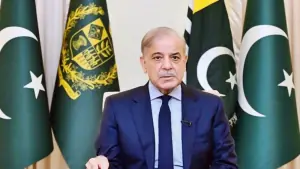
Finance Minister Muhammad Aurangzeb on Saturday defended the FY26-27 budget while addressing the concerns of stakeholders regarding the budget presented before the National Assembly (NA) a day ago.
Addressing media persons, Aurangzeb said the budget used available fiscal space to support growth and would play a ‘pivotal role’ in achieving economic growth.
“In this budget we have tried to bring all enabling factors to achieve export-led growth,” said Aurangzeb, citing measures such as abolition of advance tax and super tax.
The government proposed the complete abolition of the super tax across six income slabs. For incomes exceeding Rs500 million annually, the super tax rate has been proposed to be reduced from 10% to 8%.
ME crisis to have spillover effect
On the ongoing geopolitical tensions in the region and its impact on the national economy, the finance minister said that the government has so far been effective in managing the situation.
“We hope that this conflict ends sooner than later. However, as the energy infrastructure has been hit and it will have a spillover effect into the next fiscal year,” he said.
Talks with IMF continue
Aurangzeb said Pakistan remains in constant consultation with the International Monetary Fund (IMF) as the country is under a Fund programme.
“We are moving ahead with IMF consultations”.
On tax targets, the finance minister said the government remains focused on enforcement, compliance and plugging leakages.
Responding to a query, the finance minister said there was no discussion on imposing taxes on solar panels. “It was never part of the discussion,” he said.
To a query, Aurangzeb said that the government would talk with the private sector to impose the minimum wage. The government proposed a 10% increase in the minimum monthly wage, raising it from Rs37,000 to Rs40,700.
Buffers to mitigate external shocks
Talking about external shocks, Aurangzeb said that the only way to deal with exogenous shocks is by building buffers. “This is the role of a responsible government,” he said.
Talking about tariffs, the finance minister noted that the government was in the second year of the five-year plan “in bringing the cost down for intermediate goods and raw materials”.
Agriculture remains a key
Let me also touch upon agriculture. Agricultural credit and financing have increased by approximately 15% year-on-year and have now exceeded Rs2 trillion, he said.
“More importantly, we introduced the Zar Khaiz Scheme during this fiscal year. This is a very important initiative. One of the reasons commission agents gained such influence over the agricultural sector, particularly over small farmers, is that banks were not stepping up to provide adequate financing,” he said.
“Agriculture remains one of the key pillars of our growth strategy going forward,” he added.
The finance minister said that the government remains focused on reducing the trade deficit involving goods. “But the services are becoming more important as we go forward, especially the IT sector.”
He said that the government decision to reduce income tax on various income slabs has been ‘well-received’.
Under the budgetary proposals, tax rate for individuals earning between Rs2.2 million and Rs3.2 million annually has been proposed to be reduced from 23% to 20%.
The tax rate for those earning between Rs3.2 million and Rs4.1 million annually has been proposed to be reduced from 30% to 25%. The tax rate for individuals earning between Rs5.6 million and Rs7 million annually has been proposed to be reduced from 35% to 32%.
Aurangzeb said that the government intends to automate the taxation system, using artificial intelligence (AI), in order to reduce human intervention.
Meanwhile, Minister of State for Finance Bilal Azhar Kayani, sitting alongside the finance minister, termed it a ‘people-friendly budget’, citing measures for salaried class, industrialist, exporter and construction sector.
Similarly, Minister of Information and Broadcasting Attaullah Tarar termed it a ‘relief oriented’ budget, providing a way forward to economic growth.
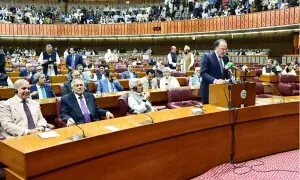
Aurangzeb on Friday unveiled a Rs18.77 trillion federal budget for fiscal year 2026-27, extending relief to the salaried class and tax incentives to exporters, real estate, and construction sectors to revive industry, promote investment, and steer the economy towards a 4% growth target.
Despite facing an estimated revenue shortfall of around Rs1 trillion in the outgoing fiscal year, the government has set an ambitious revenue target of Rs15.264 trillion for FY2026-27.
Against the revised revenue estimate of Rs12.983 trillion for the current fiscal year, the target reflects a robust 17.6% growth in revenue collection for the next year.
Out of the total budget outlay, Rs8,045 billion would be set aside for markup payment, Aurangzeb said in his budget speech.
The finance minister said the economy was expected to grow 4 percent in 2026-27, and average inflation was expected to be recorded at 8.2 percent. He added that the fiscal deficit to GDP would be 3.6 percent of GDP (or Rs5.226 trillion) while the primary surplus would be 2 percent, as it seeks to keep the shortfall within the limit under the International Monetary Fund-mandated fiscal discipline.
More to follow


















Comments