


Budget FY27: Govt tries to make sure IMF stays in good humour
- Rs18.77trn budget presented • Rs7.02trn fiscal deficit targeted • Development expenditure squeezed • Tax collection target raised to Rs15.26trn • 4pc economic growth rate set • Defence spending up 18pc • Agriculture, retail and real estate sectors still remain unscathed from due taxation
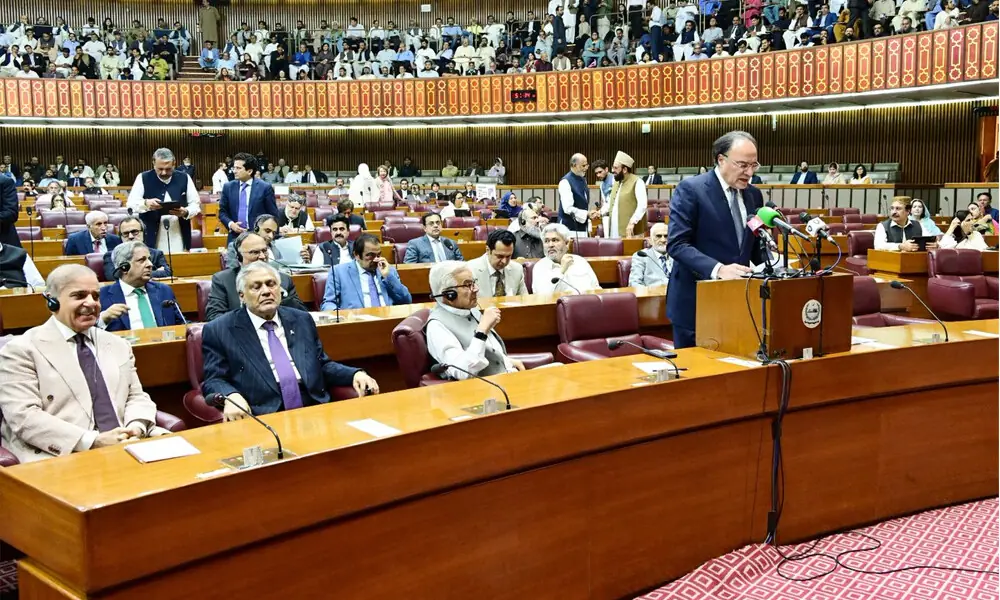

ISLAMABAD: Finance Minister Muhammad Aurangzeb on Friday unveiled a Rs18.77 trillion federal budget for fiscal year 2026-27, extending relief to the salaried class and tax incentives to exporters, real estate, and construction sectors to revive industry, promote investment, and steer the economy towards a 4 percent growth target.
Despite facing an estimated revenue shortfall of around Rs1 trillion in the outgoing fiscal year, the government has set an ambitious revenue target of Rs15.264 trillion for FY2026-27. Against the revised revenue estimate of Rs12.983 trillion for the current fiscal year, the target reflects a robust 17.6 percent growth in revenue collection for the next year.
The budget has an outlay of Rs18.8 trillion, of which Rs8,045 billion would be set aside for markup payment, Aurangzeb said in his budget speech.
READ MORE: FY26 growth target missed on 2025 floods, ME conflict, Trump tariffs
The finance minister said the economy was expected to grow 4 percent in 2026-27, and average inflation was expected to be recorded at 8.2 percent. He added that the fiscal deficit to GDP would be 3.6 percent of GDP (or Rs5.226 trillion) while the primary surplus would be 2 percent, as it seeks to keep the shortfall within the limit under the International Monetary Fund-mandated fiscal discipline.
Aurangzeb told the National Assembly while presenting its third budget, saying, “This is not just a budget of numbers; this is a budget of transformation.” “We have moved from a fragile economy to one where Fitch, Moody’s, and S&P have upgraded Pakistan’s credit rating. Today, the world seeks our strategic partnership, not our sympathy.”
To stay on track with the IMF’s targets, the government has set a primary surplus of Rs2.83 trillion, or 2.0 percent of GDP, marking the fourth consecutive year of surplus - a key IMF benchmark.
The overall countrywide fiscal deficit is expected to be 3.6 percent of GDP, up from the revised 3 percent for fiscal year 2026. This is contingent on provinces generating a surplus of Rs1.794 trillion — a steep jump from Rs1.46 trillion this fiscal year and revised Rs 1,379 billion.
The minister also announced that the provincial share under the National Finance Commission (NFC) Award would remain unchanged. To provide relief to the salaried class, the government has proposed that the salaries of government employees are likely to be increased by 7 percent. Pensions are also proposed to be increased by 7 percent, while the minimum monthly wage is proposed to be increased by 10 percent.
The Finance Minister proposed tax relief for salaried individuals, while saying that the tax rate for individuals earning between Rs2.2 million and Rs3.2 million annually has been proposed to be reduced from 23 percent to 20 percent.
The tax rate for those earning between Rs3.2 million and Rs4.1 million annually has been proposed to be reduced from 30 percent to 25 percent. The tax rate for individuals earning between Rs5.6 million and Rs7 million annually has been proposed to be reduced from 35 percent to 32 percent.
The government has also proposed to abolish the income surcharge imposed on the salaried class.
The government has also proposed the complete abolition of the super tax across six income slabs. Previously, individuals earning between Rs150 million and Rs500 million annually were subject to a super tax ranging from 1 percent to 7.5 percent. For incomes exceeding Rs500 million annually, the super tax rate has been proposed to be reduced from 10 percent to 8 percent.
However, for banks, oil and gas exploration companies, and fertilizer companies, the surcharge would remain in place.
In addition, the government has reduced income tax and withholding tax on property transfers and announced incentives for the construction sector to encourage investment and growth. The government has announced a significant reduction in property transaction taxes for tax filers.
The tax rate on the sale of property for filers has been proposed to be reduced from 5.5 percent to 2.75 percent. The tax rate on the purchase of property for filers has been proposed to be reduced from 2.5 percent to 1.25 percent, intending to encourage investment in the real estate sector and promote documented economic activity.
The government believes these incentives will stimulate construction activity, generate economic growth, and create employment opportunities across the country.
To promote the growth of Pakistan’s IT industry, the government has extended the concessionary tax rate of 0.25 percent on IT export earnings for another three years. According to the budget speech, this relief will remain in place until June 30, 2029, and is expected to boost IT exports and strengthen the country’s digital economy.
The government also announced additional relief measures for the export sector in the new budget. Export tax was reduced from 2 percent to 1.25 percent, and the Export Development Surcharge was abolished. He added that the government is also considering removing the super tax on exporters.
In addition, withholding tax on international transactions made through debit and credit cards has been proposed to be reduced. The tax rate on such transactions has been proposed to be cut from 5 percent to 0.5 percent.
Proposal also made to abolish the Capital Value Tax (CVT) on holding foreign assets. The finance minister said the new measures are aimed at encouraging Pakistanis to declare and bring their foreign financial assets into the formal economy.
The finance minister announced the abolition of taxes on essential women’s healthcare products as part of the government’s relief measures in Budget 2026-27. The government has also proposed to abolish the tax on contraceptives.
Aurangzeb announced a fixed tax scheme for small shopkeepers and traders aimed at simplifying tax compliance and encouraging documentation of the economy.
Under the scheme, FBR officials will not be allowed to enter shops for questioning or inspections related to the scheme. A verification QR code will be displayed on the shop’s plaque, while eligible traders will be issued a special green plaque as proof of participation.
Small traders will be exempt from installing Point of Sale (POS) machines. Traders covered under the scheme will not be treated as withholding agents. Beneficiaries of the scheme will not be subject to tax audits. A minimum fee of Rs25,000 must be deposited when filing the annual tax return.
The business community will be allowed to adjust withholding tax payments against their tax liability. Eligible traders will pay a fixed tax of 1% of their annual sales. The scheme will apply to traders with an annual turnover of up to Rs200 million.
The government has decided to expand the scope of the Third Schedule of Sales Tax and broaden the scope of purchases from unregistered persons. A National Faceless Centre and Assessment System has also been introduced.
Under the new system, there will be no direct contact between taxpayers and tax officers, helping improve transparency and reduce discretionary interactions. The scope of production monitoring and digital invoicing has also been expanded to strengthen tax compliance and documentation.
The budget has proposed the imposition of a Federal Excise Duty of Rs80 per litre on white spirit and mineral turpentine oil. According to the budget speech, these products are commonly used for fuel adulteration. The tax has been imposed to protect millions of consumers from damage to their vehicles and machinery.
The government has also introduced new taxes on imported SUVs with engine capacities above 2,000cc and up to 3,000cc. In addition, duties on vehicles with engine capacities exceeding 3,000cc will be increased.
The government has abolished the Federal Excise Duty (FED) on international travel in business class, providing relief to travelers and the aviation sector.
The government has proposed to present a new auto sector policy in Parliament shortly after cabinet approval. The policy is expected to outline the future direction of Pakistan’s automobile industry, with a particular focus on electric vehicles and sustainable transportation.
The government has decided to maintain the concessional tax regime for Electric motorcycles, Electric rickshaws, Electric cars, and Electric buses. In addition, a proposal has been made to offer a reduced sales tax rate of 1% on imported electric trucks.
However, the finance minister clarified that luxury electric vehicles will not be eligible for these concessions and incentives.
The government has decided to abolish taxes imposed on the local production of medicines used to treat cancer and other serious diseases. The measure is intended to support domestic pharmaceutical manufacturers and improve the affordability of essential medicines for patients.
To reduce production costs and support industrial growth, the government has decided to eliminate customs duty on more than 100 categories of raw materials. The initiative is expected to lower manufacturing costs, improve competitiveness, and encourage investment across various sectors of the economy.
He said substantial allocations had been made for the newly merged districts of Khyber-Pakhtunkhwa, Gilgit-Baltistan and Azad Jammu and Kashmir.
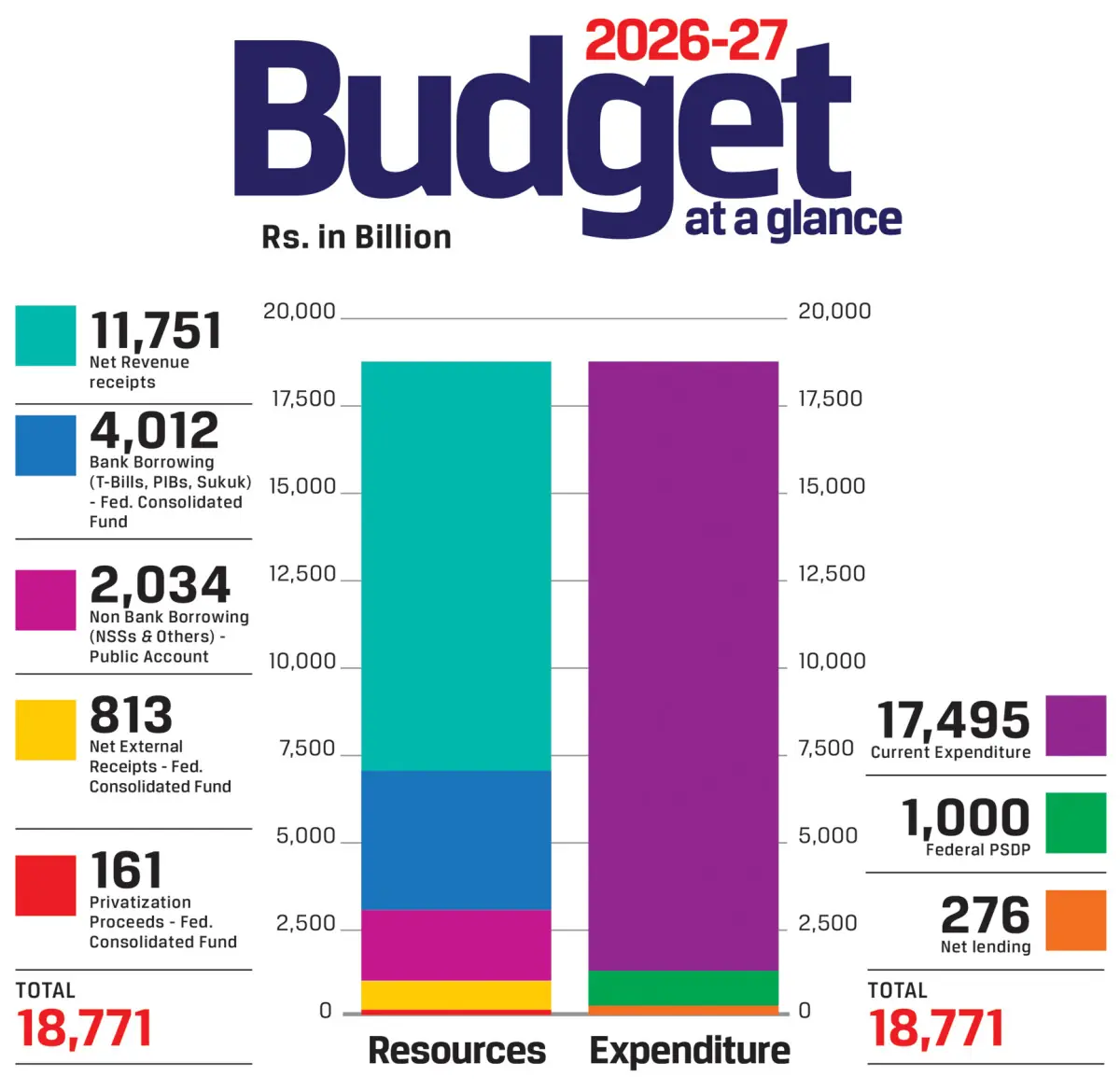
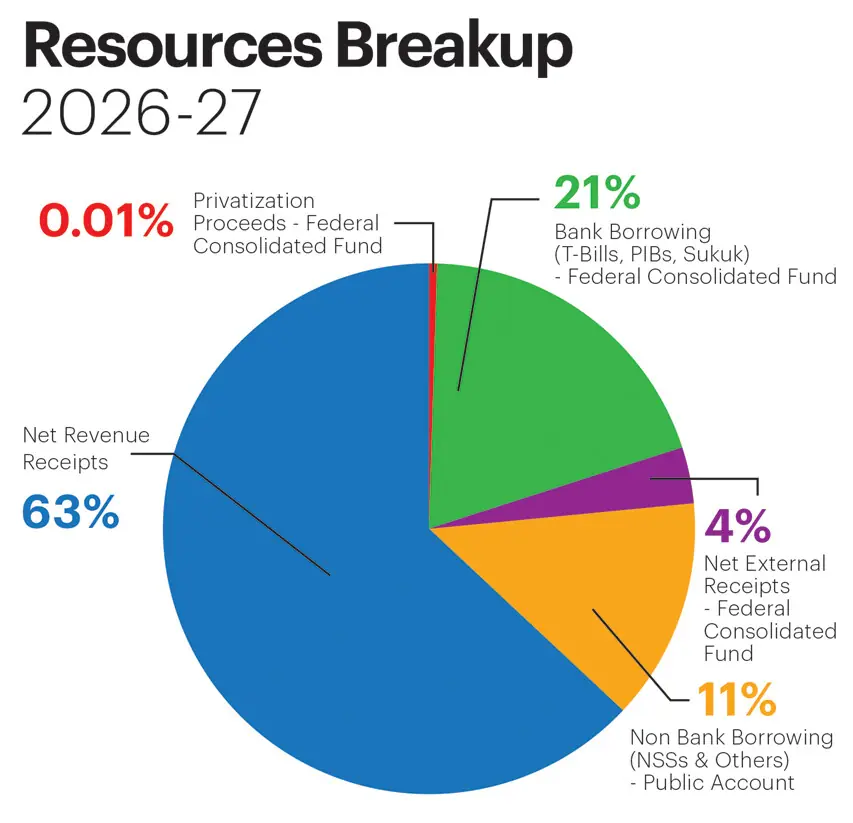
Key fiscal and economic targets for 2026-27 include: Non-tax revenue is projected to increase to Rs5,336 billion. Rupees 8,848 billion will be transferred to the provinces under the National Finance Commission (NFC) Award. The federal government’s net revenue is estimated at Rs11,751 billion. The total federal expenditure has been budgeted at Rs18,771 billion.
The federal budget deficit is projected to remain at Rs7,020 billion. The government has set a provincial surplus target of Rs1,794 billion. The overall fiscal deficit is targeted at Rs5,226 billion, equivalent to 3.6% of GDP. A primary surplus of Rs2,828 billion, or 2% of GDP, has been projected. The government has set a GDP target of Rs143,604 billion for the fiscal year 2026-27.
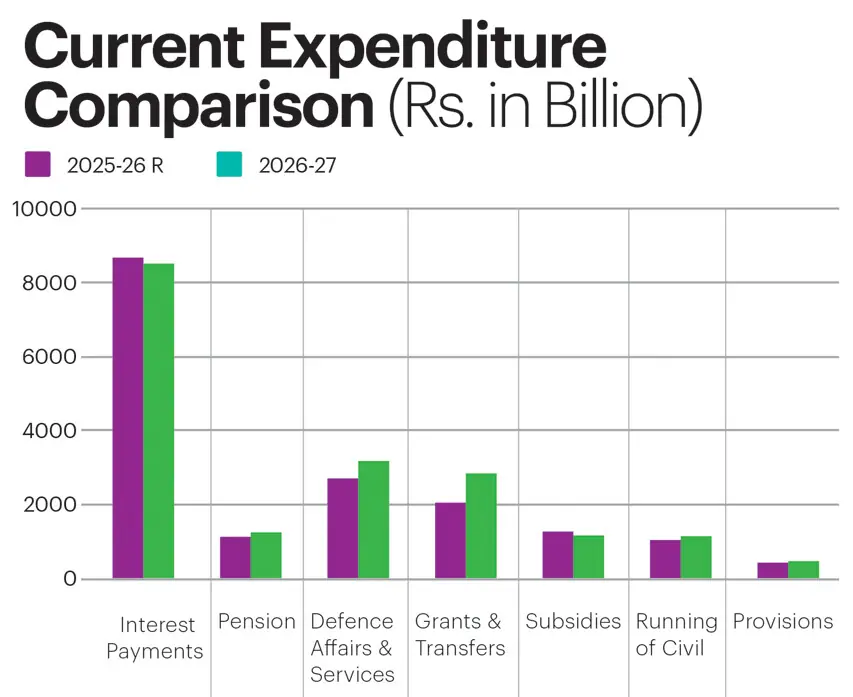
The government has allocated Rs3,000 billion for defence in Budget 2026-27. This is an increase of Rs450 billion from the FY2025-26 allocation of Rs2.55 trillion. A total of Rs1,000 billion has been earmarked for development projects. The budget document shows that Rs17,495 billion will be spent on ongoing expenses in the next fiscal year.
Debt servicing remains one of the largest expenditure heads, with Rs8,054 billion allocated for interest payments on loans. The government has allocated Rs1,169 billion for pension payments. Another Rs1,071 billion has been set aside for running the civil government.
The federal budget also includes Rs430 billion for emergency measures in the new fiscal year. The allocation is expected to support the government’s response to urgent national needs during 2026-27.
According to the budget documents, a total of Rs8,848.49 billion has been allocated for transfers from the federal government to the provinces in fiscal year 2026-27. The government has proposed keeping the size of the divisible pool taxes for provinces at Rs8,635.21 billion, while Rs213.27 billion will be transferred through straight transfers.
The provincial share of federal taxes and revenues includes: Rs4,246.43 billion from income tax, Rs2,815.06 billion from sales tax, Rs946.77 billion from customs duties, Rs611.69 billion from Federal Excise Duty (FED), Rs69.39 billion from the Gas Development Surcharge (GDS), Rs93.10 billion from natural gas royalty, Rs44.59 billion from crude oil royalty.
Punjab will receive the largest share under the NFC Award, with an allocation of Rs4,402.83 billion. Other provincial allocations include: Sindh: Rs2,207.18 billion, Khyber Pakhtunkhwa: Rs1,443.34 billion, including the additional 1% share for counter-terrorism, Balochistan: Rs795.13 billion.
He added that the government was introducing a direct subsidy model aimed at improving targeting and efficiency in the power sector. “We are introducing a direct subsidy model… There is no increase in circular debt this year,” he said.
Aurangzeb said a nationwide exercise would be carried out to identify, register and verify all subsidised consumers, enabling the launch of a Direct Subsidy Mechanism from January 2027. “This is the same equitable model that we adopted through BISP,” he said. The finance minister said Pakistan had renegotiated LNG agreements with Qatar and Italy, resulting in a reduction of 35 cargoes for 2026 and saving around USD1.2 billion in foreign exchange.
He said an uninterrupted gas supply had been ensured to fertiliser plants across the country.
“We did not let fertiliser production halt even for a single moment,” he said, adding that supply had been maintained to 10 fertiliser factories. Aurangzeb said around 100 MMCFD of additional gas had been injected into the system since March 2024, while discoveries from 17 oil and gas reserves were yielding 108 MMCFD of gas and 16,000 barrels of additional oil.
“The priority of the budget is to increase productivity and exports, so our exporters can compete effectively in international markets,” he said.
Aurangzeb said the Export Development Surcharge on export income had been abolished, while the Export Finance Scheme mark-up rate had been reduced from 19 per cent to 4.5 per cent.
He said the only way forward was a strong private-sector-led growth model that generates jobs and investment. The finance minister said 6,860 acres of Pakistan Steel Mills land would be activated as a Special Economic Zone to promote industrialisation, attract investment, and create employment opportunities.
Aurangzeb said Rs71 billion has been allocated for the Prime Minister’s Apna Ghar housing scheme, under which low-cost housing loans are provided at a subsidised mark-up rate. He also recommended extending tax exemptions for residents of the former FATA and PATA regions.
Rs365 billion has been allocated for highways, railways, and ports projects to improve connectivity. He said work on the Karachi–Rohri section of the ML-1 railway line will start next year. Rs116.2billion has been allocated for sustainable and affordable energy.
Rupees 1,071 billion has been allocated for civil administration expenditures. Rs1,169billion has been allocated for pension expenses. Rupees s2,680billion has been allocated for grants. An additional Rs103 billion allocation was also mentioned under grants. Rs54 billion has been allocated for low-cost housing to support the construction of affordable homes.
Under Daanish Schools, Rs22billion has been earmarked to provide education to deserving and deprived students. The finance minister said floods caused losses of Rs822billion this year.
He said Pakistan faces serious water challenges, including a lack of storage capacity, declining reservoir efficiency, and climate-change-induced flood risks, requiring urgent investment in dams and reservoirs.
The finance minister said the area of taxation covers tax relief, tax rationalisation, and broader FBR reforms.
He said Rs3,695 billion has been allocated for the National Development Programme for the next fiscal year. He added that Rs365 billion has been allocated for transport infrastructure, while Rs157.5billion has been set aside for the construction and improvement of highways.
The finance minister announced that tax relief will remain in place for e-bikes and e-rickshaws.
He further said the government is removing customs duty on raw materials for more than 100 medicines for cancer and other critical ailments.
The finance minister said the country’s defence sector had become a source of foreign exchange earnings. “It is proof that strong defence is not just important for the country’s sovereignty but could also contribute to economic progress.”
“This defence capability has reshaped our strategic partnerships not just in the region but in the world,” he said, mentioning a defence pact signed between Pakistan and Saudi Arabia last year.
Aurangzeb said Pakistan and Saudi Arabia have reached a defence agreement, which marks a strategic partnership. Aurangzeb said Pakistan-China relations remained an important pillar of the economy. “Pakistan’s image has improved significantly, and its voice is being heard internationally,” he said.
He said last year’s defence pact had laid a new foundation of Pakistan-Saudi ties, crediting Prime Minister Shehbaz Sharif and Chief of Defence Forces and Chief of Army Staff Field Marshal AsimMunir for it.
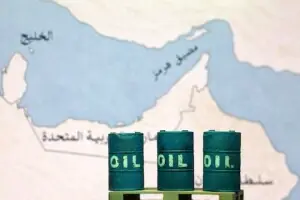
The finance minister also elaborated on Pakistan’s efforts for peace between the US and Iran. “Pakistan’s efforts are directed towards establishing long-term peace in the region through an agreement and restoring the transit of oil through the Strait of Hormuz,” he said.
Aurangzeb said Pakistan had “complete support” of China in these efforts, further highlighting the importance of ties between Islamabad and Beijing.
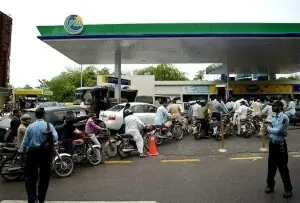
“Pak-China relations are an important part of our foreign policy. China is Pakistan’s most important trading partner,” he said. Turning his attention to oil prices, he mentioned the US-Israeli war on Iran and noted that petrol and diesel had skyrocketed globally after the conflict. He said that, however, local prices in Pakistan did not fully reflect this rise in prices. “Had the government passed on the entire burden to the people, the local prices would have been much higher,” he said, saying that the government has given people relief through subsidies of Rs128 billion.
Copyright Business Recorder, 2026
















Comments