


Inflation: Wholesale Price Index has unfinished business
Wholesale inflation, primarily driven by surging fuel prices, remains elevated and is expected to further impact consumer prices as increases transmit through the supply chain.
- Significant impact of fuel prices on wholesale inflation.
- Lagging transmission of wholesale price hikes to consumer prices.
- Potential future impact on food and manufactured goods.


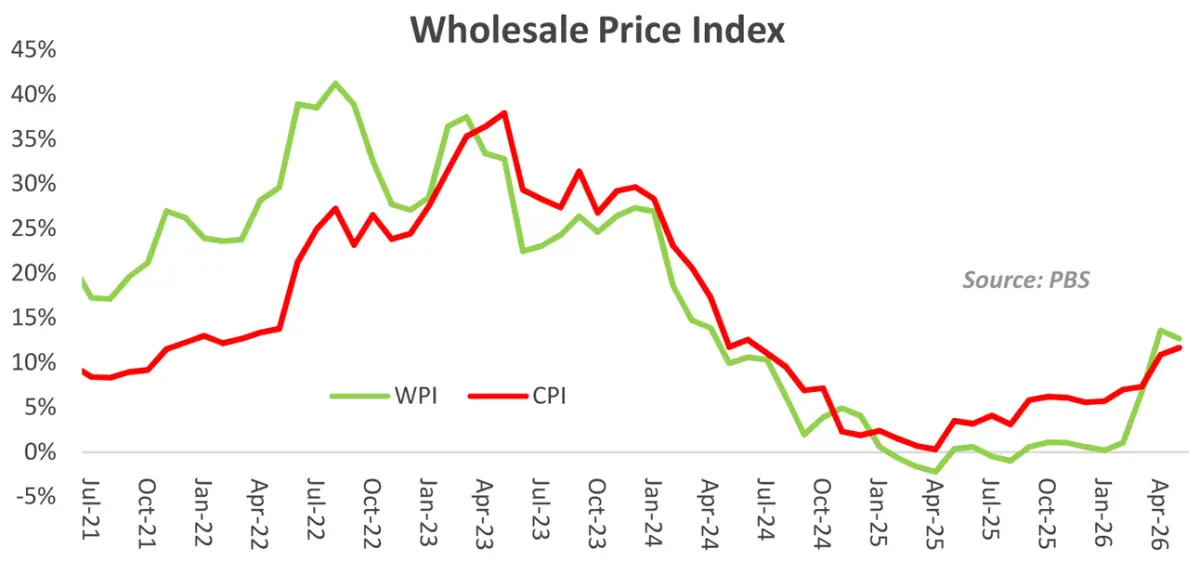
It is not quite a repeat of the 2022 commodity supercycle, nowhere close, but inflationary pressures are beginning to build on the wholesale front. The fuel price shock sits at the heart of the recent surge in the Wholesale Price Index (WPI), and the second-round effects are now becoming increasingly visible in core CPI inflation. It was a trend that looked inevitable when WPI first entered double-digit territory (see: WPI prints the next CPI story, April 9, 2026).
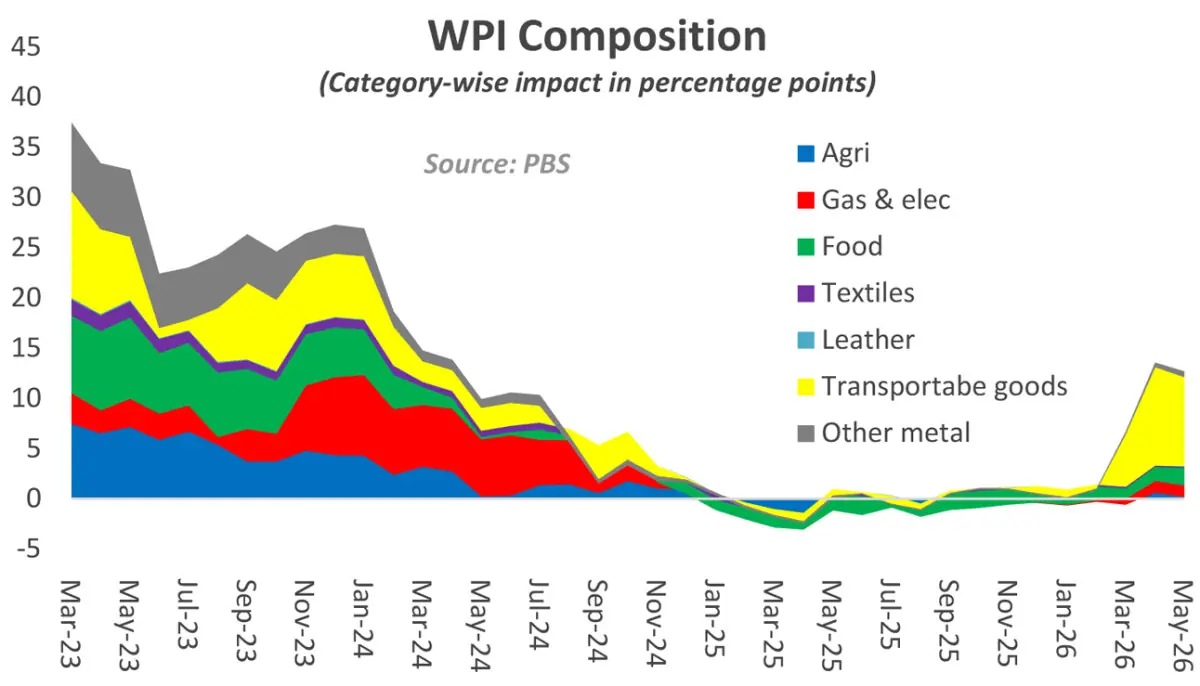
Although WPI eased slightly from last month, it remains elevated at nearly 13 percent year-on-year. Unsurprisingly, transportable goods continue to drive the increase, having risen by an average 38 percent over the past two months.
High-speed diesel, petrol, kerosene oil, mobil oil and furnace oil together account for roughly 11 percent of the WPI basket, compared to just 2.9 percent and 2.5 percent in the urban and rural CPI baskets, respectively.
Diesel alone carries a weight of 5.5 percent in WPI, followed by furnace oil at 3.3 percent and petrol at 1.6 percent. Their prices have risen 70 percent, 44 percent and 62 percent year-on-year, respectively.
The on-again, off-again nature of the US-Iran conflict, coupled with recent developments, suggests the oil market may not yet be out of the woods. That matters because fuel price transmission to retail inflation tends to be swift, and the impact is already evident in CPI readings.
The next phase of inflation transmission is likely to emerge from a broader range of transportable goods and manufactured products. Prices of soaps and detergents, chemicals, construction materials, apparel and plastic products have all been steadily climbing in the WPI. Unlike motor fuels, the pass-through to retail prices in these categories tends to occur with a lag.
Some evidence of this is already visible. Footwear prices, for instance, have risen 29 percent month-on-month in CPI, but corresponding WPI inflation stands at 51 percent, suggesting additional retail price adjustments may still be in the pipeline. Appliances and vehicles have also recorded sharp increases, with some registering the highest monthly gains on record. It would be surprising if these pressures do not eventually find their way into consumer inflation.
Food inflation, meanwhile, has remained relatively contained, barring wheat, thanks largely to favourable crop outcomes. But even that resilience faces a test. Everything ultimately needs to be transported, and wholesalers cannot indefinitely absorb higher logistics costs. So far, they largely have.
Adding to the uncertainty is the growing likelihood of a strong El Niño event. If weather patterns deteriorate, the inflation outlook could take on a very different complexion, particularly for food prices. That, however, is a story for another day, hopefully not one that catches policymakers off guard.
The inflation narrative would be incomplete without mentioning persistent anomalies in the WPI itself. Questions remain over the PBS’s treatment of industrial electricity tariffs, where the index appears to overstate costs by failing to fully capture downward revisions implemented earlier in the year.
More puzzling still is the treatment of cotton yarn prices, which have remained unchanged in the WPI for 55 consecutive months. That belongs more in the category of things that never happened than in an inflation index. Market evidence overwhelmingly suggests that yarn prices have experienced frequent and often significant fluctuations over this period, none of which appear to have found their way into the official series.
These shortcomings do not fundamentally alter the broader message coming from wholesale inflation. If anything, they merely cloud the precision of the signal. The signal itself remains clear enough: a substantial portion of the recent increase in wholesale prices has yet to complete its journey through the supply chain. As things stand, CPI inflation may still have some catching up to do.























Comments