


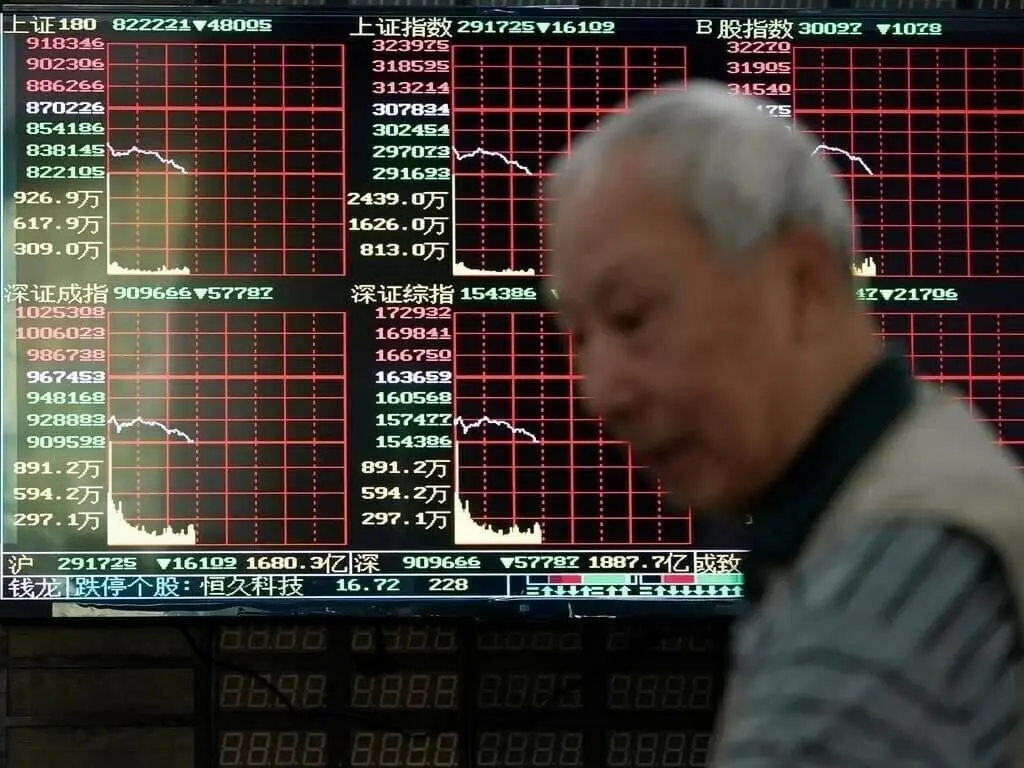

HONG KONG: China stocks weakened to their lowest levels in six weeks on Monday, dragged down by the tech sector, after lukewarm factory data added to concerns about slowing growth momentum.
The Shanghai Composite index lost as much as 0.6 percent to hit its lowest point since April 17, before dropping 0.3 percent to 4,057.74 at market close.
China’s blue-chip CSI300 index was down 1 percent.
Tech sectors led the decline, with the CSI AI Index down 2.5 percent and the CSI Semiconductor Index dropping 5.8 percent to a two-week low. The Star 50 Index slipped 5 percent to a three-week low.
Wu Zhou, fund manager at Shenzhen Deyuan Investment, attributed the tech stock dropoff to the sector’s outsized gains, overcrowded trades and news that state semiconductor funds were reducing their stakes.
“The biggest negative is simply that prices have risen too much,” Wu said. “Positions are heavily concentrated in chipmaking and AI, and any signs of selling would trigger a stampede,” he said, estimating that the top 5 percent most-traded stocks account for nearly 50 percent of total market turnover.
China’s factory activity stalled in May as new export orders contracted and input costs kept rising, an official survey showed on Sunday. A private survey on Monday showed the manufacturing sector expanded at a slower pace last month.
Lukewarm economic readings did little to lift sentiment, with investors potentially taking profits from tech after a recent rally and squaring positions ahead of some highly anticipated chip IPOs like ChangXin Memory Technologies (CXMT), said Kenny Ng, securities strategist at Everbright Securities International.
In Hong Kong, the benchmark Hang Seng Index was up 0.9 percent at 25,398.18 and the Hang Seng Tech Index added 1.7 percent after briefly hitting a two-week high earlier in the session.
Around the region, MSCI’s Asia ex-Japan stock index was firmer by 1.4 percent. Japan’s Nikkei index hit a fresh record high on an artificial intelligence boost.
Elsewhere, China’s planned rebalancing of indexes is expected to trigger an estimated USD48 billion in two-way passive investment flows, according to Goldman Sachs, as major indexes undergo semi-annual adjustments later this month.

























Comments