


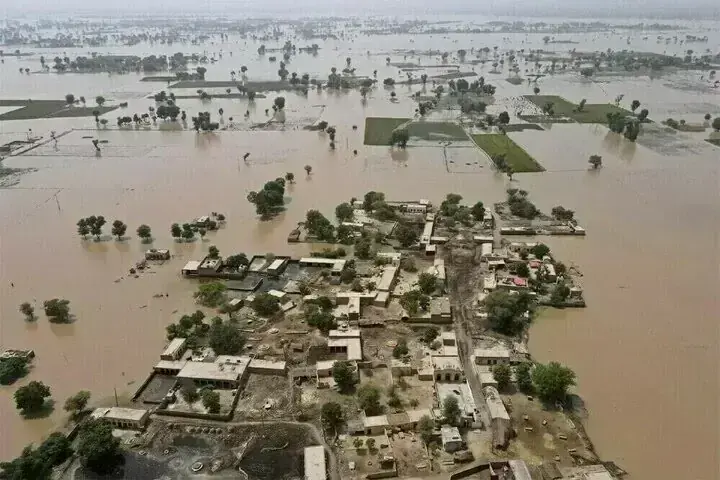

ISLAMABAD: International Monetary Fund (IMF) has warned that Pakistan remains highly exposed to climate shocks, including recurrent floods, intensifying heatwaves, and accelerated glacial melt, with implications for macro fiscal stability, livelihoods, and poverty reduction.
In its third review under the Extended Fund Facility, IMF noted that the National Disaster Management Authority (NDMA) warned that the 2026 monsoon season may be more intense, with projections for increased rainfall severity and geographic spread due to which the Prime Minister already endorsed a national flood preparedness plan. This plan focuses on improving federal provincial coordination on disaster response; strengthening early warning systems; prioritising flood mitigation infrastructure; and restoring or reinforcing climate damage assets. In parallel, NDMA issued the National Disaster Response Plan 2026, which provides a comprehensive and scalable framework to guide response operations across government tiers.
IMF stated that severe monsoon floods caused multibillion dollar damages and widespread displacement, echoing the catastrophic 2022 floods and underscoring persistent systemic risk. Recent Climate Risk Index assessments also reflect Pakistan’s elevated vulnerability over both single year and long-term horizons.
IMF stated that following the launch of the National Adaptation Plan (NAP) in 2023, the Ministry of Climate Change & Environmental Coordination (MoCC&EC) began developing a digital monitoring and evaluation system for the NAP, which is expected to be completed by mid-2026.
Furthermore, the MoCC&EC is drafting a National Glacier Preservation Strategy, currently under consultation with federal and provincial stakeholders. The Strategy is intended to fill a gap in systematic glacier monitoring and to support integration of glacier related data into national and provincial water planning, recognizing Pakistan’s unique vulnerability as home to the world’s largest concentration of non-polar glaciers.
Furthermore, the MoCC&EC is drafting a National Glacier Preservation Strategy, currently under consultation with federal and provincial stakeholders. The Strategy is intended to fill a gap in systematic glacier monitoring and to support integration of glacier related data into national and provincial water planning, recognizing Pakistan’s unique vulnerability as home to the world’s largest concentration of non-polar glaciers.
As part of the RSF programme, Pakistan has introduced climate risk assessments for all public investment projects exceeding PKR 7.5 billion, mandating all large infrastructure proposals systematically evaluate exposure to floods, heatwaves, and other climate hazards before approval. This is the first time Pakistan has moved toward integrating climate risk screening into its core development programming processes. In parallel, the government has adopted minimum climate related expenditure shares, requiring at least 30 percent of total infrastructure spending to be directed toward climate relevant or climate resilient measures, reflecting an effort to reorient public investment toward adaptation and resilience.
In the report IMF said financial regulators have taken concrete steps to align the financial system with Pakistan’s climate resilience objectives. State Bank of Pakistan (SBP) issued a circular requiring all banks and Development Finance Institutions to adopt the Pakistan Green Taxonomy, ensuring that lending and investment portfolios incorporate nationally defined green criteria beginning in 2026.
Simultaneously, the Securities and Exchange Commission of Pakistan (SECP) issued revised ESG Disclosure Guidelines for listed companies. These guidelines introduce a phased timetable under which climate risk disclosures become mandatory by June 2029, strengthening transparency and supporting the transition to climate aligned capital flows. On May 16, 2025, Pakistan launched its first Sovereign Domestic Green Sukuk valued at USD100m at the Pakistan Stock Exchange, to fund climate-resilient and new energy projects in the country.
SBP has also launched a climate stress testing framework, requiring phased implementation by June 2029. The framework promotes systematic assessment of banks’ exposure to climate related transition and physical risks, helping strengthen the financial sector’s resilience and supporting climate aligned credit allocation over time. Together, these measures represent a significant institutional step toward integrating climate considerations across Pakistan’s financial system.
The report said Pakistan’s energy transition has continued to gain momentum, with renewables surpassing earlier national targets ahead of schedule. Strong solar investments—especially several gigawatts of distributed generation capacity by consumers — has positioned solar as the fastestgrowing contributor to the power mix.
Copyright Business Recorder, 2026




















Comments