


A Rs55bn exit built on a Rs650bn fiscal cost and a staged corporate takeover
PIA's privatization is a complex financial rescue, not a simple sale, involving private investment into a restructured airline while the state retains significant legacy debt, writes Yousuf Nazar
- The complex financial structure of the Rs135 billion PIA deal.
- PIA's deep financial problems and accumulated losses.
- Major restructuring efforts before the airline's sale.
- Key risks for new owners: fuel prices and Gulf market dependence.
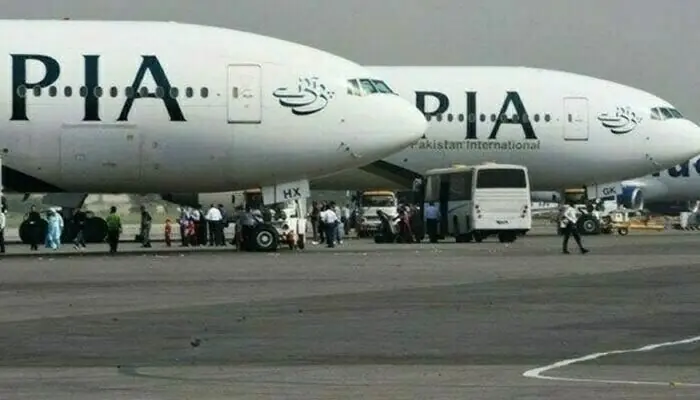

The privatisation of Pakistan International Airlines is often summarised as a Rs135 billion transaction in which a domestic consortium was selected in 2025 to acquire a 75 percent stake in Pakistan International Airlines Corporation Limited (PIACL). But this description is misleading if it is taken as a simple sale price.
In reality, it is a much more complex arrangement in which most of the money is not paid to the government as cash, but instead invested back into the airline itself to keep it running and rebuild it.
Only around Rs55 billion actually flows to the state. This includes about Rs10.1 billion linked to the first stage of the transaction and a further Rs45 billion associated with the final transfer of the remaining 25 percent government stake. Once that final step is completed, expected in May 2026, the consortium will own 100 percent of the airline through a holding company called PIA Equity Limited.
So, while the numbers sound large, the structure is not a straightforward sale. It is closer to a staged financial rescue in which private investors take over a weakened airline and inject money into it, while the state walks away with a relatively small cash amount but keeps the burden of past losses on its own books.
A long decline before privatisation became possible
To understand why the deal looks like this, it is necessary to understand how deep PIA’s financial problems became.
Over roughly the past decade, the airline accumulated losses an estimated at between Rs400 billion and Rs500 billion. When all debts, unpaid bills, pension obligations, and government-backed liabilities are added together, the total burden reaches around Rs650 billion.
These losses were not caused by a single event. They built up over time due to rising fuel costs, a falling currency, poor management, political interference, and a structure that never adjusted to the size of the airline’s operations.
At one point, PIA employed about 14,500 people but operated a fleet equivalent to only around 30 aircraft in active service. This created a heavy cost structure where too many staff were supporting too few aircraft, making it difficult for the airline to compete with private carriers in the region.
Year after year, the airline lost money. In some periods, losses reached between Rs60 billion and Rs90 billion annually.
By the time privatisation became unavoidable, PIA was no longer just an airline that was struggling. It had effectively become a large financial burden attached to a brand name.
Fuel price risk: the hidden pressure in every airline recovery
One of the most important but often underappreciated risks facing the new owners is the cost of jet fuel.
Jet fuel is typically one of the largest single expenses for any airline, often accounting for 30 to 40 percent of total operating costs. For an airline like PIA, which already suffers from older, less fuel-efficient aircraft, this exposure is even more pronounced.
This creates a structural vulnerability: even if operations improve, a sustained rise in global oil prices can quickly erase gains from efficiency or restructuring.
In practical terms, this means that PIA’s turnaround is not only dependent on management decisions or route strategy, but also on external energy markets that the airline cannot control.
A spike in oil prices—something that has occurred repeatedly in global cycles—would immediately increase operating costs and reduce already thin margins. This is one of the reasons airlines are often described as “macro-sensitive” businesses: they are heavily exposed to global shocks.
The 2024 restructuring: separating today’s airline from its past
Before the airline could be sold, the government carried out a major restructuring in 2024.
About Rs654 billion of old debts and obligations were moved into a separate holding structure. This included bank loans, pension commitments, supplier payments, and other historical liabilities.
What remained was a cleaned-up version of the airline, called PIACL, but even this new structure still carried around Rs180 billion in residual obligations.
This step was essential. Without it, no private buyer would have been willing to take over the airline at any price. But it also meant that a large part of the cost of running PIA in the past did not disappear—it was simply shifted onto the government’s balance sheet.
Partial reforms before the sale
Alongside financial restructuring, some operational changes were made, but they were only partial.
The workforce was reduced from about 14,500 employees to around 7,000. This was achieved through voluntary exit programmes, hiring freezes, and natural retirements.
The airline also reduced its network of routes. Loss-making European and secondary international destinations were cut back. The focus shifted to more profitable routes, especially in the Gulf region.
This shift is important for understanding the airline today. PIA now depends heavily on flights to Gulf countries such as the United Arab Emirates, Saudi Arabia, Qatar, and others.
However, this concentration also creates vulnerability. The airline’s financial health is closely tied not only to passenger demand but also to political and regulatory relationships with Gulf states, especially the UAE and Saudi Arabia. Any disruption in flight permissions or bilateral friction would immediately affect revenue.
What the airline looks like today
At the point of privatisation, PIA is a smaller, more focused airline.
It operates mainly domestic routes and Gulf flights, with a very limited number of long-haul international services.
Its fleet remains relatively small and ageing, with around 30 aircraft in varying levels of operational readiness. Many aircraft are more than 10 years old, increasing fuel consumption and maintenance costs.
As a result, PIA’s operating costs remain significantly higher than those of more modern regional carriers—by an estimated 15 to 25 percent per seat flown.
This is one of the central challenges the new owners will inherit.
The real structure of the Rs135 billion deal
Although the transaction is often described as Rs135 billion, this is not money paid to the government.
Instead, most of it is to be reinvested into the airline itself. Around Rs125 billion is structured as mandatory capital that must be injected into PIACL for stabilisation, operations, and gradual improvement.
Only a smaller portion flows to the state in cash.
That is why total government proceeds are limited to around Rs55 billion.
The broader financial exposure of the consortium rises to around Rs180 billion when operational commitments and support requirements are included.
The psychology of airline investing: why Buffett avoided this sector
The structure of this deal also reflects a deeper truth about airline economics: they are notoriously difficult businesses to make consistently profitable.
This is not a new observation. Investor Warren Buffett has repeatedly expressed scepticism about the airline industry. After investing billions in US airlines in 2016–2017, he later reversed course and exited the sector during the COVID-19 downturn, famously acknowledging that airlines tend to destroy value over long cycles because of high fixed costs, labour intensity, fuel dependence, and intense competition.
His broader view—often paraphrased from his shareholder commentary—is that airlines are “capital-intensive, low-margin businesses that rarely earn their cost of capital over time.”
This matters in the PIA context because it highlights the scale of challenge facing the new owners: even in stable economies, airlines are difficult; in structurally constrained environments with currency volatility, fuel exposure, and political risk, the difficulty is significantly higher.
Who is buying the airline?
The consortium acquiring PIA is not a traditional airline operator.
At the centre is Arif Habib Corporation, which structures and coordinates the deal.
Fatima Fertilizer Company provides strong cash flow support from its industrial base.
Fauji Fertilizer Company, backed by the Fauji Foundation—an investment and welfare conglomerate closely associated with Pakistan’s military-linked institutional ecosystem—adds financial strength and a degree of state-adjacent stability to the consortium.
Lake City Holdings brings real estate expertise, AKD Group contributes capital markets experience, and The City School adds diversified private investment participation.
Together, they form a financial coalition designed to absorb risk rather than operate aviation directly.
Once the remaining 25 percent stake is acquired and financial close is completed in May 2026, ownership of PIACL will be consolidated entirely under PIA Equity Limited. The consortium’s final shareholding structure will be divided as follows: Arif Habib Corporation and Fatima Fertilizer Company jointly holding 34.1 percent, Fauji Fertilizer Company 34 percent, Lake City Holdings 14 percent, AKD Group 10.25 percent, and The City School 7.65 percent.
What is actually being transferred?
PIA is not being sold in its historical form. That version of the airline has already been dismantled through restructuring.
What remains is a smaller operating airline that has been partially cleaned of legacy debt but still carries structural weaknesses.
The government retains around Rs650 billion in legacy obligations. The consortium takes responsibility for running the future airline and injecting capital into it.
The forward outlook: turnaround under constraint
The immediate post-privatisation phase will be defined by phased capital deployment, beginning with liquidity stabilisation and followed by operational strengthening.
Medium-term priorities will include fleet rationalisation, maintenance system upgrades, and cost restructuring. Without fleet modernisation, the airline will struggle to close its structural cost gap of 15–25 percent versus regional competitors.
Route strategy will remain anchored in Gulf markets, which provide the most reliable revenue base. However, this dependence also introduces vulnerability, as Pakistan’s aviation income is closely linked to relationships with Gulf countries—particularly the UAE and Saudi Arabia. Any deterioration in these relationships could quickly affect flight permissions or operational stability.
Selective rebuilding of long-haul connectivity remains a conditional objective, but depends on fleet capability, regulatory access, and financial viability.
Domestically, the focus will remain on yield optimisation rather than expansion due to strong competition from private carriers.
A further and less visible constraint is fuel price volatility. Since jet fuel represents a large share of airline costs, any sustained rise in global oil prices could quickly reduce profitability, even if operational reforms succeed.
Conclusion: a privatisation that is also a redistribution of risk
The privatisation of PIA is not a conventional sale. It is a staged restructuring in which: the state receives Rs55 billion in cash, retains around Rs650 billion in legacy liabilities, and transfers a reconstituted airline to private investors committing around Rs180 billion in total exposure.
The airline has been reshaped before being sold. But its future remains exposed to three forces it cannot fully control: fuel prices, regional geopolitics—especially in the Gulf—and the structural economics of the global airline industry itself.
In that sense, the deal is not simply a privatisation but a transfer of responsibility: the state keeps the cost of past failure, while private investors take on the uncertain task of running an airline exposed to fuel shocks, political pressures, and dependence on Gulf markets.
Copyright Business Recorder, 2026




















Comments