


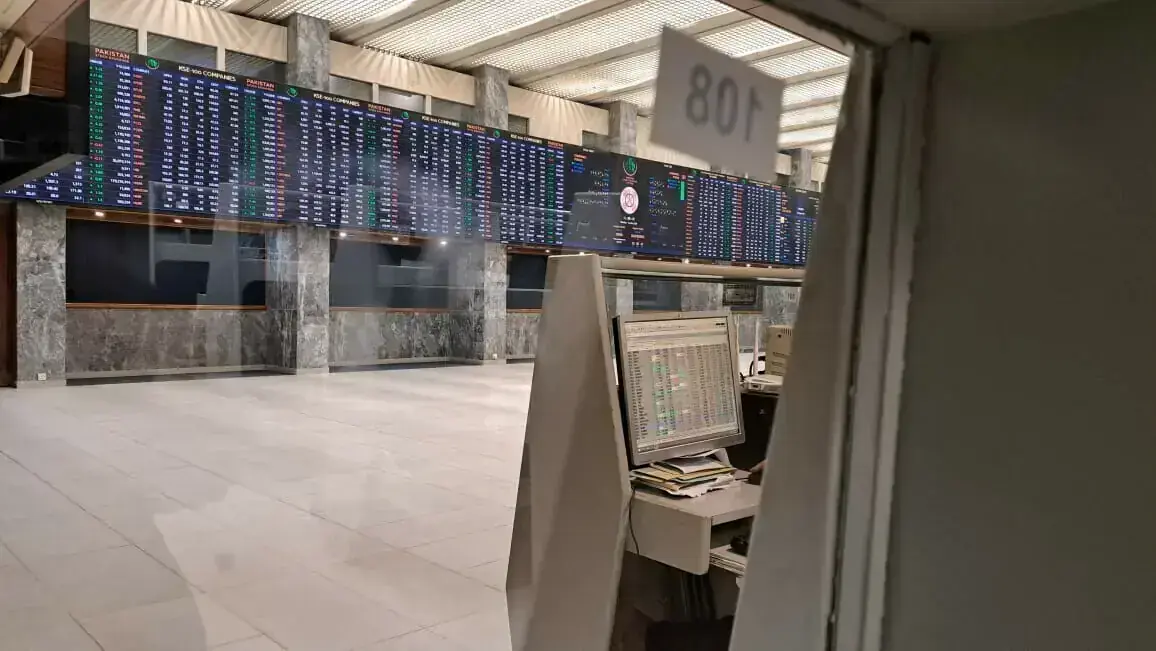

KARACHI: Pakistan’s stock market staged a strong recovery during the outgoing week, with the benchmark KSE-100 Index gaining 5.0 percent, or 8,121.64 points, as improving diplomatic sentiment surrounding a possible peace memorandum between the United States and Iran lifted investor confidence after weeks of geopolitical uncertainty.
The benchmark KSE-100 Index opened the week at 162,994.17 points and closed at 171,115.81 points, reflecting a weekly increase of 8,121.64 points, amid improving risk appetite driven by easing fears of an immediate escalation in regional conflict. Although tensions in the Middle East remained elevated, reports of possible diplomatic progress between Washington and Tehran supported a broad-based recovery in equities, allowing investors to re-enter fundamentally strong stocks.
Despite the improvement in sentiment, international oil prices remained elevated, with Brent crude hovering around USD100 per barrel, keeping concerns over imported inflation and external vulnerabilities intact. Nevertheless, investors largely focused on the possibility of reduced geopolitical tensions, helping the market rebound sharply from the previous week’s losses.
On the macroeconomic front, inflation accelerated to a near two-year high of 10.9% year-on-year in April 2026, largely driven by higher fuel prices, reinforcing concerns regarding rising cost pressures across the economy. At the same time, Pakistan’s external account remained under strain as the country’s monthly trade deficit widened by 4 percent year-on-year to USD4 billion, despite a 14 percent increase in exports during the period. On a cumulative basis, the trade deficit expanded by 20 percent year-on-year to USD32 billion during the first 10 months of FY26, underscoring persistent pressures on the external sector despite export growth.
Industrial activity, however, provided a positive signal for investors. Large Scale Manufacturing (LSM) recorded a strong 11% year-on-year growth in March 2026, taking cumulative LSM growth during 9MFY26 to approximately 6.5%, indicating strengthening industrial momentum and supporting expectations of broader economic resilience.
On the fiscal front, tax collection performance remained under pressure, with the Federal Board of Revenue (FBR) missing its monthly revenue target by Rs73 billion in April 2026, taking the cumulative shortfall to Rs683 billion during 10MFY26, highlighting continued fiscal challenges despite improving macroeconomic indicators.
Meanwhile, investor focus also remained centred on Pakistan’s engagement with the International Monetary Fund (IMF). The IMF Executive Board was scheduled to meet on May 8 to consider approval of a USD1.2 billion tranche for Pakistan under the ongoing IMF programme. Finance Minister officials expressed confidence regarding approval, citing improving macroeconomic indicators despite prevailing Middle East tensions.
In another encouraging development for external stability, the State Bank of Pakistan’s foreign exchange reserves increased by $23 million week-on-week to $15.8 billion, offering some support to investor confidence regarding the country’s external liquidity position.
Total PSX market capitalisation increased by 4.9 percent to Rs18.90 trillion, compared to Rs18.02 trillion in the previous week. In dollar terms, market capitalization rose to USD67.83 billion, up from USD64.65 billion, reflecting the broader recovery in equity prices.
Trading activity, however, remained mixed. Average daily traded volume in the ready market declined by 10.4 percent to 872.87 million shares, compared to 973.84 million shares recorded a week earlier. Despite lower volumes, market participation improved in value terms, as average daily traded turnover in the ready market rose by 16.8 percent to Rs42.01 billion, compared to Rs35.96 billion in the preceding week. In dollar terms, ready market turnover increased by 16.9 percent to USD150.74 million, from USD129 million.
Sectoral performance remained firmly positive across the board, highlighting a broad-based rally. The Cement sector emerged as the top performer, surging 9.1 percent, followed by Technology & Communication up 8.2 percent, Exploration & Production (E&Ps) gaining 7.0 percent, Engineering rising 5.9 percent while Pharmaceuticals increasing 5.3 percent.
Fertilizer stocks gained 4.2 percent, Oil Marketing Companies (OMCs) advanced 3.7 percent, Chemical sector rose 3.7 percent, Banks increased 3.6 percent, Textile Composite gained 3.4 percent, Autos climbed 3.4 percent, Food sector rose 2.5 percent, Power advanced 2.5 percent, while Refinery sector posted the lowest gain of 1.1 percent during the week.
Trading concentration remained centered around a few sectors. OMCs led traded volumes with a 12 percent share, followed by Technology & Communication at 11 percent, Power sector accounting for 10 percent, Banks contributing 9 percent, Cement at 7 percent, while all remaining sectors collectively represented 51 percent of total traded activity.
Among individual stocks, PIOC emerged as the top weekly gainer, surging 30.0 percent to close at Rs278.38, followed by JVDC up 16.2 percent to Rs138.30, PIBTL gaining 14.1 percent to Rs17.13, SSGC rising 13.0 percent to Rs27.91, GADT increasing 12.9 percent to Rs287.49, MLCF advancing 11.7 percent to Rs88.96, and PPL climbing 11.3 percent to Rs229.93.
On the downside, INDU emerged as the top laggard, declining 6.3 percent to Rs2,007.80, followed by IBFL down 2.2 percent to Rs221.86, MEHT decreasing 2.0 percent to Rs242.25, HUBC falling 1.8 percent to Rs216.53, THALL shedding 1.7 percent to Rs646.00, ATRL declining 1.5 percent to Rs903.72, and MEBL slipping 1.3 percent to Rs485.95.
Overall, the week marked a strong rebound for Pakistan’s equities as easing geopolitical concerns overshadowed inflationary pressures and macroeconomic risks.
However, elevated oil prices, widening trade imbalances, fiscal pressures, and lingering regional uncertainty continue to pose risks to investor sentiment going forward, even as improving diplomatic signals and IMF-related optimism provide near-term support to the market.
Copyright Business Recorder, 2026




















Comments