


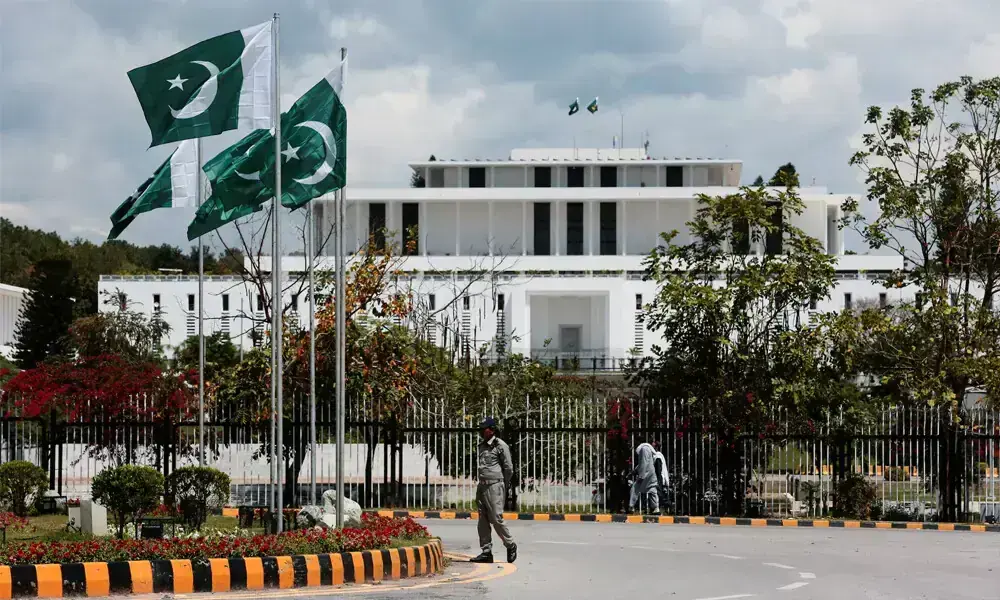
Regardless of the outcome of the Islamabad talks between United States of America and Islamic Republic of Iran, the victor has already emerged and that is the ‘universal need for peace’. In this process, Pakistan has arrived as a trustworthy conduit for bringing the warring parties onto the negotiating table. This fact will undeniably go down in the annals of history as the most successful diplomatic triumph of Pakistan since its independence. This actually is the second time that Pakistan, as a trusted ally of the US, has helped it mend fences with its adversaries.
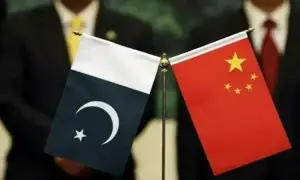
In 1971, Pakistan was the bridge that allowed for the first-ever contact between People’s Republic of China and the US since the unfurling of the flag of communist China in 1949. So, this time again, after a hiatus of nearly 50 years, Pakistani soil brought about the first meeting since the Islamic Revolution of 1979 between the US and Iran.
This carving of a unique place on the world stage has caused political tremors exceeding 7-8 on the Richter scale on the now isolated capital of Republic of India. The uncontrollable frenzy of the TV anchors and pseudo defence/international affairs experts is unbelievable. In fact, it is a comic relief to the otherwise tense global situation. They are acting as clowns and jokers, falling all over the map to record first their disgust with prime minister Narendra Modi (which is rightful) and secondly, making a flawed attempt to decimate Pakistan’s role in peace-making, albeit with complete failure.
Modi is singularly responsible (with a few of his hate-filled cabinet ministers) for India’s isolation. He thought it wise to join hands with Benjamin Netanyahu and Israel to backstab Iran. India and Iran always enjoyed good relations despite the latter’s very close association with Pakistan.
India availed economic benefits aplenty from this friendship; however, the natural instinct of the scorpion is to sting, and that’s exactly what he/India did to Iran. Modi visited Israel between 22nd to 25th February and was obviously given red carpet welcome and an award. On February 28th Israel launched its strikes against Iran. India deceived blatantly Iran, and, I am certain, the state of Islamic Republic of Pakistan has learnt a very painful lesson about diplomatic duplicity and double standards. Jai Shankar has emerged as a good disciple of The Prince, Machiavelli.
India has placed itself on the pyre and is self-igniting the sandalwood beneath its diplomatic remains. The lunacy of the reaction was so comical that a former US diplomat on one of the reputable Indian TV channels, called the anchors, politicians and analysts as ‘school children’. He gave a perfect shut-up call. But in vain mainly because of the fact that the airspace in India is only reverberating with chants of ‘how and why Pakistan gained this space and trust’ across various geographies.
Usually it is said that there is ‘method to madness’, but here there is not any – it’s a free for all – one anchor went into an overdrive of imagination when he reported that due to security reasons the aircraft carrying JD Vance has turned back mid-flight – how miserable he must have felt to see ultimately the tires of the Vice Presidential aircraft kissing the soil (tarmac) of Islamabad.
Pakistan’s silent but smooth and constant diplomatic initiatives carried out through Riyadh, Abu Dhabi, Doha, Tehran, Istanbul, Cairo and above all, Moscow and Beijing is commendable. The Deputy Prime Minister and the Field Marshal have worked unrelentingly. All global leaders, barring the upset eastern neighbour, have unequivocally lauded Pakistan’s brilliant scoop of diplomacy. The unsung heroes of the Pakistan’s foreign office and the armed forces deserve a salute from the nation. They were, indeed, ably led, also.
The most significant aspect that has emerged from this diplomatic coup is Pakistan’s recognition as a reliable, trusted and worthy of confidence player in the region if not the entire world stage. Pakistan, after a long gap, for right reasons, was flashing on television tubes in homes and offices from Auckland to Anchorage; from Tokyo to Montevideo.
The Persian Gulf conflict has also confirmed that assurances of safety and security that are guaranteed by those who are not part of the region do not go down well. NATO is a case in point. Established in 1949, it is a political and military alliance that was meant to act as a transatlantic link for peace and stability. A collective defence alliance; its article 5 says, ‘an attack against one member is considered an attack against all’. There are 32 members (Sweden being the latest entrant). It is actually an alliance in tatters. Ukraine again is a reference point. President Trump’s disgust with NATO is indicative when he referred to the leaders of the 32 countries as ‘cowards.
CENTO (1955) was established to prevent Soviet Union’s (Communist) expansionism in the Middle East; it included Turkey, Iraq, Iran and Pakistan. CENTO was led by the US as the stable guarantor. In 1965 and 1971 when India attacked Pakistan, CENTO was twiddling its thumb in the spectator box. It was political foresight of Zulfiqar Ali Bhutto that he withdrew Pakistan from CENTO in 1972. CENTO died a death of neglect in 1979.
SEATO (1954) was created to block spread of Communism in Asia. This was created following the 1953 Korean War; its members also included those who were not part of Asia (the guarantors) – the US, France, Britain, New Zealand and Australia. Again, ZAB took a bold step to abandon SEATO in 1972. During the Vietnam War, SEATO remained out of sight. This alliance also met its own Waterloo.
The point here is that no external party can offer security assurances, who are not part of the region. The current defence pact signed between Saudi Arabia, despite the presence of several US bases in the region, points effectively that Pakistan being part of the region is a more trusted ally. Today (12th April 2026), news reports have confirmed the presence of Pakistani troops and aircrafts on Saudi soil.
The defence pact with Saudi Arabia should be extended to include Turkey, Iraq, Syria, Lebanon, Iran, the UAE, Bahrain, Kuwait, Yemen, Oman and Qatar; this can lead to the creation of ‘Middle East-Pakistan Treaty Organisation’ (MEPTO). Being the only Nuclear Power in the equation, Pakistan, should lead this organisation whose sole purpose must be to maintain peace and security in the region; and all issues of mutual discontent must be resolved on the table of negotiation and not through force (war). With the trust gained of the United States, Pakistan can provide and become the net security provider in the Middle East region. Any economic alliances, multi or bilateral, can be the corollary gains of this association. ‘MEPTO’s’ headquarters can be housed in Istanbul for taming Israel and any other military adventurer nation from within or outside the region; the institution of ‘MEPTO’ is necessary.
China, which played a critical role, would have no objection to any such military alliance of Pakistan. Since almost all the countries of the region enjoy excellent relations with the US, their consent and approval would not be a difficult thing to be had.
Pakistan has proven to the world that it is a responsible, mature and peace loving nuclear state. The mere holding of Islamabad talks proves the need and case for ‘MEPTO’.
The Zionist and Hindutva-inspired media will run over time to prove that Islamabad talks have failed. To adversaries meeting after a gap of 50 years is in itself an achievement. In this, Pakistan played a pivotal role. Even JD Vance said, ‘whatever the shortcoming of the negotiations wasn’t because of Pakistan, who did an amazing job and really tried to help us and the Iranians to bridge the gap and get to a deal’.
Maleeha Lodhi, a journalist and a diplomat par excellence, made the most apt observation in a tweet. She said, ‘we should avoid any rush to judgment about the Islamabad Talks which have barely got going. Diplomacy is a process, not an event. Anyone who thinks the process will yield something quickly is mistaken. No need to see it in terms of either breakthrough or breakdown.’ It is clear that the attack on Lebanon was orchestrated by Israel to thwart the possibility of any agreement between Iran and the US. The design, intent and architect were to undermine the talks.
During university days, we read about the fad for countries in the Middle East to form and merge as union such as United Arab Republic (UAR) between Egypt and Syria lasted only a couple of years. A similar union of Libya with Egypt and Syria expired on the file. These are classic examples, and about such alliances the students would joke, that two ‘brotherly’ countries have formed ‘sisterly’ relations or ‘two sister states’ have forged ‘brotherly relations!’. All of these unions ended up in thin air.
Organisations like the Arab League and Gulf Cooperation Council have long been in the ICU – it would be best to remove the ventilators and allow them a peaceful death/end. ‘MEPTO’ is the answer in the emerging new world order. Pakistan can take the lead, now that it stands recognised as a trusted partner by the West and by nations across the Atlantic. The opportunity should be seized upon.
Copyright Business Recorder, 2026
The writer is a Senior Banker & Freelance Contributor














Comments
Comments are closed for this article.