



There is a particular kind of cruelty in a recovery that shows up in the data but not in the kitchen. But what’s really cruel (and tragic) is how quickly that recovery can dissipate in thin air. Until recently, macro numbers had just turned a corner.
The SBP was cutting rates on the back of improved inflation down into single digits and the MPC was expected to cut rates down to 10 percent. The IMF program was on track and industrial output was climbing. On paper, the worst was over. But even then, nobody told the households.
The State Bank’s business and consumer confidence surveys had been telling a different story all along.
Business confidence crossed the 50-point neutral threshold — the line between optimism and pessimism — and held there for five consecutive survey rounds. Consumer confidence never followed.
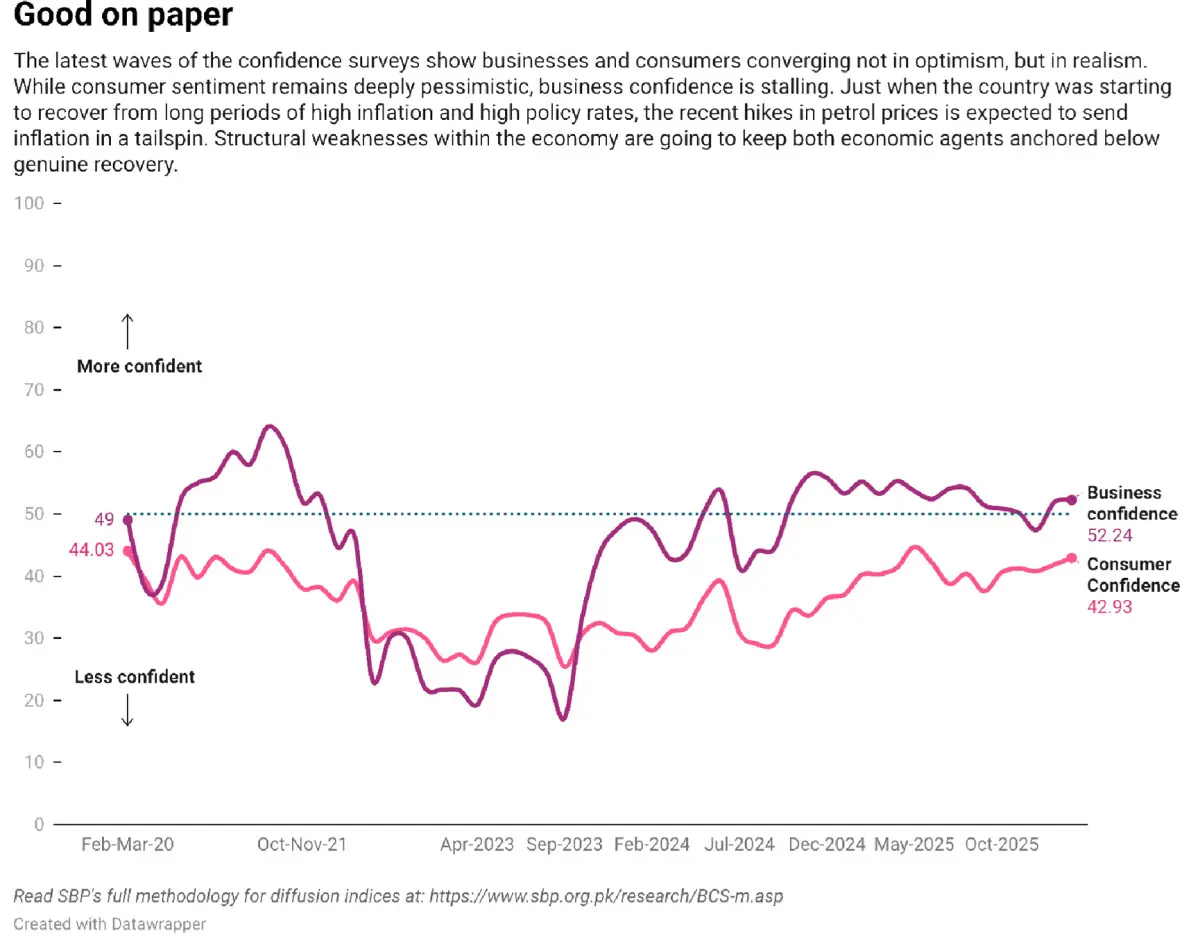
In Feb-26, the latest wave, it sat at 43. Not once in nearly two years of supposed recovery did households feel it. The gap between what businesses sensed and what kitchens felt is all too familiar—a structural feature of an economy recovering at the top but stagnating everywhere else.
The inflation expectations data shows this well. The index has barely budged from the 65-70 range throughout the entire cycleeven as actual inflation fell to 4.5 percent. Households that lived through a period when staple food prices doubled and utility bills tripled do not seem to update their anxieties around the headline CPI number. They update it when the grocery bill stabilizes, when the electricity tariff stops climbing, when their real wage recovers all the groundit lost. None of that happened during this so-called stabilization cycle. Pakistan’s poverty rate rose to 29 percent, its highest in over a decade. Seventy million people cannot meet the monthly minimum of Rs 8,484 set as the threshold for basic needs. Income inequality reached its highest point since 1998. The cumulative price shock of 2022-2024 carved a hole in household balance sheets and the past few quarters of moderate inflation could not possibly fill it.
And now the thin air has arrived. The war in the Middle East — the same conflict Pakistan is being diplomatically celebrated for helping mediate — has sent international oil prices surging and transmitted the shock directly into domestic pricing. The Sensitive Price Indicator has jumped to 12.15 percent year-on-year, a 74-week high. Diesel is up over 100 percent year-on-year. Petrol is up nearly 49 percent. LPG, the cooking fuel for tens of millions of households without piped gas, is up over 65 percent. In its third review completed in March, the IMF has already told the SBP to stand ready to raise interest rates if price pressures intensify. Rates have been held at 10.5 percent in March pending clarity on energy price dynamics, but they now facethe next decision on April 27. The easing cycle that households were expecting to soon bare fruits is almost certainly over before it delivered any meaningful relief.
What the surveys also revealis a tale of two Pakistans. Corporate Pakistan, the businesses tracking improved external accounts, those borrowing cheaper from the banks, the importers benefiting from a stabilized exchange rate, the SUV sellers whose sales hit a record high, experienced something that could reasonably be called a recovery. Household Pakistan, the employee anxious about job security, the family in the lowest income bracket whose inflation expectations remain the most elevated of any group, the household that decided now is not the right time to spend on a home or a car and does not expect that to change in the coming year,experienced nothing close to it.
The fact that Pakistan’s foundations are so weak that any kind of external shock can send the entire painstakingly achieved recovery cycle in a tailspin should be telling. No automatic stabilizers in this economy exist. And now as ever, the households who never felt the recovery arriving will be the first to feel it leave.




















Comments