


Digital wallets, real relief: Pakistan’s quiet revolution in public service delivery

When the Middle East conflict pushed global energy prices to historic highs, the government of Prime Minister Shehbaz Sharif moved with unusual speed. Within three weeks, a Rs129 billion relief package was not merely announced but operationalised.
The headline measure was a reduction of Rs80 per litre in the petroleum levy, bringing petrol’s price down to Rs378 across the country. But the headline, for once, was only the beginning of the story.
Pakistan’s transport sector is the circulatory system of its economy. Trucks move food from farms to markets. Buses carry workers to factories and offices. Vans connect small towns to cities. When fuel prices rise, the cost of everything rises with them.
The government understood this, and rather than issuing a blanket subsidy that would be impossible to target, it designed a tiered structure of direct payments to transport operators. Buses receive Rs100,000 per month, trucks get Rs70,000, large goods carriers are allocated Rs80,000, mini-buses and wagons Rs40,000, and delivery vans Rs35,000. These are not vague commitments. They are fixed monthly disbursements, routed directly to vehicle owners through digital wallets.
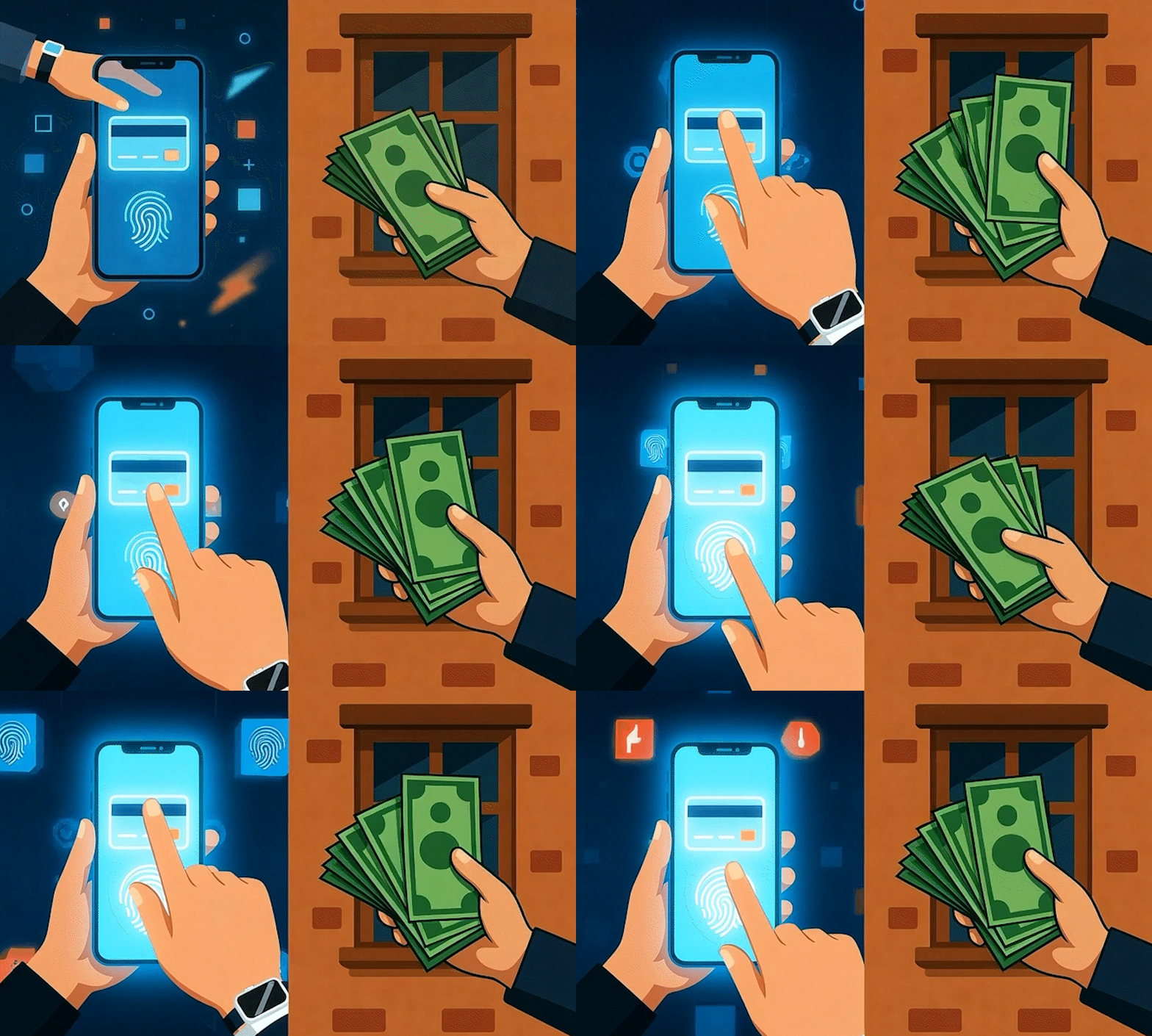
That last detail, digital wallets, is where this programme departs from the dreary history of Pakistani subsidies. Digital wallets have been the first to start disbursing funds, outpacing conventional banking channels. This matters enormously.
Digital wallets do not require the recipient to visit a bank branch during working hours. They do not create opportunities for the kind of leakage that has defined public transfers in Pakistan for decades. The subsidy for a bus operator in Sukkur reaches his phone at the same speed as one for a trucker in Peshawar.
The fuel price cut and transport subsidies, however, are only part of the architecture. The government also withdrew the increase in toll taxes, freezing all adjustments for the current fiscal year.
Public transport has received equally decisive attention. In Punjab and Islamabad, the government has announced free public transportation for one month so that daily commuters are shielded from the fuel price shock entirely during the transition period. Pakistan Railways has also stated that they shall not increase fares, while the railway network has simultaneously ramped up both passenger and freight operations to absorb the surge in demand for affordable alternatives to road transport.
The combination of free urban transit, frozen rail fares, and expanded rail capacity represents the most comprehensive public transport intervention Pakistan has attempted in recent memory.
For the millions of Pakistanis who depend on motorcycles, the country’s largest segment of private vehicle ownership, the government has introduced a concession of Rs100 per litre, capped at 20 litres per month.
The coordination behind this is worth noting. The Prime Minister chaired a high-level meeting to establish a clear division of responsibilities: the federal government manages subsidies for national-level transport, including trucks, buses, vans, and long-route vehicles, while provincial governments handle motorcycle and agricultural disbursements. This is not just administrative tidiness. It is a recognition that different tiers of government are better positioned to manage different categories of beneficiaries. Provincial governments are closer to the motorcycle-owning commuter and the smallholder farmer.
The federal government has better oversight of interstate freight and passenger networks.
Equally notable is the austerity framework that accompanies the relief. The government has grounded 60 percent of its own vehicle fleet and slashed official fuel quotas by half. Cabinet members and parliamentarians have accepted a 25 percent salary cut for six months, with ten months’ salary surrendered. Speed limits on motorways have been reduced.
Government offices are shifting to four working days a week, with 50 percent of staff working from home, and online meetings are being promoted over travel. Carpooling has been formally encouraged as shared commuting policy. These are not mere gestures.
When you put the pieces together, what emerges is something Pakistan has rarely achieved: a subsidy programme that is targeted, tiered, timely, and digitally delivered. The Rs129 billion the government absorbed was the headline.
The digital disbursement infrastructure that is getting that relief into people’s hands, bypassing the middlemen, the paperwork, and the delays, is the real story.
There is a broader lesson here as well. Pakistan’s fintech ecosystem has grown rapidly over the past few years, but much of the conversation around digital wallets has focused on consumer payments and merchant transactions.
What this transport subsidy programme demonstrates is that digital financial infrastructure can serve as the backbone of public welfare delivery. If the government can disburse transport subsidies through wallets today, it can disburse education stipends, health vouchers, and agricultural support through the same channels tomorrow.
None of this is to suggest that the system is perfect or that there will not be challenges in the phases ahead. Scaling from first phase to full national coverage will test both the technology and the bureaucracy.
But the direction is right, and the speed of execution has been genuinely impressive. For once, the announcement and the delivery arrived at roughly the same time. For a country that has spent decades watching good policies die in implementation, that alone is worth recognising.
Copyright Business Recorder, 2026
The writer is a technology and governance analyst based in Lahore

























Comments