BR100 Increased By (1.02%)
BR30 Increased By (1.71%)
KSE100 Increased By (0.58%)
KSE30 Increased By (0.65%)
BECO 6.03 Increased By ▲ 0.26 (4.51%)
BML 52.61 Decreased By ▼ -0.39 (-0.74%)
BOP 34.23 Increased By ▲ 0.24 (0.71%)
CNERGY 8.16 Increased By ▲ 0.05 (0.62%)
DCL 12.23 Increased By ▲ 0.03 (0.25%)
FCCL 53.80 Increased By ▲ 0.97 (1.84%)
FCSC 5.24 Increased By ▲ 0.17 (3.35%)
FFL 18.03 Increased By ▲ 0.08 (0.45%)
FNEL 1.30 Increased By ▲ 0.01 (0.78%)
HUMNL 11.00 Increased By ▲ 0.12 (1.1%)
KEL 8.07 Increased By ▲ 0.05 (0.62%)
KOSM 5.39 Decreased By ▼ -0.13 (-2.36%)
MLCF 87.90 Increased By ▲ 1.39 (1.61%)
NBP 186.60 Increased By ▲ 1.44 (0.78%)
PACE 10.75 Increased By ▲ 0.17 (1.61%)
PAEL 39.95 Increased By ▲ 0.53 (1.34%)
PIAHCLA 26.19 Decreased By ▼ -0.03 (-0.11%)
PIBTL 17.32 Increased By ▲ 0.65 (3.9%)
PPL 233.49 Increased By ▲ 5.31 (2.33%)
PRL 34.98 Increased By ▲ 0.30 (0.87%)
PTC 67.71 Increased By ▲ 2.38 (3.64%)
SEARL 90.90 Increased By ▲ 0.77 (0.85%)
SSGC 27.20 Increased By ▲ 0.60 (2.26%)
TELE 8.57 Increased By ▲ 0.29 (3.5%)
THCCL 60.85 Increased By ▲ 2.35 (4.02%)
TPLP 8.78 Increased By ▲ 0.56 (6.81%)
TREET 24.65 Increased By ▲ 0.12 (0.49%)
TRG 71.50 Increased By ▲ 1.79 (2.57%)
WAVES 10.01 Increased By ▲ 0.07 (0.7%)
WTL 1.27 Decreased By ▼ -0.01 (-0.78%)
Opinion Print edition: 2026-04-03

‘Iran War exposes fault lines in Trump’s team’
Published April 3, 2026 Updated April 3, 2026 06:08am
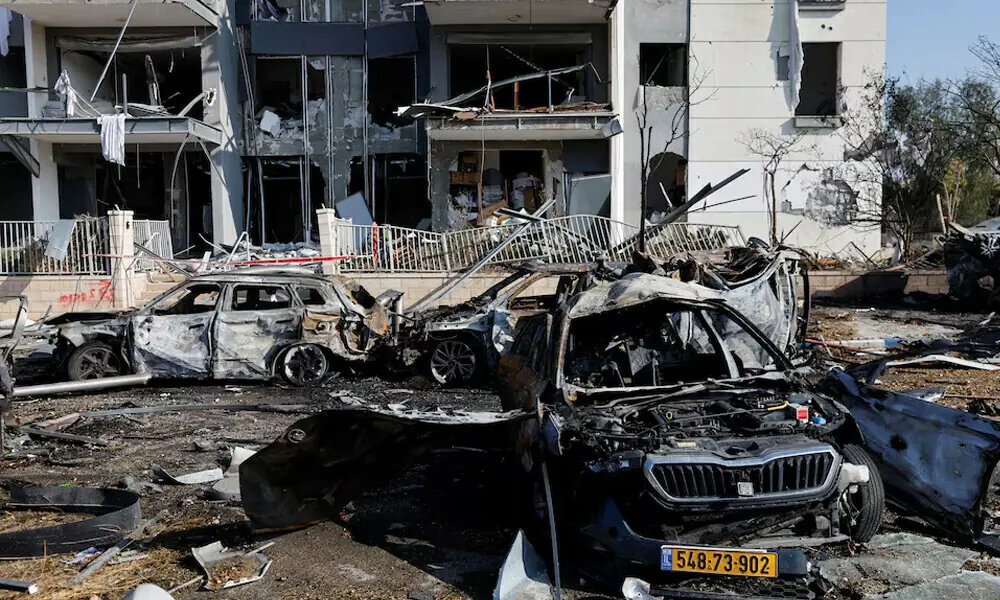
A view of burnt cars and a damaged building at an impact site following Iran’s missile strike on Israel, in Be’er Sheva, Israel, June 20, 2025. Photo: Reuters

This is apropos a letter to Editor headlined ‘Iran War exposes fault lines in Trump’s team’ carried by the newspaper on Tuesday, Wednesday and yesterday.

Instead, Iran has demonstrated a capacity for asymmetric warfare, leveraging geography, regional influence, and strategic chokepoints to offset conventional military disadvantages.

While the United States and Israel dominate in airpower and precision strikes, Iran appears to be shaping the broader trajectory of the conflict—imposing economic costs, influencing global perceptions, and forcing adversaries into a prolonged engagement.

This evolving dynamic has also triggered a shift in global alignment. Countries that once followed Washington’s lead are now acting independently, prioritizing their own economic stability and political calculations. Some are engaging diplomatically with multiple sides, while others are simply stepping back, unwilling to be drawn into an escalating conflict.

For the United States, the implications are significant. A war that lacks broad international support, faces internal dissent, and imposes rising economic costs presents both strategic and political challenges—particularly in a domestic environment where public opinion can shift rapidly.

Copyright Business Recorder, 2026

Qamar Bashir

The writer is a former Press Secretary to the President, An ex-Press Minister at Embassy of Pakistan to France, a former MD, SRBC Macomb, Detroit, Michigan

Comments

200 characters remaining