


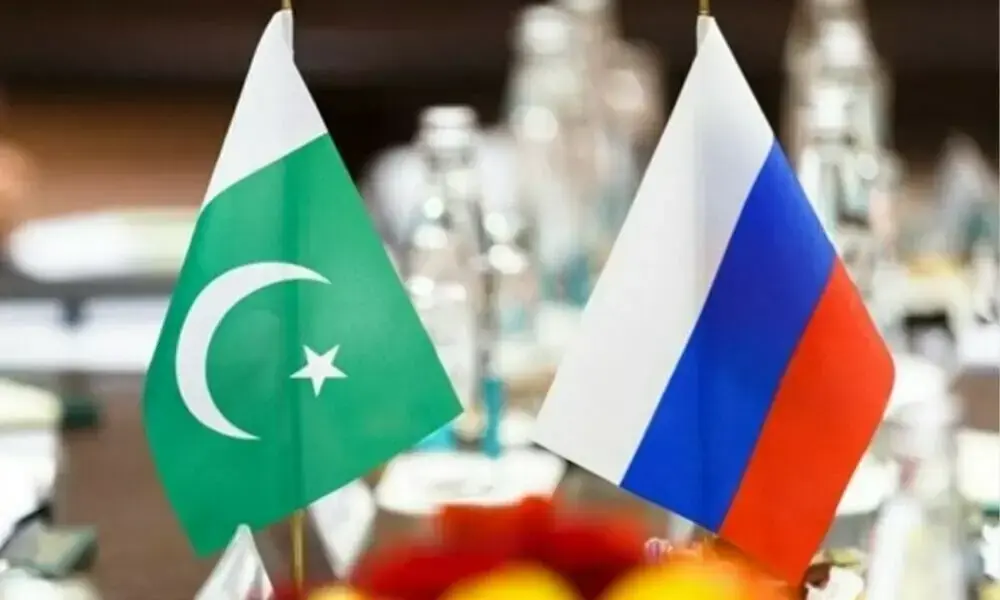
EDITORIAL: Russia’s Ambassador to Pakistan, Albert P. Khorev, has articulated a perspective that reflects both Moscow’s worldview and recognition of Islamabad’s careful diplomatic posture. His praise for Pakistan’s “balanced and consistent” stance on the Ukraine conflict highlights an increasingly important reality in today’s fractured global order: middle powers such as Pakistan are striving to navigate geopolitical rivalries without becoming entangled in them.
Pakistan’s approach to the Ukraine crisis has indeed been marked by restraint. Rather than fully aligning with Western condemnation of Russia or endorsing Moscow’s narrative, Islamabad has opted for a nuanced position, calling for dialogue, upholding the principle of territorial integrity, and maintaining functional ties with all major players. This balancing act is not merely diplomatic caution; it is a strategic necessity for a country whose economic stability and security interests are linked to multiple, often competing, global partners.
Ambassador Khorev’s assertion that the Ukraine conflict is not simply a bilateral dispute but an indirect confrontation between Russia and the “collective West” is reflective of a broader contest over the nature of the global order. From Moscow’s standpoint, the war represents resistance to Western push for continued dominance. This view resonates with wider debates across the Global South about the fairness and inclusivity of existing international structures.
The ambassador’s emphasis on the emergence of a “multipolar world” is particularly noteworthy. There is little doubt that the unipolar moment that followed the Cold War is giving way to a more diffused distribution of power. Yet this transition is neither smooth nor inherently stabilising. Multipolarity can encourage balance and cooperation, but it can also heighten competition and uncertainty, especially when institutional frameworks fail to keep pace with shifting realities.
In this context the concept of “indivisible security” highlighted by the Russian envoy merits careful consideration. The principle that the security of one state should not come at the expense of another has strong and clear appeal. Its application within regional platforms such as the Shanghai Cooperation Organisation (SCO) appears more feasible than at a broader level, where competing interests and historical mistrust remain significant obstacles. For Pakistan, this concept aligns with long-term strategic interests. As an SCO member since 2017, Islamabad is already engaged in regional initiatives that prioritise connectivity, counterterrorism cooperation, and economic integration.
A security framework based on mutual reassurance rather than zero-sum calculations could reduce regional tensions and create new avenues for trade and development.
However, translating such ideas into reality requires more than diplomatic rhetoric. It demands political will, institutional capacity, and a genuine commitment from all stakeholders to move beyond narrow strategic calculations. For Pakistan, the challenge lies in leveraging emerging frameworks such as the SCO and BRICS without alienating traditional partners.
As the global balance of power evolves, Pakistan’s ability to maintain strategic autonomy while engaging constructively with competing blocs will be crucial.
In a world gradually moving towards multipolarity, balance is not merely a policy choice; it is a prerequisite for stability and survival.
Copyright Business Recorder, 2026




















Comments
Comments are closed for this article.