


‘Our intelligence was correct’: DG ISPR says Kabul strike targeted ammunition depot
- Says video evidence of the strike and its aftermath was publicly available
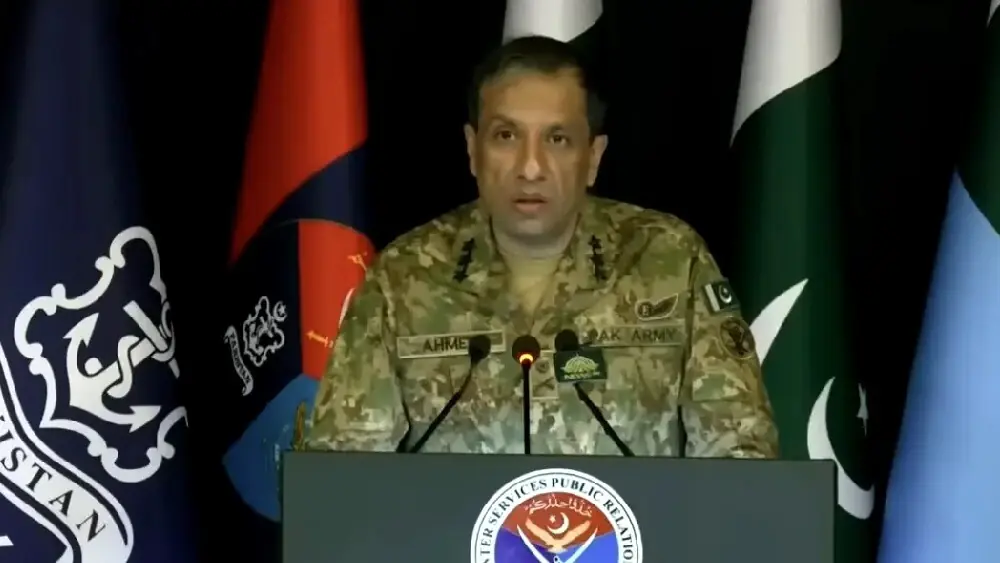

Inter-Services Public Relations (ISPR) Director General Ahmed Sharif Chaudhry on Wednesday said that Pakistan’s recent strike in Kabul targeted an ammunition and drone storage facility, rejecting claims of civilian infrastructure being hit.
Speaking on ‘Capital Talk’ aired on Geo News, Lt Gen Chaudhry said the strike was based on verified intelligence and formed part of the broader Operation Ghazab lil Haq, launched last month against militant networks.
“Our intelligence was correct. We targeted an ammunition storage site, and the resulting secondary explosions confirmed the presence of weapons, including old missiles, drones and other equipment,” he said, adding that video evidence of the strike and its aftermath was publicly available.
He emphasised that Pakistan used precision-guided munitions (PGMs) to minimise collateral damage, noting that the operation focused strictly on “terrorist support infrastructure”.
The military spokesperson rejected assertions by the Afghan Taliban that a drug rehabilitation centre was hit, questioning the credibility of such claims.
“Is there any facility in the world where a rehabilitation centre is built next to an ammunition depot?” he asked, suggesting the structure in question was a “military containerised facility” possibly used for training or sheltering militants.
Read More: Armed Forces strike target 6 terror bases in Kabul, Nangarhar: Tarar
Lt Gen Chaudhry said the strikes were part of Pakistan’s ongoing counter-terrorism campaign and not a standalone action, stressing that the country was responding to threats emanating from Afghanistan.
“This war has been imposed on Pakistan by terrorists and their sponsors,” he said, alleging that militant groups were operating from Afghan territory with external backing.
He reiterated Pakistan’s long-standing position that India was supporting anti-Pakistan militant networks and using Afghanistan as a “base of operations.”
According to the DG ISPR, multiple incidents — including attacks in Islamabad and Wana — involved militants originating from Afghan soil.
Read More: UN seeks independent probe into deadly Kabul clinic strike
He added that key militant leaders, including Noor Wali Mehsud, Bashir Zeb and Gul Bahadur, were being sheltered in Afghanistan.
Providing operational details, he said Pakistan had targeted 81 locations inside Afghanistan in recent strikes, including command centres, ammunition depots and logistical hubs used to facilitate attacks inside Pakistan.
He claimed that tensions escalated after Pakistan initially targeted militant hideouts along the border, following which Afghan Taliban elements struck 53 locations inside Pakistan.
“They initiated it, and we responded. We will continue to take action where necessary,” he asserted.
The DG ISPR also raised concerns over the use of drones, stating that several had recently been intercepted near Islamabad. He questioned how such capabilities were being acquired, alleging external support.
“There is no drone manufacturing in Afghanistan. These are being provided by India,” he claimed, adding that Pakistani air defence systems were successfully neutralising incoming threats.
Highlighting evolving warfare dynamics, he said Pakistan was operating in an era of drone and non-contact warfare, requiring constant vigilance and technological adaptation.
He further alleged that the Afghan Taliban regime was providing shelter to militants within state infrastructure and maintaining links with extremist elements, citing concerns also reflected in reports by the United Nations.
“Afghanistan has become a hub for multiple terrorist organisations,” he said, adding that Pakistan’s actions were part of a broader effort to counter global terrorism.
Despite the escalation, Lt Gen Chaudhry said Pakistan had no hostility towards the Afghan people, but stressed that Kabul must ensure its territory is not used for attacks.
“Our position is clear: Afghanistan should not be used as a base for terrorism against Pakistan,” he said. “The choice lies with the Afghan Taliban — whether they prioritise peace or continue supporting militant groups.”
He added that Pakistan remained open to dialogue but ruled out meaningful talks unless concrete steps were taken to dismantle terrorist networks operating from Afghan soil.






















Comments
Comments are closed for this article.