


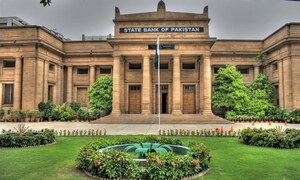
SBP’s decision to hold the policy rate at 10.5 percent might have looked prudent in a world where the Middle East war remained brief, oil merely spiked for a few sessions, and global supply chains settled before the damage spread. That is not the world Pakistan is facing.
If Brent moving toward $150 a barrel and gas markets spiraling into disorder is even a plausible near-term risk, then the policy question is no longer how to preserve recovery momentum at the margin. It is how to force adjustment before the external account, the inflation path, and exchange-rate expectations all come under renewed stress.
That is where the current monetary stance begins to look conflicted. The same central bank that is warning of sharply higher uncertainty, rising fuel, freight and insurance costs, and a materially more challenging external environment is also leaning on the argument that inflation will remain broadly within earlier projected ranges, that growth should stay within the 3.75 to 4.75 percent band, and that the current account should still land within 0 to 1 percent of GDP.
At the same time, it is celebrating that the recent CRR cut and lower budgetary borrowing have created space for more private-sector lending. In plain language, the MPC is confronting a live imported energy shock while still keeping the liquidity channel supportive of credit expansion. That is not an obviously coherent wartime monetary posture.
This is not a small technical inconsistency. The pre-war baseline rested on relatively benign oil assumptions, inflation staying within target, a contained current account deficit, and reserves continuing to build. That framework made sense in a world where imported energy prices were not exploding and where the lagged transmission of prior rate cuts had not yet generated excessive pressure on inflation or the external account.
The March hold still leans heavily on that architecture, even though the central assumption underpinning it, a manageable external energy backdrop, has plainly broken down.
SBP’s own communication only makes the tension harder to ignore. On one side, it says inflation outturnsshall remainbroadly in line with the forecast path.
On the other, it concedes that uncertainty has widened materially, core inflation remains sticky, and war-related upside risks to inflation have risen. That is the problem with clinging to the phrase “broadly in line.” It can quickly become a way of narrating away a broken regime shift. If Brent were to spend the rest of the fiscal year anywhere near double the pre-war assumption – from $60 to $120 and beyond,the first-round impact alone on CPI would be of at least one percentage point: not trivial. And direct fuel impact is the easy part.
Freight, insurance, LNG, shipping disruption, and second-round pass-through are where the real pain begins.
Nor does it help to pretend that the fiscal side is doing the hard work while monetary policy calmly waits. It is not. The real problem is almost the opposite. A fuel price hike does not automatically translate into demand destruction if the political system is simultaneously preparing to cushion the backlash through relief, subsidies, or compensatory spending elsewhere.
In Pakistan, higher administered prices rarely translate into clean adjustment. They are usually followed by efforts to soften the political blow. So what appears to be restraint on one side is often neutralized on the other. The state taxes with one hand and reflates with the other. That is not austerity. It is choreography.
Seen from that angle, the search for larger deferred oil financing is not a separate solution. It is another expression of the same instinct. Deferred oil is not disinflationary policy. It does not reduce underlying demand for imported energy. It merely eases the financing constraint and postpones the adjustment. It buys time for reserves. It does not cure the inflationary impulse. If anything, it reduces the pressure to allow real demand compression to take place.
So if fuel pass-through is politically softened at home while the import bill is being financially softened abroad, then neither leg of the response is truly doing the work of adjustment. The burden falls back, even more heavily, on monetary policy.
That is why the liquidity stance looks especially ill-timed. If the economy genuinely faces an external energy shock large enough to threaten inflation expectations and import financing, then this is a strange moment to celebrate the creation of extra space for private credit. In a normal recovery, that would be welcome. In the middle of a live imported shock, it looks misplaced.
The central question has shifted. It is no longer whether growth needs a bit more oxygen. It is whether the country should be preparing for demand destruction rather than greasing the wheels of demand transmission.
The external account story is where the optimism looks most brittle. Even before the war, the improvement in the current account relied heavily on remittances and official inflows rather than deep structural export strength.
The reserve build-up was real, but it was conditional and financing-dependent. Now add a Gulf-centered war, disruption to regional trade and travel, repricing of shipping and insurance, and a broader hit to confidence.
In that setting, treating remittance growth and goods exports as though they will proceed on something like business-as-usual terms is not prudence. It is hope masquerading as baseline forecasting. More than half of Pakistan’s remittances originate in Gulf economies.
A meaningful share of goods exports is also tied to the region. Even if oil-producing Gulf states do not enter recession, settlement delays, shipping bottlenecks, insurance repricing, and labour-market uncertainty are hardly conditions under which one serenely assumes continuity.
Then there is the theatre of austerity. Pakistan does not get fiscal austerity by shifting work schedules, changing iftar venues, or trimming ceremonial excess. It gets austerity by cutting the bloated footprint of the state, hard-pruning nonessential expenditure, and refusing to use every crisis as a pretext for fresh political spending. That, of course, is precisely what the system struggles to do. So the burden of adjustment is pushed disproportionately onto consumers through higher prices, while the machinery of the state remains structurally obese and politically protected.
That is why this episode feels so jarring. This is the same SBP leadership that helped pull Pakistan back from the edge of external default, drove inflation down from crisis highs, rebuilt some reserves, and restored a path toward stabilization. Its pre-war framework was not fantasy. Inflation had fallen sharply, the current account had stabilised, and growth was finally beginning to revive.
The trouble is that the path they worked so hard to build now requires a different instinct. It requires them to accept that preserving that path may mean braking it. And that is always the hardest pivot for policymakers to make. Nobody likes tightening into a recovery they spent two years rescuing. Nobody likes admitting that a growth story is suddenly conditional again.
But hope is not a strategy. If the war fades quickly, oil retraces, and the shipping shock proves temporary, then this hold will be defended as a measured pause. If the conflict persists, this decision will look like something less flattering: a central bank hoping that an external shock will remain polite enough not to force a rethink.
Monetary policy cannot outsource adjustment to fuel pumps, cosmetic government circulars, and deferred oil facilities while insisting that inflation and the external account are still “broadly” where they were expected to be. Either the war is serious enough to change the stance, or it is not. Right now, SBP is trying to say both.








Comments
Comments are closed for this article.