



Pakistan’s services exports maintained strong momentum in 7MFY26, rising 19 percent year-on-year to $5.66 billion compared to $4.77 billion in the same period last year.
The expansion reflects a continued structural shift toward modern, knowledge-intensive services, with Telecommunications, Computer and Information Services (IT) and Other Business Services (OBS) emerging as the primary growth engines.
IT exports reached $2.6 billion in 7MFY26, up 20 percent year-on-year. Monthly exports stood at $374 million in January 2026, reflecting a 19 percent annual increase despite some month-on-month moderation.
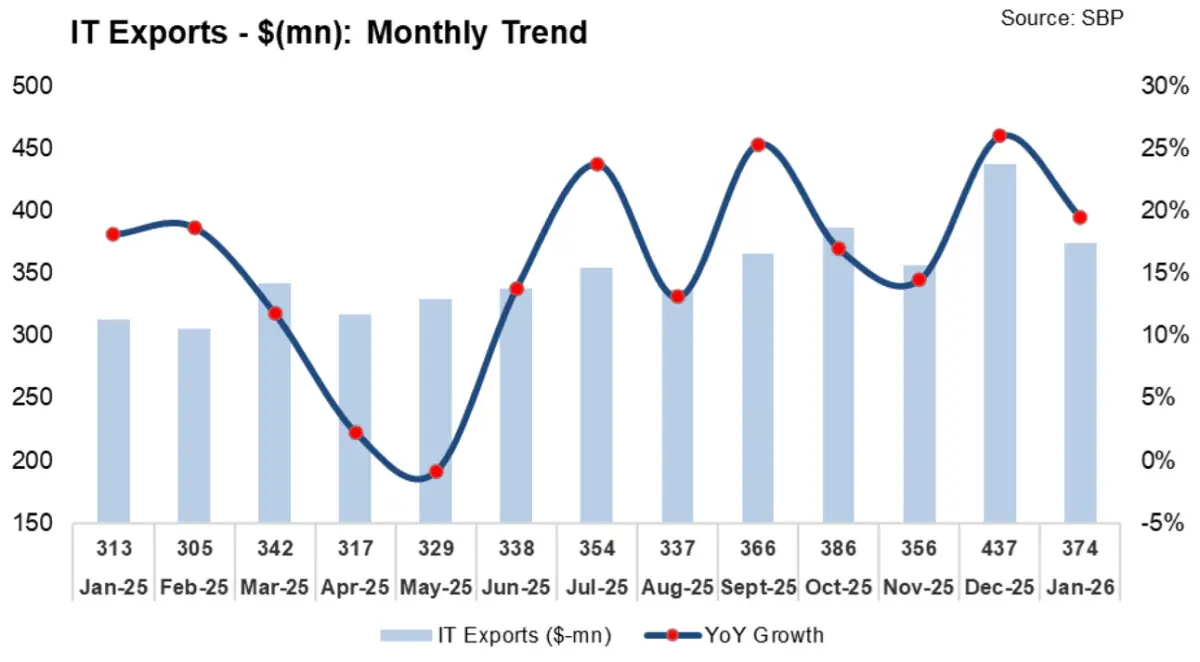
The sustained growth highlights resilient global demand for software development, IT-enabled services, and freelancing, even amid a mixed global tech environment.
Net IT exports remained strong in January, reinforcing the sector’s role as a critical source of foreign exchange.
With cumulative exports already at $2.6 billion in seven months, the sector remains on track for another year of double-digit expansion.
Alongside IT, Other Business Services posted even stronger relative growth. OBS exports rose from $958 million in 7MFY25 to $1.205 billion in 7MFY26, marking an increase of around 26 percent year-on-year. This segment now represents a meaningful share of total services exports and reflects Pakistan’s deepening participation in global professional and technical services markets.
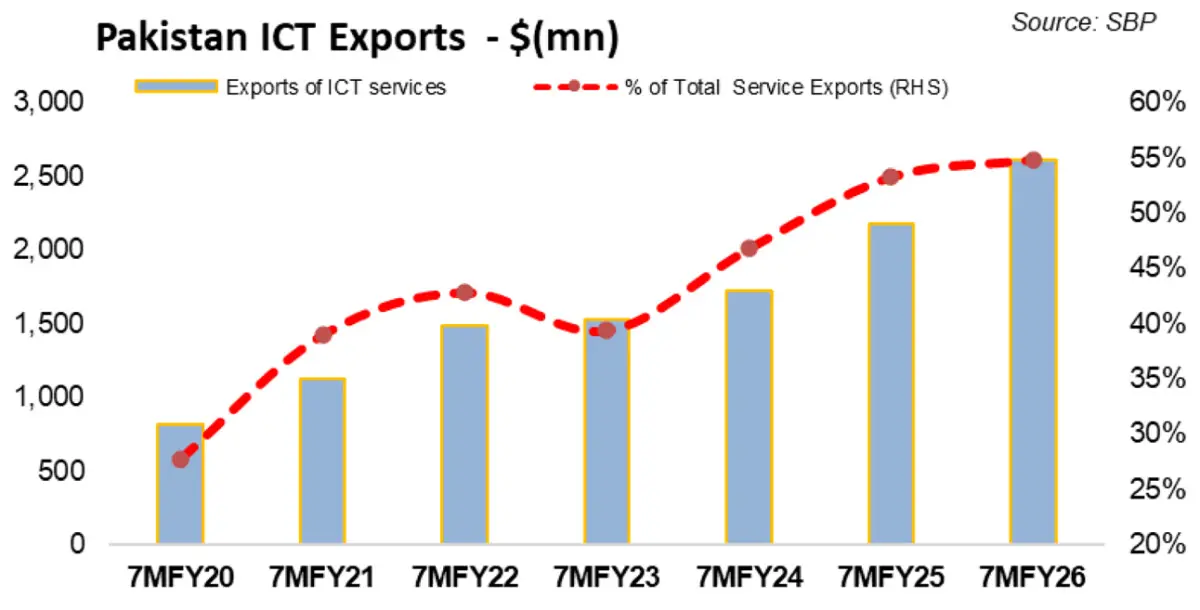
In balance-of-payments terms, OBS covers a broad spectrum of commercially traded services, including engineering, consulting, legal, accounting, marketing, research, and other professional activities. The expansion signals increasing formalization of freelance income streams and sustained outsourcing demand from international clients.
The composition within OBS further underscores the structural evolution of Pakistan’s services base.
Roughly 70 percent of OBS exports stem from technical, trade-related, and other business services—including architectural, engineering, scientific, and freelance services—while about 27 percent comes from professional and management consulting services such as legal, accounting, management consulting, and public relations. This distribution highlights the growing role of skilled professionals and SMEs operating in global value chains beyond core IT services.
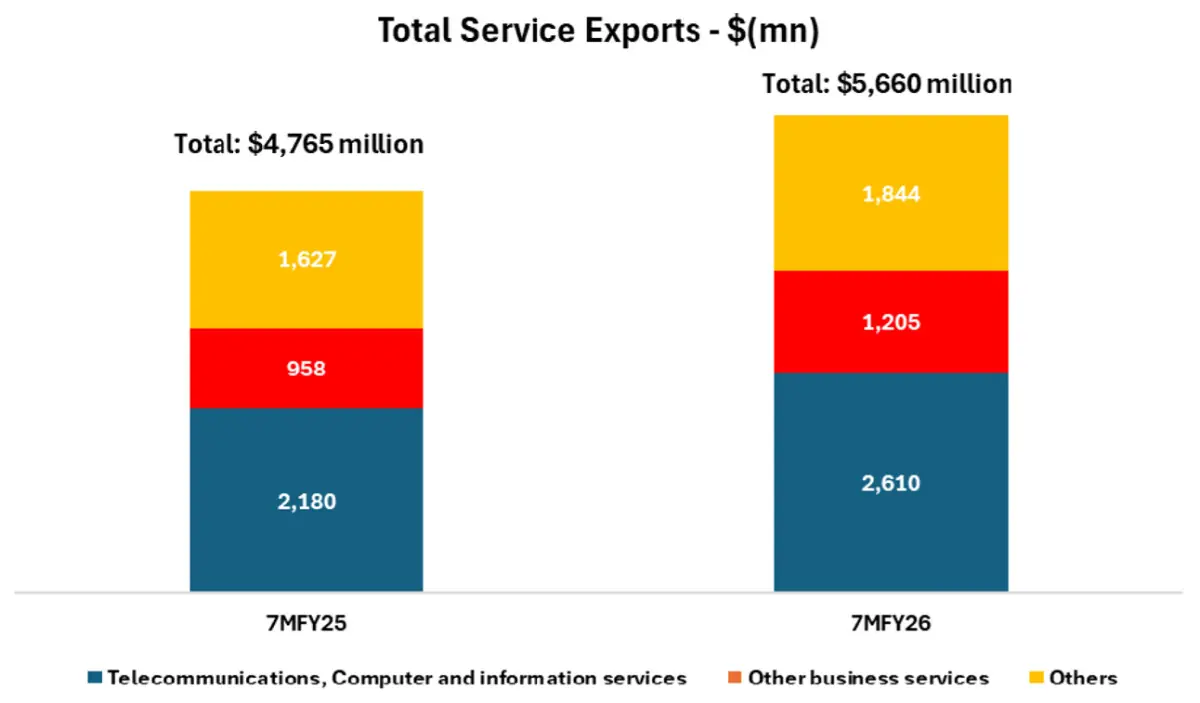
Taken together, IT and OBS account for the bulk of incremental growth in services exports during 7MFY26. Their combined performance indicates that Pakistan’s external sector is gradually diversifying away from traditional, trade-linked services toward digitally enabled and human-capital-intensive exports.
While goods exports remain constrained by structural bottlenecks, the continued expansion of IT and OBS strengthens the case that modern services can serve as a durable and scalable pillar of foreign exchange earnings—provided policy stability, digital infrastructure, and skill development keep pace with the sector’s ambitions.























Comments
Comments are closed for this article.