


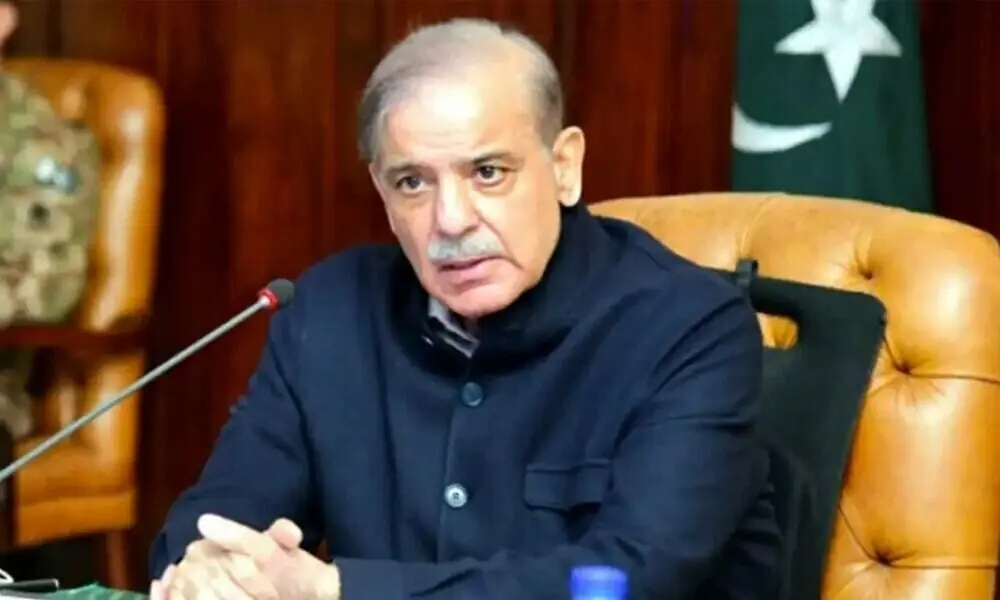
EDITORIAL: Prime Minister Shehbaz Sharif while talking to the Qatari Businessmen Association (QBA) members led by Chairman Sheikh Faisal bin Qassim al-Thani highlighted Pakistan’s improving macroeconomic indicators and reforms currently underway to facilitate foreign investors.
He then proceeded to invite the businessmen to explore investment opportunities in various sectors including infrastructure, agriculture, logistics, energy, technology and export-oriented manufacturing sector.
The government has repeatedly declared that attracting foreign investment is its preferred growth model and for this purpose it set up the Special Investment Facilitation Council (SIFC) on 20 June 2023 designed to operate at the federal/sectoral levels with the highest representation from the military (critical due to legitimate security concerns) and the civilian administrations at the federal and provincial level to ensure swift decision-making.
The number of foreign trips that have been undertaken by Prime Minister Shehbaz Sharif by far exceed those undertaken by his predecessors is the following: 13 in 2022, 10 in 2023, 13 in 2024 - the caretaker set-up was in place from 12 August 2023 till 4 March 2024 - 25 in 2025 and five from January to February 2026.
The thrust of these visits has varied from seeking foreign investment to attending international forums, to securing financial assistance for rollovers/budget/project support (budgeted at nearly USD 20 billion for the current year), a condition set by the International Monetary Fund (IMF) under the ongoing programme, and more recently, as the only nuclear armed Muslim country, to provide a security blanket to those Muslim nations that are visibly concerned at Israel’s overt hegemonistic regional objectives.
To-date the Shehbaz Sharif-led government has signed numerous Memoranda of Understanding amounting to over USD 25 to 30 billion and yet, as per data released by the State Bank of Pakistan, total foreign investment declined by a whopping 51 percent July-January 2025-26 in comparison to the same period the year before - from USD 1429 million to USD 694 million.
The reason is obvious: foreign investors are attracted to risk-free investments - political and economic - which disturbingly remain high in Pakistan. In this context, it is relevant to note that the three international rating agencies have never ever rated Pakistan as investment grade with our rating, fluctuating from non-investment grade highly speculative to junk status.
True that macroeconomic data has improved somewhat with GDP and large-scale manufacturing (LSM) sector growth showing visible improvement yet this is being challenged on three counts: (i) continuing clamour by the LSM to reverse some of the contractionary policies with the recent exit of multinational companies and domestic factory closures cited as indicative of a worsening trend; (ii) the government’s inability to extend monetary and fiscal incentives like in the past because of the pledge to the IMF not to incentivise productive sectors, given the Fund’s contention that “intervention in price setting, including for agricultural commodities, fuel products, power, and gas (biannual), combined with high tariff and non-tariff protection tilted the playing field in favour of selected groups or sectors.
Despite all this support, the business sector has failed to become an engine of growth, and the incentives eventually weakened competition and trapped resources in chronically inefficient (including perpetually “infant”) industries”; and (iii) the IMF claims that there are “important shortcomings in our data collection for sectors accounting for around a third of GDP, while there are issues with the granularity and reliability of the Government Finance Statistics.”
Thus, in spite of claims to the contrary, the economy remains fragile, a situation exacerbated by the severely contractionary monetary and fiscal policies that the government is pursuing as per the IMF diktat.
Until and unless the government can provide a booming economy foreign inflows would remain elusive; however, given the country’s improved geopolitical situation perhaps the way forward would be to request write-offs in the short term that would, in turn, strengthen the economy by reducing the existing high reliance on borrowing domestically and externally.
Copyright Business Recorder, 2026




















Comments
Comments are closed for this article.