


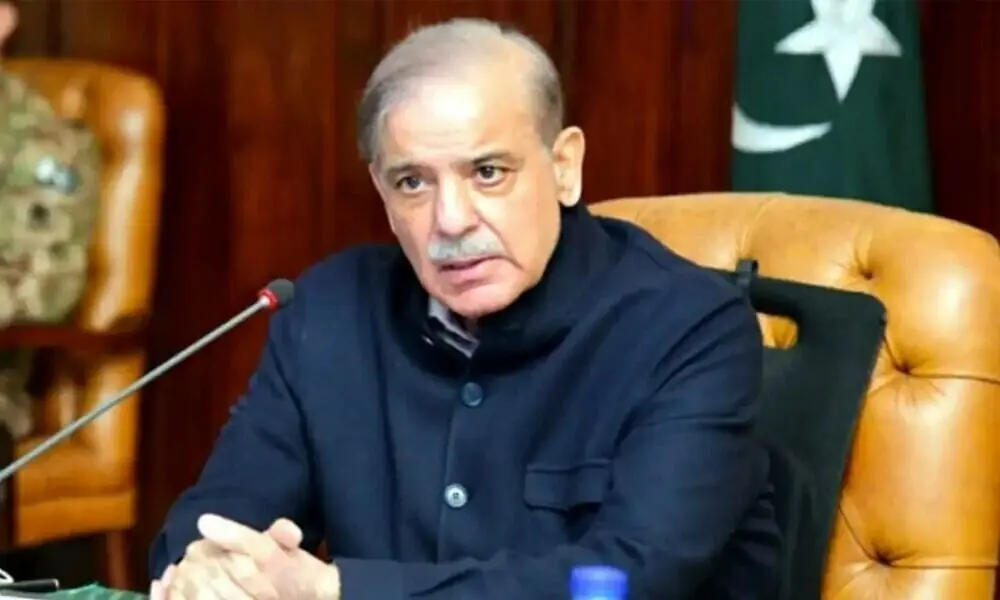

ISLAMABAD: Prime Minister Shehbaz Sharif on Wednesday hinted at a reduction in direct taxes across the board in the upcoming federal budget, stressing that sustainable economic growth cannot be achieved by continually raising the tax burden.
Addressing the opening session of the two-day Pakistan Governance Forum 2026, attended by leading businessmen from across the country, PM Sharif emphasised the need to prioritise production, exports, investments, and foreign direct investment (FDI).
“I believe that in the upcoming budget, we must decrease direct taxes across the board so that businesspersons and investors are facilitated,” he said.
He further noted that his government was united in the goal of tax reduction, underscoring that businesspeople typically do not pay indirect taxes, which are passed on to consumers.
READ MORE: Direct tax boost catapults tax-to-GDP ratio into double-digit
The prime minister criticised businesses for retaining indirect taxes that should be paid to the government. “You obtain the indirect tax from the consumers, but if you keep it in your pockets, then what can be a bigger injustice to the nation,” he remarked, singling out industries such as sugar, cement, and tobacco.
PM Sharif cited an increase of Rs36 billion in tax recovery from the sugar sector in 2025, compared to the previous year, and Rs60 billion from the cement sector, but noted that some businesses’ failure to pay taxes was causing unhealthy competition.
He reiterated that improving the nation’s economy required collective action from the federal government, provinces, and military leadership. “It has to be a whole-of-government approach,” he stated, stressing the government’s role in facilitating businesses rather than running them.
“I believe that it is not the government’s duty to run businesses, it is that of businessmen,” he said, adding that the government’s duty was to provide support in areas such as productivity, efficiency, research, and exports.
The Prime Minster also called for urgent action to address the country’s economic challenges, warning that “time is running out” to recover the country’s lost economic standing.
Speaking at the function, Federal Minister for Planning, Development and Special Initiatives Ahsan Iqbal outlined the goals of the Pakistan Governance Forum 2026, emphasising the need for practical solutions to ensure sustainable economic growth. He highlighted the potential for Pakistan to reach a USD1 trillion economy by 2035, provided the nation maximized its capabilities. He also called for a shift in focus from political marches to an “Economic Long March.”
Iqbal, who also discussed the launch of the PSDP Data Portal to ensure transparency in national development, reaffirmed the government’s commitment to reforms. He said international financial institutions were now viewing the country’s economic transformation as a success story, stressing that policy consistency, institutional reforms, and digital transformation would strengthen the economy.
Federal Minister for the Board of Investment Qaiser Ahmed Sheikh added that the government was committed to regulatory reforms and a shift towards export-led growth, focusing on value-added exports and competitiveness.
Federal Minister for Petroleum Ali Pervaiz Malik outlined the government’s energy sector reforms, emphasising the need for an efficient, sustainable energy framework. He highlighted key initiatives, including the revival of the Cabinet Committee on Energy, steps to address gas circular debt, and the introduction of a new Tight Gas Policy.
Malik noted that the principal amount of gas sector circular debt, which had risen to Rs1,831 billion by June 2025, declined to Rs1,816 billion by September 2025. He also reported that a shale pilot project was under way in Hyderabad, and the DGPC office was being restructured with World Bank support.
He pointed to growing foreign investor interest in Pakistan’s energy sector, with Turkish Petroleum opening an office in Islamabad, SOCAR’s recent visit, and KUFPEC’s upcoming visit.
He reaffirmed the government’s commitment to deregulation, market efficiency, and boosting private sector investment in the energy market.
Senator Sherry Rehman of PPP, chairing a panel on “Governing Pakistan in an Uncertain World,” discussed the nation’s economic and demographic challenges.
With Pakistan’s public debt exceeding Rs80 trillion and unemployment rising, Rehman warned that the country was facing a “demographic time bomb” as three million young people entered the job market annually.
Rehman also noted Pakistan’s vulnerability to climate change, highlighting water scarcity in regions like Balochistan and the Sindh delta. She called for a “whole-of-country” approach to managing environmental risks and stressed the need for a reimagined budget that prioritizes investment in jobs, research, and development.
The forum also featured speeches from several key figures, including Power Minister Awais Leghari, IT Minister Shaza Fatima Khawaja, and Sindh Chief Minister Murad Ali Shah, along with British High Commissioner Jane Marriot.
Copyright Business Recorder, 2026




















Comments
Comments are closed for this article.