


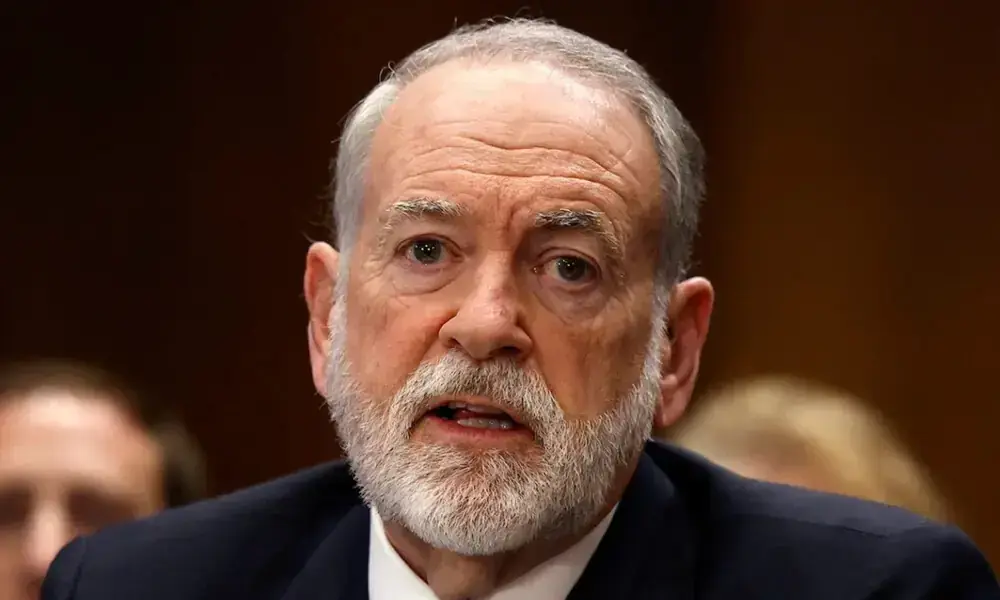
EDITORIAL: Pakistan’s Foreign Office rightly, and very predictably, joined the condemnation of remarks made by US Ambassador to Israel Mike Huckabee, asserting that his suggestion that Israel could “take it all” in reference to biblical territorial claims undermines existing peace efforts and contradicts diplomatic commitments, including plans aimed at containing escalation and promoting a political horizon for a Palestinian state. That response carried weight because it followed remarks by Huckabee, made during an interview with podcaster Tucker Carlson, in which he appeared to endorse maximalist territorial claims framed in scriptural terms.
Across the Muslim world, those comments were interpreted as lending legitimacy to expansionist visions long associated with the idea of a “Greater Israel,” a concept that directly challenges the sovereignty of multiple states in the region and unsettles an already fragile diplomatic environment.
In a region defined by occupation, contested borders and unresolved sovereignty disputes, such statements are read as strategic signals, not casual commentary. When an accredited envoy of a superpower appears to legitimise expansive territorial claims stretching beyond internationally recognised borders, governments and people alike read it as a departure from established diplomatic commitments.
The reaction was swift and coordinated. Fourteen governments, including Pakistan’s, alongside the Organisation of Islamic Cooperation, the Arab League and the Arab Gulf Cooperation Council, issued a joint condemnation describing the remarks as dangerous, inflammatory and contrary to international law and the UN Charter. That level of collective response is reserved for moments when states believe foundational principles are being tested.
The anger in Muslim capitals stems from several overlapping concerns. First is the issue of sovereignty. Modern international order rests on territorial integrity. References to land extending “from the river of Egypt to the Euphrates” evoke maps that cut across multiple sovereign states. Even if presented as theological commentary, such language from a serving ambassador cannot be detached from policy implications.
Second is the already fragile two-state framework. However weakened, it remains the formal diplomatic reference point for resolving the Palestine dispute. Statements that appear to endorse territorial absorption undercut the credibility of any claimed commitment to negotiated settlement.
Arab governments that maintain working relations with Washington do so partly on the assurance that US policy ultimately supports stability and a political resolution. When that assurance wavers, their domestic political space narrows.
Third is precedent. Diplomacy functions through signals. An ambassador’s public comments are rarely dismissed as private musings. They are interpreted as reflections of thinking within the administration he represents. If left unchecked, such rhetoric risks normalising expansionist narratives at a time when tensions are already high.
The legal dimension further complicates matters. International law does not recognise territorial acquisition by force.
The UN Charter’s principles of sovereign equality and territorial integrity are explicit. Experts have noted that an envoy is not positioned to endorse aggressive actions without placing his sending state in a difficult position. If Washington aligns itself with the remarks, it absorbs diplomatic and legal costs. If it distances itself, it raises questions about discipline and coherence in its own diplomatic ranks.
Huckabee subsequently argued that his comments were theological rather than policy-oriented. Yet his clarification did little to calm the storm. By framing the backlash as the product of disinformation and naming countries such as Pakistan and Turkiye, he shifted the dispute from substance to confrontation. That approach may resonate domestically in the United States, but it deepens mistrust abroad.
For Pakistan, the issue is neither abstract nor rhetorical. Islamabad has consistently supported Palestinian self-determination within internationally recognised parameters. It has also advocated de-escalation in a region prone to spirals of violence. When a senior US official appears to dismiss those parameters, it becomes necessary to respond firmly.
More broadly, Washington must consider the strategic cost of rhetorical excess. American influence in the Middle East rests not only on military partnerships but on the perception that it ultimately values stability and lawful order. If regional actors conclude that US policy tolerates or encourages open-ended territorial ambitions, cooperation becomes politically expensive.
Words spoken in interviews may be intended for domestic audiences, but they travel. In a volatile region, especially, they can unsettle alliances, inflame public opinion and complicate already fragile diplomacy. Responsible statecraft demands discipline in language as well as action.
The alternative is erosion of trust at a moment when the region can least afford further destabilisation.
Copyright Business Recorder, 2026




















Comments
Comments are closed for this article.