


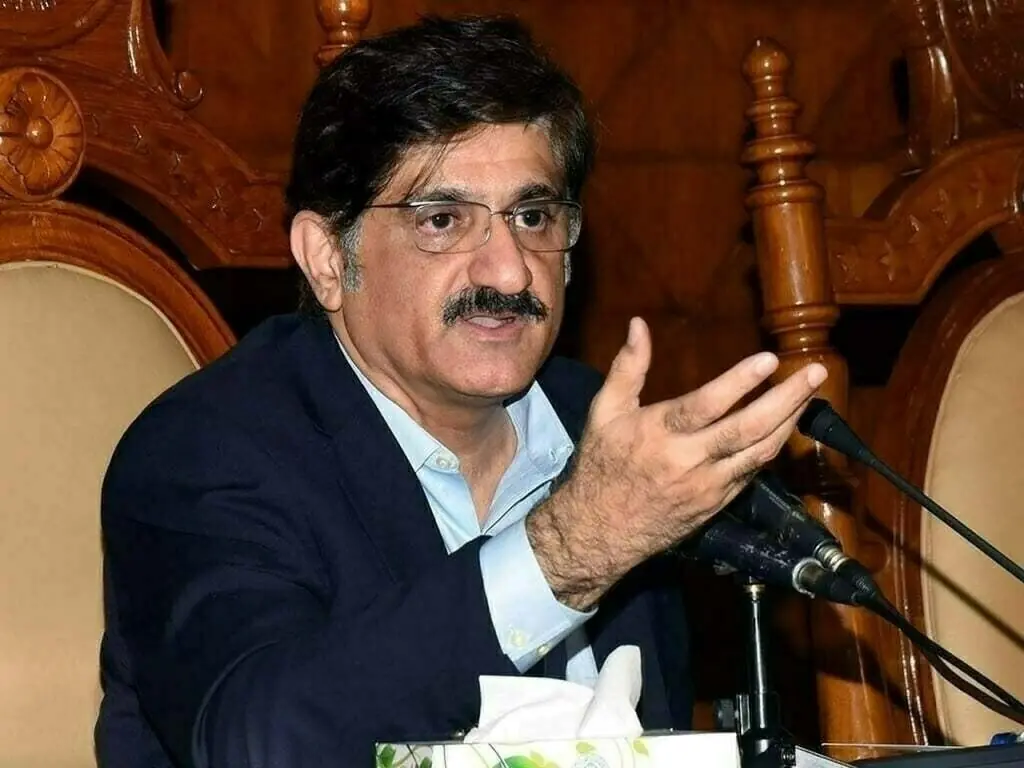

KARACHI: The Sindh Assembly on Saturday adopted a resolution moved by Chief Minister Syed Murad Ali Shah declaring Karachi an inseparable and inalienable part of Sindh, amid strong opposition from the Muttahida Qaumi Movement (MQM), which termed the move unconstitutional and opposed it.
The House warned that any attempt to divide Sindh or create a separate province for Karachi would violate history, the Constitution, and democratic principles, and would endanger national unity and the federal structure. The PTI landed its complete support to the resolution and Sindh’s unity.
READ ALSO: Mustafa Kamal demands federal control and economic capital status for Karachi
The resolution categorically condemned what it described as any conspiracy to divide Sindh or separate Karachi. While presenting the motion, the chief minister said that opposing the resolution would amount to opposing Sindh. Referring to recent meetings where Sindh’s division was discussed, he strongly denounced such ideas and said Sindh had played a foundational role in the creation of Pakistan. He clarified that the resolution did not name any individual or political party.
The session, chaired by Speaker Syed Awais Qadir Shah, began with routine proceedings before the chief minister sought permission to table the resolution. In his speech, he recalled that the Sindh Assembly had passed the Pakistan Resolution before independence and reaffirmed Pakistan’s unity following the assassination of Benazir Bhutto through the slogan “Pakistan Khappay.” He expressed hope that members across party lines would support the motion.
According to the resolution, Sindh is not merely an administrative unit but one of the world’s oldest living civilisations. It describes the province as the land of Mohenjo-daro and the cradle of the Indus Valley Civilisation, home to Shah Abdul Latif Bhittai, Sachal Sarmast, Abdullah Shah Ghazi and Lal Shahbaz Qalandar. It states that Sindh’s cultural identity, language and historical continuity predate modern political borders and have survived invasions, empires and colonial rule.
The text further states that Karachi, historically known as Kolachi, emerged from Sindh’s land and developed as its port city, commercial centre and gateway to the world. Despite becoming Pakistan’s first capital after independence in 1947, Karachi, it says, remained historically, geographically and emotionally linked to Sindh. The resolution recalls Sindh’s separation from the Bombay Presidency in 1936 as a landmark achievement following a prolonged constitutional struggle.
The motion also refers to the March 3, 1943 resolution passed by the Sindh Assembly endorsing the demand for a separate homeland for Muslims of the subcontinent, highlighting Sindh’s decisive role in the creation of Pakistan. It asserts that the first provincial assembly to support Pakistan cannot allow the division of its own historic territory. Public resistance to the One Unit scheme in 1955 and the restoration of Sindh’s provincial status in 1970 are cited as evidence of popular resolve. Reference is also made to the 1973 Constitution, noting that Article 239 bars changes to provincial boundaries without a two-thirds majority.
Reaffirming Sindh’s status as a historic federating unit, the resolution recognises collective contributions from Karachi to Keti Bandar and from Kashmore to Karoonjhar. It describes Karachi as Pakistan’s economic lifeline and a symbol of unity.
Declaring Sindh’s territorial integrity and historical identity a sacred trust, the House pledged to defend the province through constitutional and democratic means and urged political parties to avoid divisive narratives. Members also committed to unity beyond party affiliations for Sindh’s defence.
During the debate, Sindh Local Government Minister Syed Nasir Hussain Shah supported the resolution, alleging that history had been distorted through claims that Karachi was never part of Sindh. He cited Talpur-era cannons at Keamari as historical evidence and questioned whether governance failures justified calls for division. He also acknowledged Urdu-speaking citizens who rejected such narratives.
PPP lady lawmaker, Sadia Javed endorsed the resolution, recalling past separatist slogans and alleging provocative remarks against federal institutions at the Governor House. She warned against ethnic polarisation and demanded action against those advocating provincial division.
From PTI, Muhammad Shabbir Qureshi said Sindh would neither break nor face disintegration, but argued that rural–urban distinctions, particularly in employment policies, created resentment. Ending discrimination, he said, would remove the need for such resolutions. He confirmed PTI’s support for the motion. PTI’s Bilal Hussain Khan Jadoon and Sajjad Ali Soomro also backed the resolution, stressing equal rights for all residents and rejecting any attempt to separate Karachi.
MQM members opposed the motion. Aamir Siddiqui questioned the need for the resolution, arguing that criticism of government performance should not be criminalized. He said Karachi contributed significantly to national revenue but lacked decision-making authority. Maaz Mehboob stated that the Governor House event focused on public issues and highlighted IT education initiatives for thousands of children. He questioned the rural–urban quota system and opposed the resolution, calling it unconstitutional.
MQM legislator, Muhammad Dilawar argued that Karachi was historically a fishing settlement and claimed it had not been part of Sindh before British development, citing constitutional provisions regarding federal administration. While, MQM’s Taha Ahmed said the Constitution allowed discussion on new provinces and warned that the resolution would deepen divisions. He rejected allegations of supporting separatism and criticised the PPP for promoting nationalist rhetoric.
Responding to the criticism, the chief minister said the resolution violated no constitutional provision, did not mention the governor, and simply opposed Sindh’s division and the creation of a separate Karachi province. He recalled that a similar resolution had been unanimously adopted in 2019, including MQM’s support at the time.
Senior Minister Sharjeel Inam Memon also backed the resolution, saying all legitimately elected members should support it. He criticised the Governor House conference, questioned the electoral legitimacy of its participants, and defended local governments. He said Karachi served as a hub for employment and healthcare for people across Pakistan, noting that the city had effectively been under federal control during the Musharraf era.
He reiterated that the PPP had consistently upheld national unity. Following the conclusion of the debate, the Sindh Assembly adopted the resolution and the session was adjourned.
Meantime, a statement by MQM MPA Rana Shaukat Rajput again dominated proceedings in the Sindh Assembly on Saturday, after a video clip of his earlier remarks was replayed in the House.
Raising a point of order, Rajput said the issue referred to a day earlier had been resolved through mutual understanding. Sindh Minister for Home and Law Zia Ul Hassan Lanjar countered that the MPA had made serious allegations and must either apologize for a false statement or allow a case to be registered if his claim was correct. He insisted the video be replayed to determine the course of action.
On the Speaker’s orders, the clip was played. Sindh Assembly Speaker Awais Qadir Shah asked Rajput to apologise to fellow MPA Shariq Jamal, warning that such conduct reflected poorly on the House. He stressed that Rajput must either apologise or pursue legal proceedings.
Rajput maintained that his statement was “100 percent correct,” while acknowledging that reconciliation had taken place in the Speaker’s chamber and apologies were exchanged. The Speaker later said he would personally take up the matter.
Separately, the issue of the suspension of MQM MPA Engineer Muhammad Usman was raised. MQM Parliamentary Leader Iftikhar Ahmed submitted an apology letter, with the Speaker directing that the suspended member personally appear in the House to read it out.
Copyright Business Recorder, 2026




















Comments
Comments are closed for this article.