


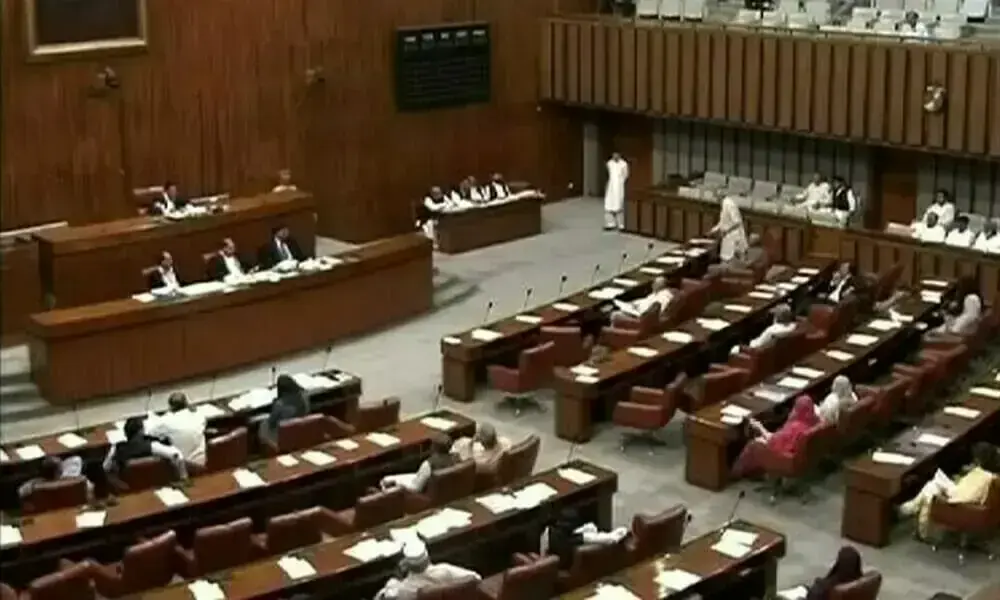
EDITORIAL: The proposal placed before a recent meeting of the Senate Standing Committee on Law and Justice, chaired by Senator Farooq H. Naek, to make graduation a mandatory qualification for holding high constitutional and public offices is not merely ill-conceived; it strikes at the very heart of democratic principles.
The Constitutional (Amendment) Bill 2024, introduced by BAP Senator Samina Mumtaz Qadir, echoes a discredited impulse from Pakistan’s political history: the use of formal qualifications as a gatekeeping device to exclude inconvenient political actors rather than to genuinely improve governance.
At a superficial level, the argument advanced by the bill’s mover that holders of high office shoulder enhanced constitutional responsibilities and therefore warrant elevated eligibility standards may sound reasonable. The problem lies in the deeply flawed assumption that a graduation degree is either a reliable proxy for competence or a legitimate constitutional requirement.
Pakistan’s own experience, as well as that of functioning democracies worldwide, offers no evidence to support such a claim. The country already has a political class at both federal and provincial levels that is, by and large, well-educated. Many incumbents boast degrees from prestigious local and foreign institutions.
Yet this impressive academic pedigree has not translated into improved governance, meaningful institutional reform, or tangible relief for citizens grappling with economic hardship, poor service delivery, and systemic injustice. Formal education, while valuable, is neither a substitute for political acumen nor a guarantee of ethical conduct or administrative competence.
The proposed amendment also raises serious constitutional concerns, particularly in relation to Article 25, which guarantees equality before the law. By imposing an educational bar on eligibility for public office, the amendment would run counter to this principle.
More fundamentally, modern democracies are premised on the idea that sovereignty resides in the people — in our case exercised by the people on behalf of God Almighty — who retain the right to choose their representatives as they see fit. To deny voters the option of electing a leader solely because that individual lacks a formal degree is to substitute elite judgement for popular will. It privileges access to education—often shaped by class, geography, and historical inequality—over lived experience, grassroots legitimacy, and public trust.
The reference to General Musharraf’s era is especially instructive. His regime’s decision to impose graduation requirements on legislators was widely understood not as a reformist measure, but as a calculated attempt to sideline specific politicians and engineer the political landscape to suit authoritarian objectives.
That experiment neither strengthened democracy nor improved governance; instead, it deepened public cynicism about contrived reforms. Committee member Senator Abdul Qadir’s observation that states are governed by wisdom, experience, and vision rather than academic degrees neatly captures the essence of the issue.
History is replete with transformative leaders—both in Pakistan and elsewhere—who lacked formal higher education but possessed political insight, moral authority, and a deep understanding of their societies.
If the real goal is better governance, the focus should be on strengthening institutions, enforcing accountability, improving internal democracy within political parties, and ensuring transparency in decision-making.
Arbitrary educational barriers achieve none of these objectives. In that sense, the proposed amendment is not merely unnecessary; it is fundamentally regressive.
Copyright Business Recorder, 2026




















Comments
Comments are closed for this article.