


Achakzai advocates for comprehensive overhaul of counterterrorism strategy
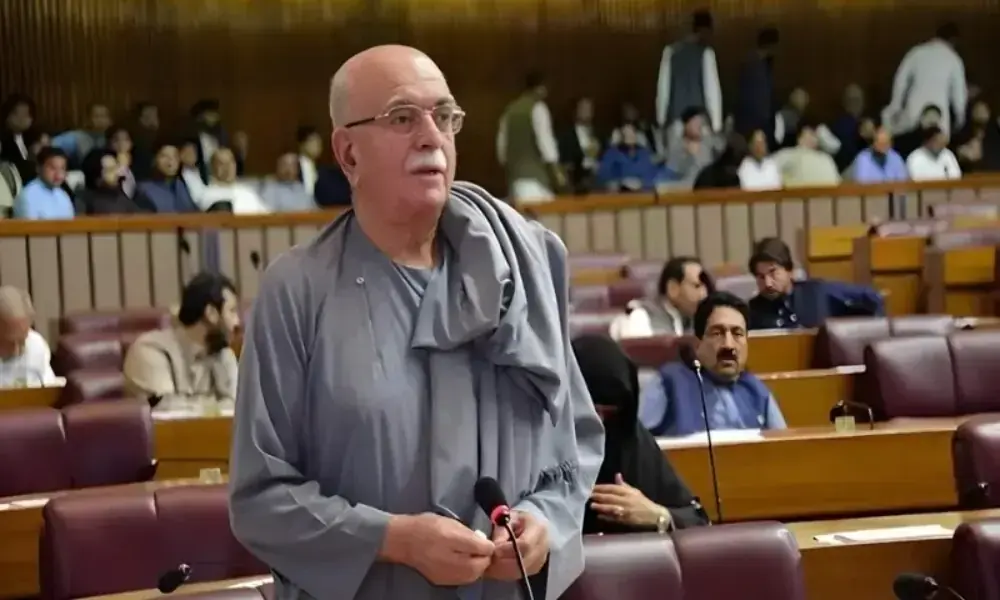

ISLAMABAD: Opposition leader in National Assembly Mehmood Khan Achakzai called for a comprehensive overhaul of the country’s counterterrorism strategy on Monday, urging Parliament to take a central role in decision-making following last week’s deadly suicide bombing at a Tarlai Imambargah in federal capital.
Speaking during a debate on the attack in the House, Achakzai argued that the solution to the country’s growing terrorism problem lies in strengthening democratic institutions, particularly Parliament.
He emphasised that the country’s military and intelligence agencies must operate within a framework of public accountability, rather than remaining entrenched in political affairs.
“Anyone who calls for weakening the military or intelligence agencies should be questioned,” he said. “However, our military must learn to function as militaries do in other countries, focusing on their primary role: eradicating terrorism and ensuring the nation’s security.”
Criticising the military’s political involvement, Achakzai referred to Pakistan’s historical policies, particularly the alignment with the US during the Cold War.
He described this as a “blunder,” noting that Pakistan’s security challenges today are partly the result of the “Kalashnikov culture” that emerged during that time, with cheap, widely available firearms continuing to impact the country’s security situation.
Achakzai also criticised Pakistan’s past decisions to align with the West in controversial conflicts, citing the cases of Libya and Iraq as cautionary examples.
“The West does not forgive anyone where its national interests are involved,” he warned, pointing to the fate of Libyan leader Muammar Gaddafi, who was killed despite having provided information to the West on Pakistan’s alleged uranium transfers.
On sectarianism, Achakzai blamed Western powers for exacerbating divisions in the Arab world, arguing that their human rights rhetoric often serves their own interests, rather than the genuine welfare of Muslim nations.
In contrast, Defence Minister Khawaja Asif accused India of waging a “proxy war” against Pakistan, highlighting the ongoing threat of terrorism linked to Afghan soil.
He insisted that Afghan territory was being used as a launchpad for attacks on Pakistan, further complicating regional security dynamics.
Asif stressed the need for national unity in combating extremism, acknowledging the sacrifices made by Pakistan’s armed forces in the fight against militancy.
“The sacrifices of our armed forces must be respected and acknowledged,” he said, adding that unity within Pakistan was crucial to securing long-term peace. Asif also called for resolution of internal disputes through dialogue in Parliament, stressing that such discussions, not violence, should be the proper forum for resolving national issues.
Echoing Achakzai’s concerns, Asad Qaiser of the opposition Pakistan Tehreek-e-Insaf (PTI) blamed the government’s reliance on closed-door decision-making for the rise in militancy.
He criticised the government for joining US President Donald Trump’s “Board of Peace,” arguing it undermined the role of Parliament.
He reiterated the need to make Parliament supreme, especially on matters of national security, and stressed the need for transparent and democratic decision-making.
He also called for improving relations with Pakistan’s neighbours, warning that deteriorating ties with neighbouring countries posed a significant risk to national stability. Pakistan People’s Party (PPP) leader Raja Pervez Ashraf also condemned India, accusing it of actively funding and supporting terrorism in Pakistan.
“India is not just a spectator but is actively involved in fanning the flames of terrorism in our country,” he said.
Other lawmakers, including Qadir Patel, Maulana Abdul Ghafoor Haideri, Khurram Shehzad, and others condemned the growing tide of militancy, calling for stronger efforts to address the root causes of terrorism.
In response to the recent terrorist attacks, the House unanimously passed a resolution condemning the suicide attack at Tarlai Imambargah.
The resolution expressed solidarity with the victims and their families and reaffirmed the nation’s resolve to confront terrorism. Lawmakers pledged to bring those responsible for the attack to justice and called for heightened efforts to combat extremist propaganda, including on social media platforms.
The resolution also called for effective investigations and compensation for the families of the victims.
Copyright Business Recorder, 2026

























Comments
Comments are closed for this article.