


Asia shares wobble, oil prices climb and gold makes a comeback
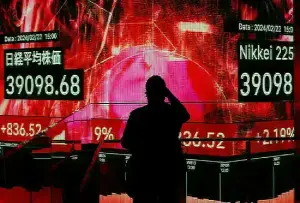
- MSCI's broadest index of Asia-Pacific shares outside Japan eased 0.2%, while Japan's Nikkei fell 1.23%


SINGAPORE: Asian stocks were on shaky ground on Wednesday, following steep losses in US and European equities on fears that advancements in artificial intelligence could supplant traditional software.
Oil prices climbed after the US shot down an Iranian drone and armed boats approached a U.S.-flagged vessel in a key waterway, while precious metals found a firmer footing after a recent rout.
A selloff among U.S. and European data analytics, professional services and software companies deepened after Anthropic’s launch of plug-ins for its Claude Cowork agent on Friday sparked worries of an AI-fuelled disruption to those industries.
Selling pressure was, however, less acute in Asia, given the region’s historical dominance in hardware manufacturing.
MSCI’s broadest index of Asia-Pacific shares outside Japan eased 0.2%, while Japan’s Nikkei fell 1.23%.
Nasdaq futures slipped 0.25% after losing more than 1% in the cash session overnight, while S&P 500 futures were down 0.1%. EUROSTOXX 50 futures dipped 0.07%.
“The AI trade is splitting between relative winners and losers,” said Ben Bennett, head of investment strategy for Asia at L&G Asset Management.
“We saw that last week after Microsoft fell despite decent results on fears of disruption to its software business. And that software wobble has continued this week. So it’s not simply that the tech sector is a universal winner - it’s going to have some weak areas too.”
South Korea’s technology-heavy KOSPI fell 0.14%, while stocks in Taiwan shed 0.68%.
Volatile times
In the oil market, Brent crude futures rose 1% to $68.03 a barrel while U.S. crude advanced 1.1% to $63.90 per barrel as recent events stoked concerns that talks aimed at de-escalating U.S.-Iran tensions could be disrupted.
The U.S. military on Tuesday shot down an Iranian drone that “aggressively” approached the Abraham Lincoln aircraft carrier in the Arabian Sea, the U.S. military said.
A group of Iranian gunboats also approached a U.S.-flagged tanker in the Strait of Hormuz north of Oman, maritime sources and a security consultancy said. OPEC members Saudi Arabia, Iran, the United Arab Emirates, Kuwait and Iraq export most of their crude via the strait, mainly to Asia.
Precious metals were meanwhile recovering from a rout. Spot gold reclaimed the $5,000 level and was up 1.5% at $5,014.31 an ounce, while silver rose 1.7% to $86.57 an ounce.
The meltdown came after US President Donald Trump announced Kevin Warsh as his pick to lead the Fed, while a margin hike by CME exacerbated the selling. Warsh is expected to shrink the Fed’s balance sheet, which usually hurts non-yielding precious metals.
“We expect elevated volatility to continue in the near term, but stabilization should return once the market finds its footing,” said Joshua Chim, general manager of online broker FSMone.
He added that retail investors on the platform had been “buying the dip via unit trusts or ETFs”, following the “significant correction” in gold and silver prices.
FED implications
Moves in currencies were more subdued on Wednesday, with the dollar halting a recent rally that came on the back of the Warsh announcement.
The yen struggled and fell to the weaker side of 156 per dollar, ahead of a weekend lower house election in Japan that could see Prime Minister Sanae Takaichi winning a stronger mandate to pursue tax cuts and expanded stimulus.
The euro last bought $1.1821 while sterling traded at $1.3710.
In cryptocurrencies, bitcoin languished near its lowest level since November 2024 and was up just 0.6% at $76,658.96, having lost 2.9% on Tuesday.
“The market structure has weakened strongly since October,” said Manuel Villegas Franceschi from Julius Baer’s next generation research team, adding that the “tipping point for the crypto drawdown” had been Warsh’s nomination.
Treasury yields were little changed, with the benchmark 10-year yield last at 4.2794%, while the two-year yield stood at 3.5778%.
Longer-end yields have edged higher as investors mull a Fed under Warsh, whose preference for a smaller balance sheet could reduce the amount of bonds the bank owns.
“I’m not thinking that necessarily, he’s coming in and says ‘for sure, we shrink the balance sheet’. I think he will make it data dependent, and say, dependent on developments,” Deutsche Bank Private Bank’s global chief investment officer Christian Nolting said at a media briefing.

























Comments
Comments are closed for this article.