


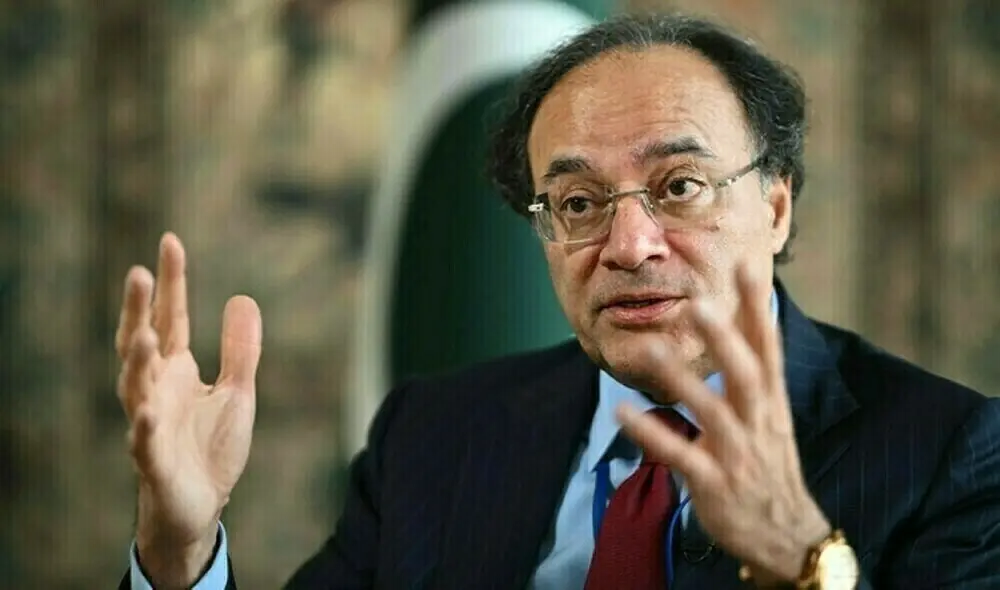
All ears are tuned towards Finance Minister Muhammad Aurangzeb who is resolute in his commitment to jump-start the economy. His endeavours towards providing economic stability are gradually reaping benefits but there is lot to be done.
An extraordinary radical and revolutionary vision should emanate from his office and focus should be more on facilitation for the private sector as well as the fenceline population.
A pragmatic shift from bureaucratic high-handedness to a laissez faire business environment would strengthen his hands and enable him to achieve his objectives. This swing is dependent on courage, charisma, and gravitas. He has these qualities aplenty.
The heart-burning point that is imperative is that positive policies are detoured midway leading to utter confusion and negatively affecting private sector endeavors as well as resulting in loss of trust.
The government resorts to ad hocism, piecemeal incentives, and populist measures in the heat of the moment. There are absolutely no gains from putting the business community between a rock and a hard place.
There are absolutely no benefits if industries pull down their shutters, leaving huge number of workers who then struggle for food on the table, withdraw children from academia, and expend their meager savings whenever health issues crop up in the family. Then, of course, there is hue and cry over exodus of citizens to foreign lands as well as fast-track transfer of wealth to safe havens out of Pakistan.
The first and foremost initiative is to attract domestic investors, including Overseas Pakistanis. The trust factor has withered away over the decades because day in and day out, new rules, regulations, and laws are churned out from officialdom in Islamabad.
The Finance Minister has to take the lead to get the nation out of the mess created on account of faulty and unwise state policies pursued for many decades. Solutions presently offered are bureaucratic and driven by short-term political considerations or favorable to elite capture and vested interests.
Political leaders have to create a climate that is easy for doing business and their obligation to the people and the environment should equally occupy high priority. It is time to change strategy and adopt a well-balanced track for an unruffled and successful future instead of palliative recipes. If maybe ten mega conglomerates resolve to change the elite capture environment, others will follow along and there will be egalitarian prosperity all across. It goes without saying that those who still want to subvert the system and get rich quickly should be proceeded against with the full might of law, irrespective of their influences.
There are fundamental issues that need to be immediately addressed regarding Foreign Direct Investment before any turbo-charged initiative is undertaken to attract foreigners. Policymakers must recalibrate their approaches to embrace a new forward-looking foreign investment architecture that should be anchored in the fundamentals of geo-economics. They must refrain from adopting unyielding measures that could be construed as extremely uncertain and detrimental in the scheme of things. There is a prevalent egregious xenophobic mindset in the country, whether among bureaucrats, religious leaders, political dispensation, and even in private sector organizations. This mindset is a paramount reason why roadblocks and firewalls are erected while dealing with foreigners.
The country’s portals are wide open for foreign loans and foreign grants, but when it comes down to foreign investment, the doors become windows or even cubby holes. Trust is the real currency of leadership that foreign investors emphasize.
One prominent example of FDI needs to be highlighted. A 100 percent Chinese-invested enterprise operating in Gwadar, export-based on non-traditional livestock, is all set to export donkey meat and hides to cater to the Chinese consumer.
After five years of consistent quality controls and compliances, it was able to secure Certification from General Administration of Customs of China and all set to ship the first cargo of 50 containers.
However, at the final procedural stage—the issuance of the health certificate required for export—the quarantine authorities informed the company that Pakistan currently lacks specific legislation permitting the slaughter of donkeys, and therefore the health certificate cannot be issued. It is pathetic that the Animal Husbandry Commissioner of the Ministry does not even give an appointment to even the President of the company. This situation has caused serious concern, as it appears to be inconsistent with existing policies, approvals, and bilateral commitments, including the official protocols signed between China and Pakistan covering the export of donkey meat and donkey hides, the No Objection Certificate and slaughterhouse registration issued to it by Ministry of National Food Security & Research, and the broader national policy objectives, including agricultural industrialization, value-added exports, and introduction of new technologies into Pakistan’s livestock sector that are repeatedly emphasized by government hierarchy.
The irony is that the company is in Gwadar, a region that faces exceptional developmental challenges and urgently requires sustainable economic opportunities.
The successful establishment of this investment has created employment, generated optimism among local communities, and opened a completely new export channel for Pakistan. For the people of Gwadar, this project represents genuine hope and tangible progress. It has overcome immense logistical, security, and operational challenges in Gwadar to deliver a project fully aligned with national priorities, but the lack of coordination and proactive support at the implementation level has been deeply discouraging.
Creating a predictable, supportive, and positive business environment is the shared aspiration of most of the current and prospective investors who wish to contribute to Pakistan’s development.
The industry and trade ecosystem has always been weighed down due to weak foundation. Progress of an enterprise usually begins from the middle or by following the leader instead of ensuring and building a bedrock base. One missing pillar is a skilled and trained workforce.
Enterprises depend on a workforce by poaching from other companies or having little choice but to impart on-job-training. The new business equation now requires a more proficient workforce, especially technically qualified and possessing talented readiness. There is a mismatch between academia outputs and job market realities.
The Finance Minister has to factor in substantial allocation for skills development and vocational programs in emerging technologies, especially digital and AI, among other disciplines. His vision should manifest a structural shift from ordinary educational curricula and established systems and instead allocate resources for a resilient infrastructure to boost reskills and upskills, versatility, and competency development as well as a future-ready workforce market.
The Finance Minister must also tackle the unbearable taxation system that is suffocating and depressive. The compliance mechanism must be simplified to facilitate better execution. The wretched process of audit, inspection, and checking must be restructured and made facilitative so that the concerned officials are not abusing powers, especially discretionary powers.
Tax forms must be redesigned, official letters should not be threatening, and there should be a limit to over issuance of notices demanding, often frivolous information, and even when FBR already has the information in its database. IRIS needs to be upgraded too.
There are approximately 400,000 Sales Tax registered payers while around 200,000 file returns (including nil filers). If, for example, 80,000 try to access IRIS at about the same time, the system often crashes. The business community is fully supportive of digital integration, but the efficiency of the integrated system is frustrating.
The private sector is supporting the Finance Minister and eagerly expecting that the Budget would catch the bull by its horns instead of it being a rocking horse that moves but does not make progress.
American physicist and Nobel Prize winner Jerome Isaac Friedman once remarked that “Excessive bureaucracy is distracting, time-consuming, and destructive to creativity.”
Copyright Business Recorder, 2026
The writer is an industrialist


















Comments
Comments are closed for this article.