


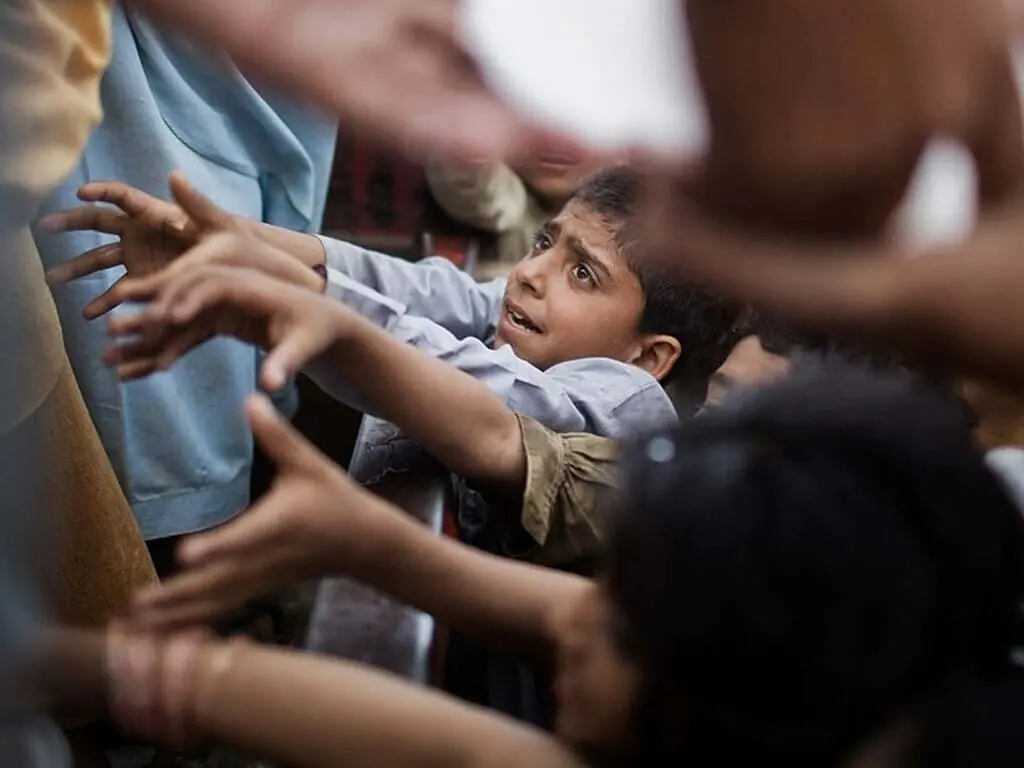

Poverty, long regarded as Pakistan’s most stubborn national challenge, has once again surged to the forefront of public debate, this time not as a distant statistic, but as a lived reality for millions. The latest poverty estimates paint a sobering picture: after years of gradual improvement, poverty has sharply deteriorated in recent times, erasing hard-won gains made under previous political regimes. These figures are more than numbers; they are a mirror reflecting the economic pressures facing households today and a stark commentary on policy outcomes under changing governments.
At the heart of these estimates lies a rigorous and internationally aligned measurement framework. Pakistan measures poverty using the Cost of Basic Needs approach, anchored in the national poverty line first established in 2013-14. This benchmark defines the minimum monthly spending required for a person to meet basic food and non-food needs.
To ensure fairness and comparability over time, this poverty line is not redefined each year but is updated for inflation, allowing analysts to track real changes in household welfare rather than methodological shifts. In simple terms, the same standard of living is assessed year after year, adjusted only for rising prices.
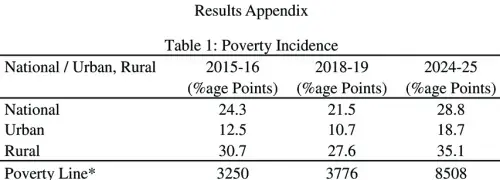
When this benchmark is applied to household consumption data collected by the Pakistan Bureau of Statistics, a clear story emerges, one that aligns closely with Pakistan’s recent political and economic history. During the period spanning 2015-16, under the PML-N government, national poverty stood at 24.3 percent. By 2018-19, during the early years of the PTI government, poverty had fallen further to 21.5 percent.
This decline reflected steady economic activity, relatively stable prices, and improvements in household purchasing power. For millions of families, especially in rural areas, this period translated into modest but meaningful improvements in daily life.
That progress, however, proved fleeting. The latest estimates for 2024-25, covering the period of the Coalition Government, reveal a stark and deeply troubling reversal. National poverty has surged to 28.8 percent, exceeding not only its 2018-19 level but even eclipsing the rate recorded nearly a decade ago.
Put plainly, “almost three out of every ten Pakistanis are now living below the poverty line”, a grim marker of mounting economic distress and eroding living standards. Beneath these figures lies a sobering human toll: “26.4 million people have been pushed into poverty during this period”.
Urban Pakistan, once considered relatively insulated from extreme deprivation, has not been spared. Poverty in cities declined steadily from 12.5 percent in 2015–16 to 10.7 percent in 2018–19, reflecting better employment opportunities and income growth. By 2024-25, however, urban poverty surged dramatically to 18.7 percent. Rising food prices, soaring rents, energy costs, and fragile labour markets have combined to squeeze urban households, many of whom were previously classified as lower middle-income. The city, once a ladder out of poverty, has increasingly become a site of economic vulnerability.
Rural areas tell an equally troubling, if more familiar, story. Poverty fell from 30.7 percent in 2015-16 to 27.6 percent in 2018-19, reflecting gains in agriculture, remittances, and rural livelihoods. But by 2024-25, rural poverty had climbed to 35.1 percent, meaning more than one in three rural Pakistanis now live in poverty.
Structural weaknesses in agriculture, rising input costs, climate shocks, and limited access to services have intensified the burden on rural households, deepening long-standing inequalities between urban and rural Pakistan.
Perhaps the most striking indicator of economic strain is the dramatic rise in the poverty line itself. In 2015-16, a person needed approximately PKR 3,250 per month to meet basic needs. By 2018-19, this figure had risen modestly to PKR 3,776. By 2024-25, however, the poverty line had ballooned to PKR 8,508 per adult per month.
This steep increase reflects relentless inflation and the rapid erosion of purchasing power. Simply put, households today must spend more than double what they did a few years ago just to survive at the same basic standard.
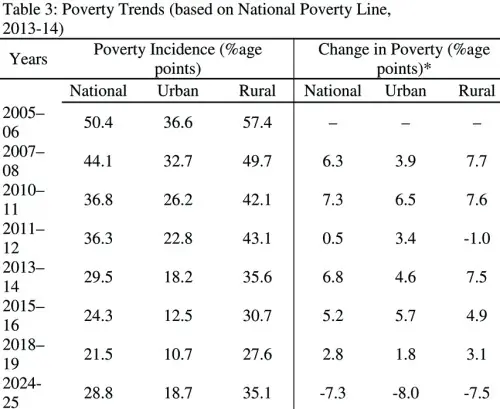
Looking at the longer trajectory, Pakistan’s poverty story had, until recently, been one of cautious optimism. From 2005-06 to 2018-19, national poverty fell dramatically, from over half the population to just above one-fifth.
These gains were broad-based, benefiting both urban and rural areas, and reflected sustained economic growth and relative price stability across successive governments. Yet the latest figures confirm that much of this progress has been undone in a remarkably short period. The rise in poverty by 2024-25 signals not a marginal setback, but a substantial rollback of earlier achievements.
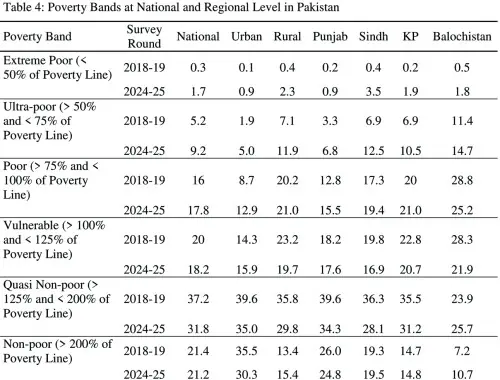
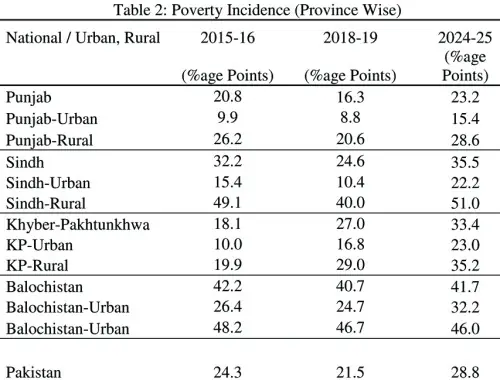
Provincial patterns reinforce this narrative of uneven and worsening outcomes. Sindh and Balochistan continue to bear the heaviest burden, particularly in rural areas where poverty rates remain alarmingly high. Punjab, while still relatively better off, has experienced a noticeable rise in poverty since 2018-19, especially outside urban centers.
Khyber Pakhtunkhwa stands out for its persistent vulnerability, with poverty rising sharply even before the latest period and continuing upward thereafter. Across provinces, urban poverty has increased significantly, highlighting a growing stress among households that were once considered economically secure.
Equally concerning is the shift within poverty itself. The share of the extreme poor and ultra-poor has expanded markedly since 2018-19, especially in rural areas and lagging provinces.
At the same time, many households that were previously just above the poverty line have slipped downward, shrinking the ranks of the quasi non-poor. While the overall proportion of non-poor households appears relatively stable at the national level, this masks a fragile reality: millions now hover precariously close to poverty, one price shock away from falling below the line.
Taken together, the evidence presents a clear and unsettling conclusion. Poverty reduction gains achieved between 2015-16 and 2018-19 have not merely stalled, they have been reversed.
The deterioration observed by 2024-25 underscores the economic cost of macroeconomic instability, high inflation, and weakened household incomes during the Coalition Government period. For policymakers, the message is unmistakable.
Restoring price stability, protecting real incomes, and strengthening targeted social protection are no longer optional, they are urgent imperatives. Without a decisive action, the recent surge in poverty risks becoming entrenched, shaping Pakistan’s social and economic landscape for years to come.
Copyright Business Recorder, 2026
The writer is Professor of Economics and Analytics at IBA, Karachi ([email protected])
















Comments