


EDITORIAL: India-EU trade raises uncomfortable questions for Pakistan
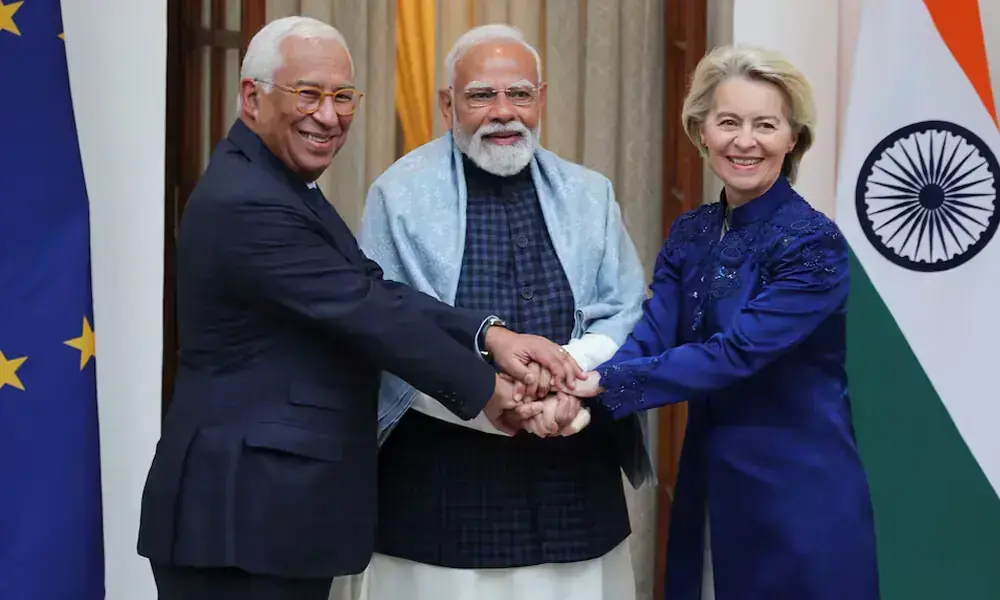
EDITORIAL: The India-EU trade deal is a significant development, no doubt, but for Pakistan it raises uncomfortable questions that cannot be postponed. Agreed in principle and now moving toward ratification, the pact will eventually link the world’s most populous country, with roughly 1.5 billion people, to a market of around 500 million consumers. For global trade flows, that scale alone is transformative. For Pakistan, whose export base is narrow and fragile, the implications are immediate and strategic.
The deal still requires ratification by EU member states and the European Parliament, a process expected to take around six months. That interval is not procedural noise; it is the only window Pakistan has to assess risks, recalibrate policy and defend its competitiveness before new preferences take effect. Once the agreement is operational, adjustment will come at a far higher cost.
At the centre of Pakistan’s concern should lie the EU’s GSP+ scheme. Since 2014, Pakistan has enjoyed duty-free access on more than 66 percent of tariff lines under this arrangement, a concession that has been central to sustaining textile exports to Europe. Most clothing, garments and home textiles, including bed linen, enter the EU at zero duty. This preference has not merely boosted exports; it has compensated for domestic disadvantages such as high energy costs, tax distortions and weak logistics.
India was not part of this scheme. That difference mattered. Under the new trade deal, Indian exporters will gain preferential access to EU markets, including in textiles, Pakistan’s flagship export sector. Even partial tariff reductions for India threaten to narrow the gap that has so far worked in Pakistan’s favour. In price-sensitive markets, where buyers shift sourcing quickly, relative advantage matters more than intent or goodwill.
READ MORE: OPINION: ‘Mother of all deals’: India-EU free trade agreement
This is the puzzle Islamabad must solve. Pakistan’s export earnings are already perilously low, and textiles remain the backbone of what little resilience exists. Losing ground in the EU, even incrementally, would have knock-on effects across employment, foreign exchange and industrial capacity. Unlike larger economies, Pakistan does not have diversified export buffers to absorb such shocks quietly.
The challenge is compounded by global uncertainty. Trade patterns are shifting not through negotiated multilateralism but through abrupt tariff announcements and reversals emanating from Washington. Countries are responding by locking in access where they can. India has done so with the EU. Pakistan cannot assume that existing arrangements will remain untouched simply because they have endured for a decade.
What is required now is not rhetoric but preparation. The government needs to begin with granular analysis. Which textile categories face the greatest overlap with Indian exports under the new regime? How sensitive are EU buyers to marginal tariff differences? Where does Pakistan retain advantages in compliance, lead times or specialised production, and where does it not? These are empirical questions, and they demand urgent answers.
Therefore, the margin for complacency has disappeared. Competing in EU markets alongside India, without a clear tariff edge, exposes how costly Pakistan has allowed its export environment to become. Energy pricing for industry, tax policy that penalises documented firms, delayed refunds and regulatory unpredictability all erode competitiveness. These weaknesses were survivable under GSP+. They become dangerous if that cushion thins.
The six-month ratification window must therefore be treated as a policy deadline. Export competitiveness cannot be defended after orders have been lost. It has to be protected in advance through targeted relief for export sectors, clearer exchange rate management, and credible signals that production, not extraction, is the priority.
The broader lesson is stark. Preferences erode, markets shift and scale asserts itself. Countries that remain ahead of the curve are those that anticipate these shifts rather than explain them after the fact. The India-EU trade deal is not a future risk. It is a present warning.
Pakistan has a narrow window to respond with seriousness and strategy. If it fails to do so, the loss of competitiveness will not arrive dramatically. It will come quietly, shipment by shipment, until the damage is done.
Copyright Business Recorder, 2026

























Comments
Comments are closed for this article.