


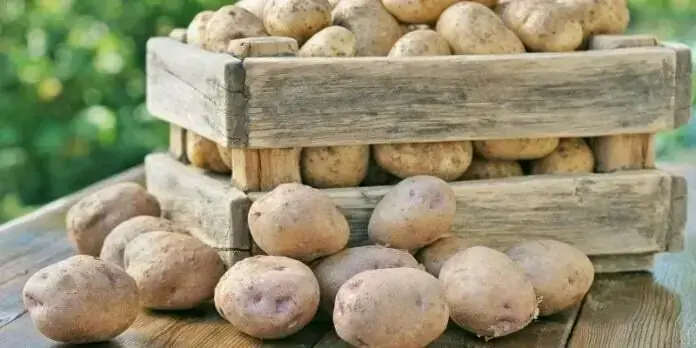

ISLAMABAD: The National Assembly Standing Committee on National Food Security and Research on Thursday decided to hold a meeting with Prime Minister Shehbaz Sharif to discuss the ongoing potato export crisis, as growers across the country and particularly in Punjab province face massive financial losses due to falling prices and shrinking exports.
The committee, which met under the chairmanship of MNA Syed Hussain Tariq, reviewed the sharp decline in potato prices and the reduced volume of exports, noting that the situation has severely impacted farmers.
The committee decided that to send a letter to Prime Minister requesting a meeting at his convenience during the coming week to apprise him of the severity of the potato crop crisis and present plausible solutions for timely and effective action.
Members also recommended that the government consider intervening in the market to purchase potatoes directly from farmers at fair prices, to protect farmers’ incomes, stabilize the market, and prevent further financial distress.
Rao Muhammad Ajmal Khan, special invitee briefed the committee on the actual cost of production and selling of potatoes, highlighting the reasons for the recent decline in prices. He also outlined the challenges affecting exports, including transport difficulties, storage limitations, visa issues, problems with phytosanitary certificates, and associated delays.
He informed the committee that stored potatoes have already suffered losses estimated at Rs30 billion, warning that within the next 15 days farmers’ produce could rot in the fields or be dumped on roads if no action is taken.
Tariq committee chairman said that potato farmers are expected to face losses worth billions of rupees due to the current situation.
A senior official of the Department of Plant Protection (DPP) said efforts are underway to export potatoes to Uzbekistan and other countries. A senior official of Ministry of Commerce told committee that, in response to a request from the Punjab Government, export-related issues had been taken up with the relevant authorities.
However, the chairman directed the Ministry of Commerce, Ministry of National Food Security and Research (MNF&R), Ministry of Foreign Affairs, National Logistic Corporation (NLC), Agriculture Department of Punjab, Potato Growers Association, and other relevant stakeholders to hold a joint meeting and submit a report on potato exports during the next meeting to be held on Monday.
The chairman said that potato exports do not fall directly under the mandate of the MNFS&R, but added that the ministry could have coordinated more effectively with other departments.
According to the Deputy Food Security Commissioner, potatoes have been cultivated on 1.1 million acres in Punjab this year. Representatives of the Potato Growers Association emphasized the need to focus on value addition as a long-term strategy and noted that Russia’s ban on potato imports cannot currently be lifted.
Punjab food officials informed the committee that potato production has reached 12 million tons, which is 2.2 million tons higher than last year. They added that 40 trucks are being exported daily via the Taftan border, but farmers are still unable to recover their production costs. Officials said the closure of the Afghan border has further depressed prices, though work is ongoing to identify alternative export routes.
The committee also discussed the government’s future policy on the deregulation of the sugarcane industry, with emphasis on safeguarding the interests of sugarcane growers, ensuring timely procurement and crushing of sugarcane, and facilitating prompt payment to farmers.
Tariq said that mills briefly raised the price to Rs500 per maund but reduced it to Rs400 per maund once farmers began harvesting their crops.
Committee members said that no sugar mill starts crushing on the designated date and farmers have not received payments for up to two years.
Punjab Cane Commissioner Amjad Hafeez informed the committee that Rs600 million in payments are still pending from Channar Sugar Mills, adding that mills are allowed to operate after paying partial dues.
Copyright Business Recorder, 2026

























Comments
Comments are closed for this article.