


India-EU FTA ‘to hurt’ Pakistan’s textile sector, warn experts
- The EU remains a key destination for Pakistan’s textile exports
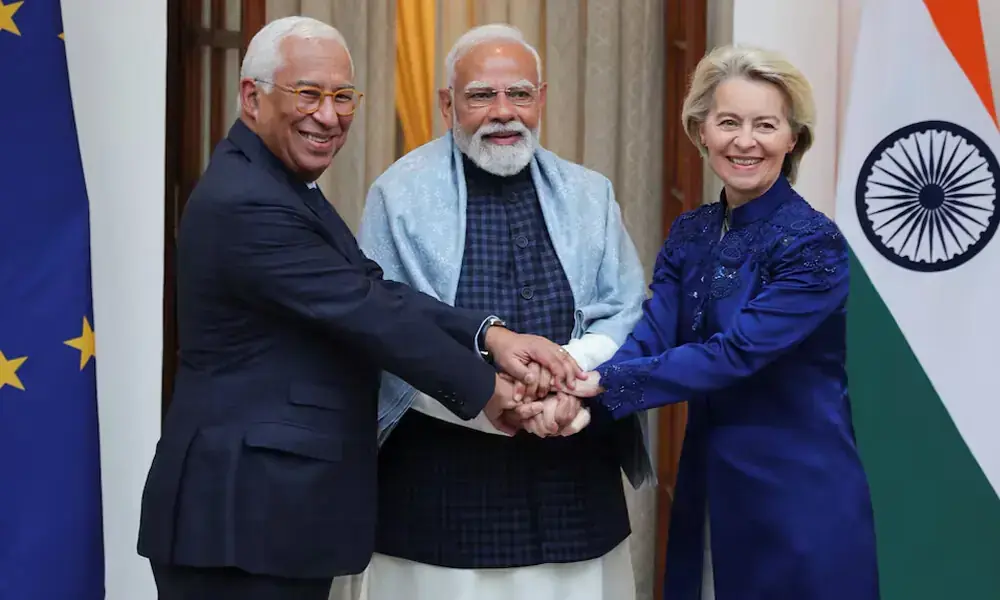

The newly finalised EU-India Free Trade Agreement is expected to put pressure on Pakistan’s exports, said JS Global on Wednesday, with 24% of the country’s shipments, predominantly textiles, destined for the EU.
On Tuesday, India and the European Union finalised a landmark trade deal that will represent a quarter of the world’s economy as the two sides seek to hedge against fickle ties with the US.
After nearly two decades of on-and-off negotiations, the deal paves the way for India to open up its vast and guarded market, the world’s largest, to free trade with the 27-nation EU, its biggest trading partner.
As a result, Indian textile and garment products will now witness a reduction or elimination of tariffs in EU member states.
India-EU FTA: MoC weighing potential impact on exports
“Indian textile and garment exports are currently subject to an 8-12% tariff under the GSP regime, which was suspended last week, while Pakistan enjoys zero tariffs under its GSP+ status. With the FTA now in place, Pakistan is likely to lose its comparative advantage, which was already thin, as India benefits from higher value addition and vertical integration,” said JS Global.
“We believe the EU-India FTA is likely to hurt Pakistan’s exports, 24% of which are targeted to the EU, mainly textile exports,” it said.
The EU remains a key destination for Pakistan’s textile exports after the USA. “Among the listed players, GATM (58%), ILP (45%), and NML (25%) have higher exposure to the EU compared to others.”
Similar sentiments were echoed by Gohar Ejaz, Chairman Economic Policy & Business Development Think Tank, in a post on a social media platform on Wednesday.
“The $9 billion exports last year to the EU with market access at zero-tariff honeymoon is over as the same zero -tariffs to the EU are now applicable on all main regional competitors,” said Ejaz.
The industrialist urged the Government of Pakistan to enable industry to compete in the region at regional energy, tax, and financing costs.
“Industry can no longer bear the burden of systemic inefficiencies.
“The decision must be taken today—$9 billion exports to the EU and 10 million jobs are at risk,” he warned.
Earlier, Pakistan Textile Council (PTC) Chairman Fawad Anwar expressed serious concern over the agreement’s repercussions for Pakistan’s export-oriented textile and apparel sector, warning that the country’s already fragile competitiveness in the EU market now faces an existential threat.
He said Pakistan currently exports approximately $9 billion worth of goods to the EU, of which nearly 65% consists of value-added textile and apparel products. “Even before the India–EU FTA, Pakistan’s competitive edge over India in the EU market was extremely thin and largely preference-driven. That narrow margin is now at serious risk,” he told Business Recorder.
According to recent trade data, Pakistan’s total textile and apparel exports to the EU stood at $6.2 billion in 2024, only marginally higher than India’s $5.6 billion. “This gap was never structural,” Anwar noted. “It existed primarily because Pakistan enjoyed preferential access under GSP Plus, while India faced tariffs of up to 12% on apparel.”
“With the India–EU FTA granting zero-duty access to Indian garments across all tariff lines, that advantage has effectively disappeared,” he said.




















Comments
Comments are closed for this article.