


No broad military operation under way in Tirah: Members of TTP, their families residing in Tirah: Asif
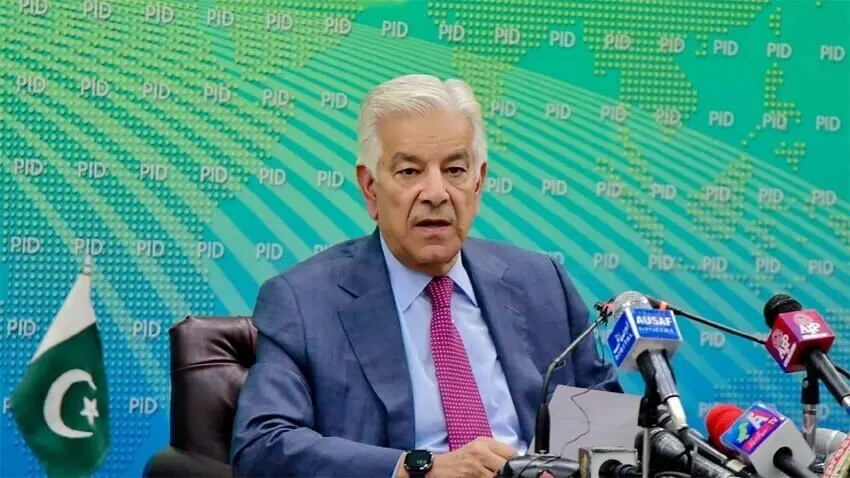

ISLAMABAD: Clarifying the situation in Tirah, senior PML-N leader and defence minister Khawaja Muhammad Asif said on Tuesday that no broad military operation is under way in the area, and that security actions remain limited to intelligence-based, targeted operations against terrorist elements, in line with earlier decisions taken in consultation with stakeholders.
Asif made these remarks during a press conference in Islamabad, where he was flanked by Information Minister Ataullah Tarar and Special Assistant to the Prime Minister for Information and Khyber Pakhtunkhwa Affairs Ikhtiar Wali Khan.
At the outset of the press conference, Asif said members of the banned Tehreek-i-Taliban Pakistan (TTP) had been residing in Tirah along with their families. “They are around 400 to 500 in number,” he said.
Addressing the press conference, Asif said the current movement of people from Tirah and adjoining areas was being wrongly portrayed as forced displacement, whereas seasonal migration from the region has been a long-established practice. He cited historical records, including the British Gazette of 1889, which documented that Afridi tribes traditionally migrated from Tirah and BaghMaidan to lower and warmer areas during winter that is a pattern that has continued for more than a century across the former FATA regions.
He questioned why the Khyber Pakhtunkhwa provincial government failed to make timely arrangements despite being aware of this recurring seasonal movement. Asif said that around eight months ago, it was agreed between the provincial government, security institutions, tribal elders and other stakeholders that temporary evacuation of civilians would precede any targeted counterterrorism action in Tirah.
In this context, Asif said the understanding was reached through three separate Jirga consultations, recalling that the Jirga held meetings on December 11, 21 and 31 last year with the civilian government on the issue. He said the jirga was constituted many years ago and all 24 members were unanimous on the demands raised for Tirah.
“It has been meeting the civilian government. You don’t see the military anywhere in this matter,” Asif said, adding that all demands, including relief, registration and facilitation, originated from the jirga itself. “Now, in the presence of the jirga and this notification, where do you see the military’s involvement in this?” he asked.
Despite the formal approval of a Rs4 billion relief package by the provincial government for the people of Tirah Valley who were to migrate, Asif said the funds were not operationalised in a timely manner. He said adequate registration points were not established, sufficient staff was not deployed, and contingency planning for severe weather conditions was ignored.
The minister claimed that there was a complete absence of civilian law enforcement agencies in Tirah. “There is no police station there,” he added.
Asif further stated that hemp cultivation was taking place over more than 12,000 acres in Tirah, adding that each acre generated profits of around Rs3 to 3.5 million. “This is a major factor in this entire issue,” he said.
He said hemp had multiple uses, including in medicines, construction material and bricks, but alleged that the dividends earned from the crop either went to political elements or the TTP.
“Hemp is harvested there and the money earned from it either goes to people associated with politics or the TTP. We have initiated measures to stop this, so that the people of Tirah benefit from this harvest, and schools and hospitals are constructed there,” Asif said.
He went on to allege that the interests of the KP provincial government aligned with those of the TTP in Tirah, claiming that both were exploiting the same revenue source.
Asif said that practical support for temporarily migrating families is currently being provided primarily by the Pakistan Army, while provincial and district administrations remain largely absent at key locations. He alleged that a deliberately limited number of registration counters and personnel were deployed at Tirah’s entry and exit points, resulting in congestion and long queues for affected families.
According to Asif, these avoidable administrative bottlenecks were subsequently highlighted to build a political narrative instead of being addressed through governance and service delivery. He alleged that the KP government was attempting to deflect blame for its administrative failures onto the military or an operation that did not even exist.
Speaking after him, Information Minister Ataullah Tarar said it was stated in official gazetteers from the 1880s that the Afridi and Akakhel tribes of Khyber traditionally descended to lower areas during winters and returned to Tirah in summers. “This is an established fact,” he said.
For his part, Special Assistant to the Prime Minister Ikhtiar Wali Khan questioned how much of the Rs4 billion package approved by the provincial government had actually been provided to the people who had been “forced to relocate.”
“PTI has been in power in Khyber Pakhtunkhwa for the last 13 years, and we know their methods. They announce such packages and then use these funds for political campaigns and street movements,” he alleged.
Wali also referred to the KP government’s own notification stating that the movement of people from Tirah would be voluntary, arguing that this contradicted claims of forced relocation.
“This proves that a project was created to mint money,” he said, adding that the armed forces had nothing to do with the movement of people from Tirah, regardless of whether it was described as depopulation or forced relocation.
The PM’s aide further claimed that, in his assessment, the people of Tirah were being used to ensure the success of the opposition’s protest scheduled for February 8.
Copyright Business Recorder, 2026




















Comments
Comments are closed for this article.