


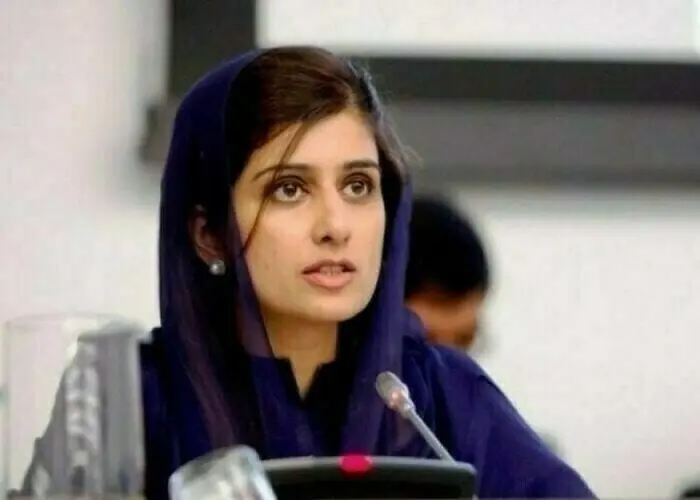

LAHORE: Former Foreign Minister of Pakistan and LUMS alumni Hina Rabbani Khar delivered a comprehensive address on Friday, arguing that the international order once established by the United States through trade, climate, and governance frameworks is now being systematically dismantled by its own architects.
Speaking at the session titled “Pakistan: Between the US & China” on the opening day of ThinkFest at Alhamra Arts Council in Lahore, Khar talked in detail on shifting global power dynamics and Pakistan’s position within an increasingly fragmented international system.
Khar emphasized China’s rapid advancement across multiple sectors, particularly in solar power, manufacturing, and technology. She pointed out that China’s annual solar energy production has now surpassed the combined accumulated production of both the United States and Europe.
She further argued that future technologies, particularly artificial intelligence, will ultimately depend on access to affordable energy, an area where China has established a decisive competitive advantage.
Addressing the common characterization of Pakistan’s diplomatic position, Khar rejected the notion that the country is walking a tightrope between major powers. She described China as a credible, predictable, and strategic partner, emphasizing that Beijing maintained open channels for defense and technology cooperation even when Western nations closed their doors to Pakistan.
However, Khar also stressed the continued importance of engagement with the United States, characterizing Washington as an unpredictable yet unavoidable superpower. She noted that while the US provides Pakistan with diplomatic space, the crucial question remains what the country chooses to do with that opportunity.
Turning to the China-Pakistan Economic Corridor, Khar acknowledged that Pakistan failed to demonstrate adequate patience and preparedness despite the project’s strategic significance.
While affirming that the corridor remains relevant, she criticized Pakistan for prematurely celebrating its role as the flagship initiative of China’s Belt and Road Initiative rather than undertaking the necessary institutional groundwork.
In a comparative analysis, Khar observed that China spent decades quietly building capacity, while India overestimated its strategic importance to Western powers, a miscalculation that recent regional security developments have revealed.
Delivering perhaps her strongest criticism, Khar focused on Pakistan’s internal challenges, particularly its inability to reform its own governance structures and economic ecosystem. She emphasized that no external superpower can resolve Pakistan’s fundamental issues in industry, education, or small and medium enterprises.
She urged the country to move beyond cycles of dependence on International Monetary Fund programs and instead focus on comprehensive structural reforms.
Concluding her address on the opening day of ThinkFest, Khar asserted that Pakistan’s future trajectory will not be determined by global power alignments but rather by its willingness to address fundamental domestic challenges. In a concise summation of her message, she stated that fixing the country’s foundational ecosystem would allow everything else to follow naturally.
Copyright Business Recorder, 2026




















Comments
Comments are closed for this article.