


OPINION: From solar subsidy to system stress: rethinking net metering in Pakistan
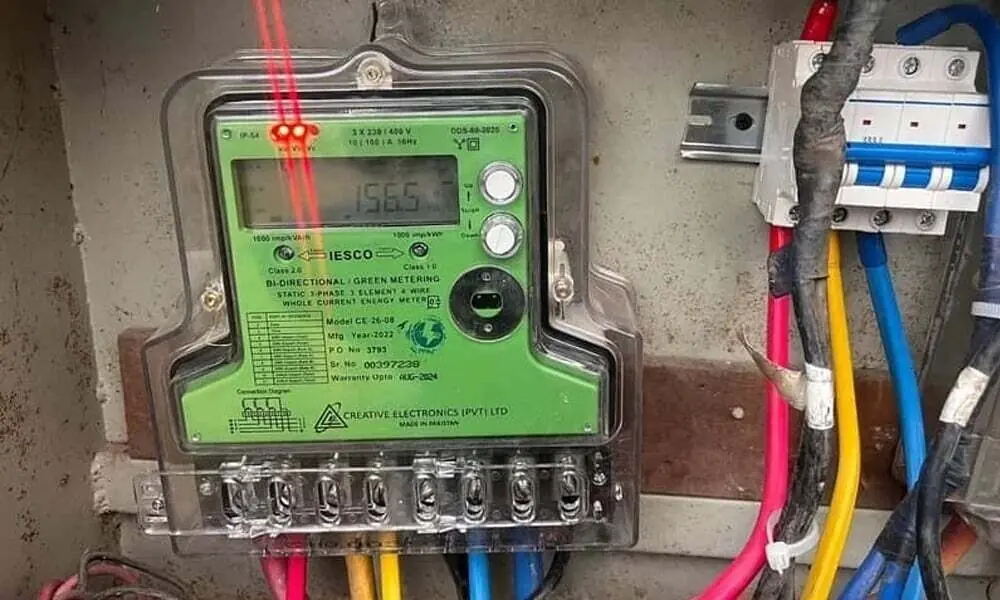
The National Electric Power Regulatory Authority’s (Nepra’s) latest revision in net metering scheme stirred an expected backlash. Much of the debate focused on lower buyback rates and potential discouragement of rooftop solar adoption. Yet this framing obscures the deeper policy logic.
The net-metering adjustment is more about addressing three structural distortions that are embedded into Pakistan’s power market than about discouraging solar power: regressive cost shifting, incompatibility with a capacity-payment dominated system, and unchecked solar expansion lacking grid flexibility.
Under the Alternative & Renewable Energy Distributed Generation and Net Metering Regulations, 2015, solar prosumers were allowed to offset electricity imports with exports at the retail tariff. This retail rate is not, however, a marginal energy price. It embeds a large share of fixed costs: capacity payments, network charges, legacy inefficiencies, and cross-subsidies for protected consumers.
READ MORE: Pakistan’s net metering generation surges over 100% in Sept 2025
As the adoption of rooftop solar grew, mainly by upper-income urban households and commercial consumers, they increasingly escaped paying fixed system costs. As a result, the burden was imposed on the rest of the grid-dependent consumers, many of whom are not in the protected lifeline brackets, but lack the capital to invest in solar.
The NEPRA’s State of the Industry Reports regularly record the increasing regressivity of surcharges and cross-subsidies in the tariff structure of the country. In this context, net metering functioned as a shadow subsidy, which bypassed the scrutiny of the parliament and redistributed system costs from top to bottom.
The revised policy implicitly reaffirms the cost causality principle, which is a statutory obligation under the Nepra Act, and not a matter of policy consideration.
The more fundamental tension lies in Pakistan’s generation contracting structure. The power sector has evolved over the past ten years toward a regime largely dominated by long-term take-or-pay contracts. Capacity payments have become a significant and rigid part of the total system cost irrespective of the level of electricity consumption.
Net metering enabled an increasing percentage of consumers to draw down grid offtake during daylight hours without reducing the system’s fixed costs.
Capacity costs were being recovered on an increasing per unit basis as sales volume fell. Higher tariffs in turn enhanced the economic incentive for additional consumers to install rooftop solar not as a productivity-enhancing investment, but as a defensive response to tariff escalation.
This mechanism generated a self-reinforcing loop: higher tariffs contributed to more grid defection, which further squeezed the sales base over which fixed costs were recovered.
WATCH: Will Pakistan abolish net metering?
Importantly, instead of relaxing circular debt tensions, it heightened them. In this respect Nepra’s policy shift should be seen as a reaction to stop the unsustainable erosion of the tariff base, and not as a pullback from the renewable energy targets.
The third aspect which is often ignored is more on the technical side. Pakistan’s net-metering policy was designed for rapid growth of solar with zero structure towards system integration. Rooftop solar exports peaks in the midday, when demand is weak, but no incentives have ever been offered to prosumers to get batteries or smart inverters.
The new net-metering regime, while harsh, throws an implicit hint at an emerging solar market orientated towards self-consumption, where solar value lies in matching generation with load, rather than sending excess out the grid at fixed prices.
But without a package of complementary measures, including time-of-use tariffs, incentives for storage, and mechanisms for flexibility at the distribution level, the reform may be perceived as punitive rather than corrective. Although the adjustment made by Nepra does cater to some of the distortions, the real problem is not net metering, rather it is the absence of a suitable distributed energy policy in line with the market design.
Capacity charges continue to be volumetric rather than fixed. Although solar remains an important component of energy security for Pakistan, reforming net-metering only, in the absence of addressing these macro-structural issues, would not lead to just energy transitions.
Incentives for green energy transition cannot be simply added on top of a fundamentally distorted structure of the market without creating further inequalities and inefficiencies.
So the real issue is not about the rising tariffs but whether Pakistan is prepared to restructure its power system so distributed solar flourishes with the grid rather than at the grid’s expense.
Copyright Business Recorder, 2026
The writer is a Research Economist at Pakistan Institute of Development Economics (PIDE). She can be reached at: [email protected]



















Comments
Comments are closed for this article.