


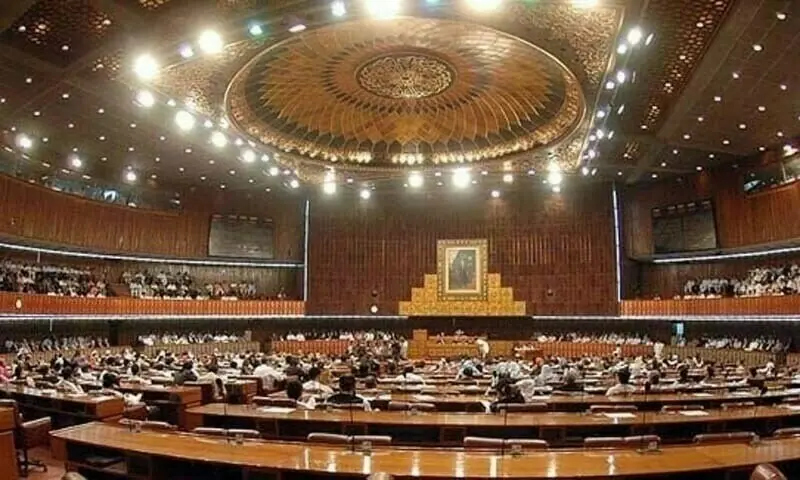

ISLAMABAD: The National Assembly was informed on Monday that the total circular debt, which stood at Rs2,794 billion in March 2024, was brought down to Rs1,614 billion in June 2025 – marking an improvement of Rs780 billion within just one year.
In response to questions raised by lawmakers, Minister for Power Awais Leghari outlined a series of measures designed to curb the accumulation of circular debt.
He explained that the measures included negotiations with power producers to waive Rs260 billion in late payment interest charges, along with efforts to reduce inefficiencies within Distribution Companies (Discos), which led to an improvement of Rs193 billion. As a result, the debt in Discos decreased from Rs590 billion in 2024 to Rs397 billion in 2025, he added.
He also highlighted improvements in macroeconomic indicators – such as a stable exchange rate, lower KIBOR, and reduced inflation – as factors that contributed to lower tariffs and reduced markup charges on payables. These, in turn, played a key role in reducing the circular debt, he added. The minister also confirmed that K-Electric had resumed regular payments as part of the debt reduction plan.
He stated that the government has set a target to eliminate circular debt within the next six years, supported by parallel reforms aimed at addressing inefficiencies in the power sector. “This initiative is expected to lead to the removal of the Debt Servicing Surcharge, which currently stands at Rs3.23 per unit and is levied to cover the markup on circular debt payables,” he added.
Additionally, he mentioned that the government plans to reconstitute the boards of Discos to further address inefficiencies within distribution companies.
Moreover, he stated that the government has begun transitioning to a more competitive electricity market, moving away from the long-standing single-buyer model, where the state was the sole purchaser of electricity.
The new structure will operate through competitive bidding and market-based pricing under the Competitive Trading Bilateral Contractual Market (CTBCM) framework, he added.
During the question hour, Minister for Petroleum Ali Pervaiz Malik assured the House that the domestic gas sector is receiving uninterrupted supply at optimal pressure, especially during peak cooking hours.
He added that Sui companies are ensuring daily gas availability from 5 am to 10 pm. Malik also informed the House that the addition of 12 LNG cargoes to the supply network had improved the availability of regasified LNG (RLNG), helping meet demand across all sectors. Additionally, a dedicated dashboard has been set up to address consumer complaints on a daily basis.
Parliamentary Secretary for Communications, Gul Asghar Khan, confirmed that all infrastructure projects carried out by the National Highway Authority (NHA) adhere to international standards.
Khan explained that the design of highways includes a 10-year lifespan for pavements and 50 years for bridges and tunnels. He also stated that the feasibility study for the M-10 Motorway is near completion and that the project will be executed under a public-private partnership (PPP) model. The M-9 Karachi-Hyderabad expressway will remain unchanged.
Copyright Business Recorder, 2026




















Comments
Comments are closed for this article.