




While overall exports are on a downward trajectory, Pak-istan’s IT and IT-enabled services sector continues to chart a vastly different course — quietly emerging as the country’s most resilient and scalable source of foreign exchange.
Nov-25 and the first five months of FY26 provide a clear snapshot of this divergence: at a time when traditional merchandise exports are struggling with weak global demand, energy costs and competitiveness issues, IT exports are posting record numbers, driven by structural reforms, a maturing exporter base and expanding global footprints.
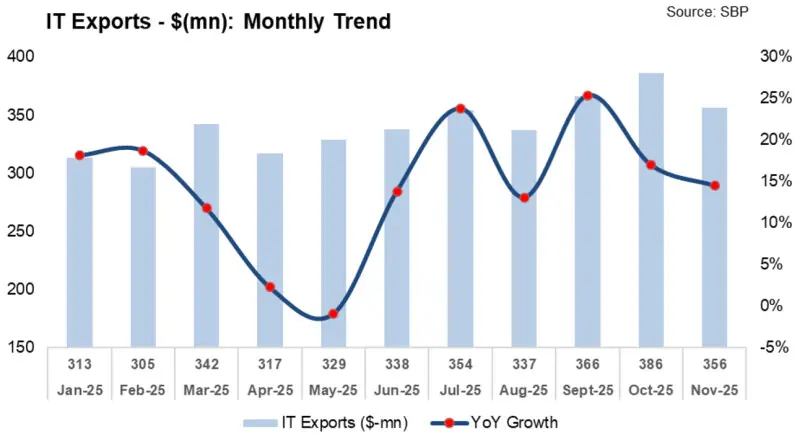
Pakistan’s IT exports reached $356 million in Nov-25, marking a 14 percent year-on-year increase, although they were 8 percent lower month-on-month compared to Oct-25.
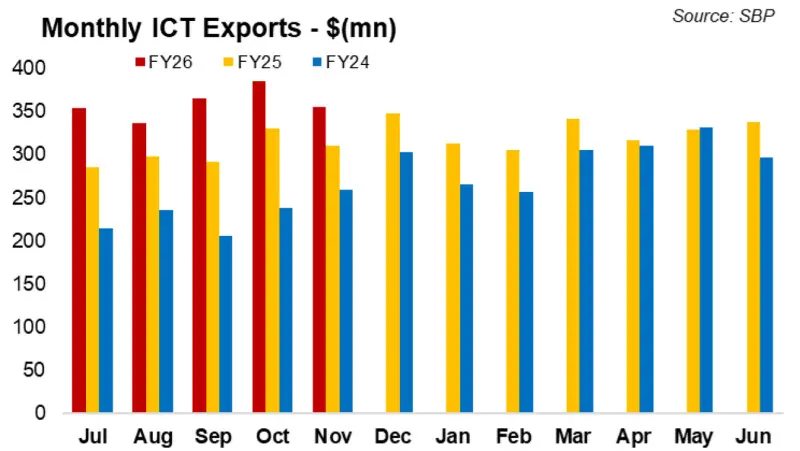
Despite the monthly dip, the number is significant: it remains higher than the 12-month average of $337 million, confirming that November’s performance was not an outlier but part of a higher trend line.
Export proceeds per day in Nov-25 also remained elevated at $17.8 million; up from $16.8 million in Oct-25, suggesting that underlying invoicing and repatriation flows continue to strengthen even with short-term monthly volatility.
READ MORE: IT exports hit all-time high of $386m
More importantly, net IT exports (exports minus imports) stood at $309 million, up 13 percent year-on-year, reinforcing the sector’s ability to generate genuine foreign-exchange inflows rather than just gross billing volumes.
For July–November FY26 (5MFY26), Pakistan’s IT exports reached $1.8 billion, reflecting a robust 19 percent year-on-year growth.
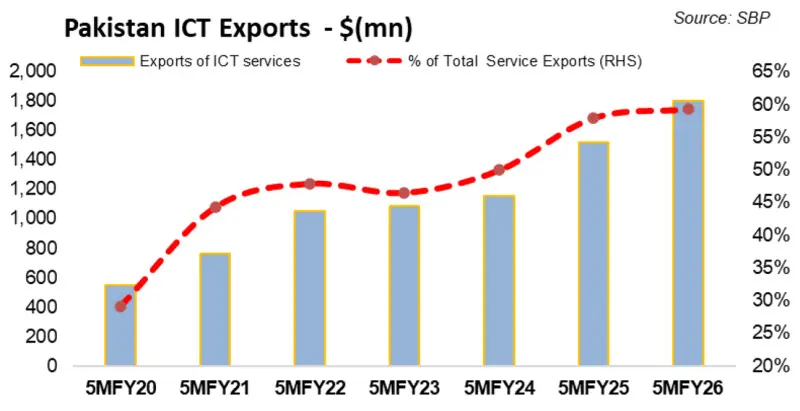
At this pace, Pakistan’s IT sector is running at an annualized export rate of roughly $4.3 billion, placing it comfortably on track to exceed FY25’s $3.8 billion and getting closer to government’s $5 billion FY26 target.
Topline Securities expects IT exports to grow 18–20 percent in FY26 to around $4.5 billion, slightly below the official target but still representing one of the fastest-growing segments in the economy.
The recent growth in IT exports is not just cyclical — it reflects a series of structural shifts in how Pakistan’s IT firms operate and repatriate earnings. Pakistani IT firms have aggressively expanded their client base in the Gulf region, diversifying away from traditional US and Europe-centric outsourcing. This has created new revenue streams in fintech, e-commerce, logistics, health tech and enterprise IT across Saudi Arabia, UAE, and Qatar.
Then the State Bank of Pakistan increased the permissible retention limit in Exporters’ Specialized Foreign Currency Accounts from 35 percent to 50 percent, allowing IT exporters to hold a much larger share of their earnings offshore. This has removed a long-standing disincentive to formal remittances: exporters are now more comfortable sending money back to Pakistan, because they can still use those funds to pay for cloud services, overseas staff, marketing, and their foreign offices.
And perhaps the most important reform has been the introduction of Equity Investment Abroad (EIA), which allows IT exporters to use up to 50 percent of their foreign-currency proceeds to acquire equity in companies abroad — such as sales offices, R&D centres, or customer-facing subsidiaries. This effectively integrates Pakistani IT firms into global corporate structures rather than keeping them as pure offshore vendors — a shift that dramatically improves long-term competitiveness and revenue stability.
And then, with the exchange rate stabilizing, exporters have become more willing to repatriate a higher share of their profits instead of keeping funds parked abroad as a hedge.
Under the government’s “Uraan Pakistan” plan, IT exports are targeted to reach $10 billion by FY29, implying a required CAGR of around 27% over the next three years. While ambitious, the recent trajectory shows that with the right regulatory framework — particularly around foreign currency retention, outward investment, and taxation — such growth is no longer implausible.





















Comments