


Economic reset needs continuity beyond political cycles: Ishaq Dar
- Emphasises technology-enabled governance to improve public service delivery
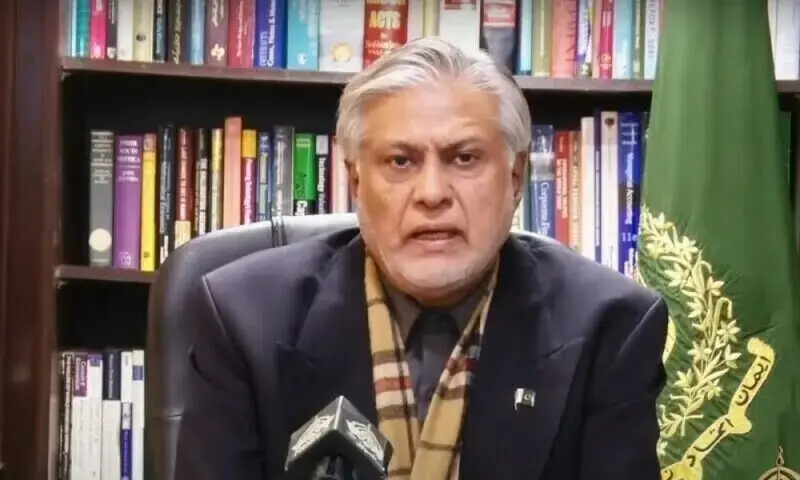

Deputy Prime Minister and Foreign Minister Ishaq Dar on Wednesday said Pakistan’s economic reset hinges on policy continuity and institutional stability that extends beyond political cycles, stressing that sustainable growth cannot be achieved through short-term or fragmented measures.
Addressing the Pakistan Policy Dialogue: Correcting Course – Pakistan’s Economic Reset in Islamabad as chief guest, Dar said resetting the economy meant strengthening its structural foundations through responsible governance, consistent policymaking, and institutional continuity.
“Resetting and correcting course is about strengthening the foundations of the economy itself,” he said, adding that policies must survive electoral cycles to deliver lasting results.
READ MORE: Pakistan’s first Policy Dialogue to be held in Islamabad today
He emphasised the need for technology-enabled governance to improve public service delivery and ensure that policy intent translates into measurable outcomes.
Highlighting the government’s diplomatic engagement, Dar said Pakistan’s foreign policy was increasingly aligned with economic objectives. “All diplomatic efforts are geared towards helping business boost exports and create mutual partnerships based on economic interests,” he noted.
The dialogue brought together senior policymakers, corporate leaders, economists, and development experts to deliberate on reform pathways, growth-oriented policy choices, digitisation, and institutional strengthening at a critical juncture for Pakistan’s economy.
The forum was organised by the Policy Research and Advisory Council (PRAC) in collaboration with the Corporate Pakistan Group (CPG) and Nutshell Group as strategic partner, with the Ministry of Commerce and the Trade Development Authority of Pakistan as founding partners. Bank Alfalah and BankIslami participated as platinum and gold partners, respectively.
READ MORE: Pakistan’s international standing has improved: Dar
The inaugural session, Resetting Pakistan’s Economic Direction, featured Federal Minister for Planning, Development and Reforms Ahsan Iqbal; Finance Minister Senator Muhammad Aurangzeb; Climate Change Minister Senator Dr Musadik Malik; Adviser to the Prime Minister on Privatisation Muhammad Ali; former State Bank governor Dr Ishrat Husain; PRAC Chairman Muhammad Younus Dagha; and former investment minister Muhammad Azfar Ahsan.
Ahsan Iqbal stressed that Pakistan’s recovery required balancing short-term stabilisation with long-term development, noting that productivity, export competitiveness, education, and health indicators remained key gaps compared to peer economies.
Finance Minister Aurangzeb outlined reform priorities focused on macroeconomic stability, population pressures, and climate risks, while also pointing to the need to regulate emerging sectors such as crypto and blockchain to harness youth-driven growth.
Subsequent sessions focused on bridging the digital divide, green growth pathways for a climate-vulnerable Pakistan, and restoring macroeconomic competitiveness, with participants underscoring the importance of digitisation, private-sector participation, and predictable policy frameworks to sustain growth.
The dialogue concluded with a consensus on strengthening collaboration between the state and private sector, investing in human capital, and ensuring policy continuity to support Pakistan’s ongoing economic reset.
Addressing the session, Federal Minister for Planning, Development and Special Initiatives Ahsan Iqbal shared his personal life journey, describing it as a testament to the power of purpose, education and perseverance, while urging young Pakistanis to believe in their potential despite socio-economic challenges.
Ahsan Iqbal noted that Pakistan’s greatest strength lies in its young population, which must be equipped with skills, knowledge and confidence to navigate a rapidly changing global landscape.
He emphasised that the world was undergoing a fundamental transformation driven by automation, technological innovation and climate change, requiring countries to rethink traditional development models.
Referring to the government’s long-term development framework, Uraan Pakistan, the minister said the initiative focuses on investing in human capital through education, digital capability, climate-smart agriculture and youth empowerment.
“Development in the modern era is no longer about infrastructure alone; it is about creativity, resilience and value addition,” he added.
He further highlighted the need for shifting Pakistan’s economic trajectory from consumption-led growth to export-led growth by enhancing value addition across key sectors, including agriculture, information technology, minerals and creative industries.
The minister concluded by encouraging young people to set clear goals, remain resilient in the face of setbacks and contribute positively to national development, saying that Pakistan’s story is not only about challenges, but also about immense possibility.




















Comments
Comments are closed for this article.